Hello, everyone.
This is Enta.
This is a continuation of the previous post.
Last time, I presented a table showing annual and monthly incomes and compared them to the national averages.
In this post, I’ll discuss “Why is there such a big difference between small and medium-sized companies and large corporations?,” “The key differences between construction managers and skilled workers,” and “How do certifications affect annual income?”
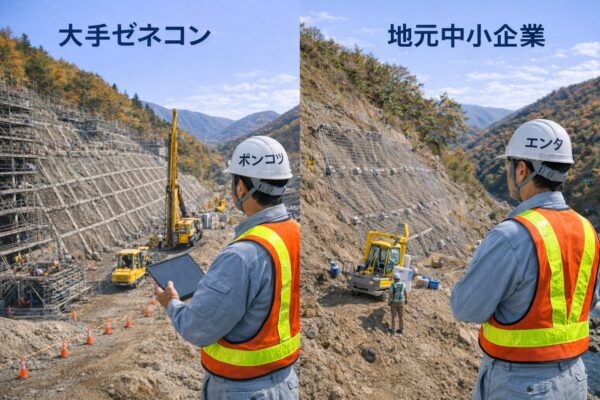
Local Small and Medium-Sized Businesses vs. Major General Contractors: What’s the Difference?
The root cause of this difference is"Scale and Unit Price of Construction Projects We Can Undertake"That's it.
Major companies handle construction projects worth hundreds of millions or billions.
There is a significant difference in the absolute amount of “management fees and miscellaneous expenses” included in the construction costs.
The resulting labor costs for administrators will also vary.
According to the Ministry of Health, Labor and Welfare’s “Reiwa 5 Basic Survey on Wage Structure,” in the construction industry,Managers and ProfessionalsThe average monthly income (including construction management) for companies with 1,000 or more employees isApproximately 545,000 yenFor small and medium-sized businesses with "10 to 99 employees,"Approximately 400,000 yenIt says...
(“Reiwa 5 Basic Survey on Wage Structure”: By Industry, Job Category, and Company Size)
You can see that these figures are generally consistent with the ones I presented this time, right?
There's also the fact that "major companies offer generous bonuses."
For the sake of consistency, we’ve set the figure at 500,000 this time, but there are quite a few cases where, if your abilities are recognized at a major company, you can earn 1 to 2 million in bonuses alone.
So even the figure of 11 million for a veteran at a major company is a number that could be achievable, depending on the conditions.
Hey, you clueless person—I hope you realize this! LOL (That's all I'm saying.)
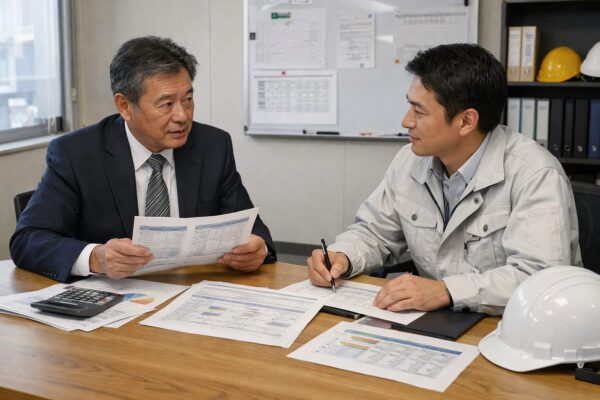
The Key Difference Between a Construction Manager and a Tradesperson
Looking at the numbers, you might think, “Construction managers make better pay, don’t they?” but they’re expected to do their fair share of work.
Being a craftsman is a job where you earn a living “with nothing but your own two hands.”
A construction manager is responsible for everything—people, materials, money, paperwork, the construction schedule, quality, and safety.
← You can scroll horizontally →
| Item | Artisan | Construction Manager |
|---|---|---|
| Working Hours | On-site hours only | On-site + Office + Overtime |
| Paperwork | Almost none | Mass Production (Product Specifications, Quality, Process, Safety) |
| Client Support | None | Yes (Inspection, Consultation, and Witnessing) |
| Working at Multiple Sites Simultaneously | Rare | Common among small and medium-sized businesses |
| Handling Phone Calls on Days Off | None (default) | Possible (emergency response, weather changes, etc.) |
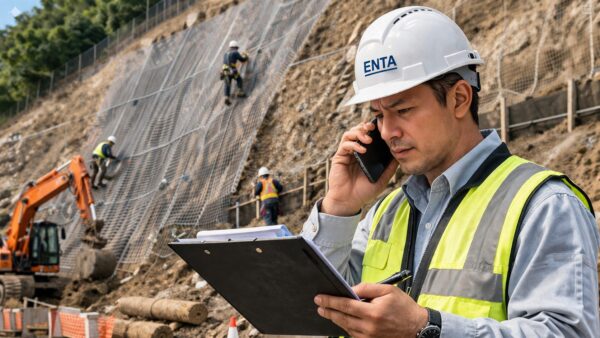
Construction managers at small and medium-sized enterprises often oversee multiple job sites at the same time.
Some people might think that, if you're managing multiple job sites while making about 330,000 yen a month, being a skilled tradesman is actually better value for money, lol.
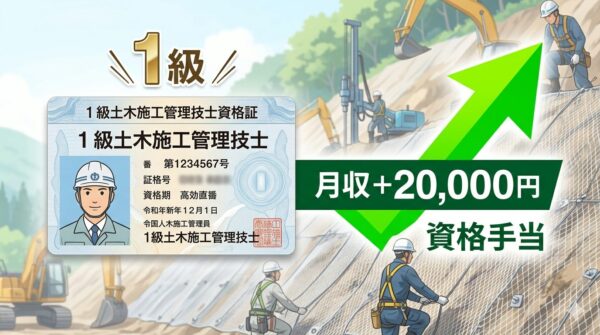
How a Certification Affects Your Annual Income
When discussing the salary of a construction manager, one thing that cannot be overlooked is"Class 1 Civil Engineering Construction Management Technician"This is a certification.
If you hold this certification, you are eligible to participate in public works projects with a contract value of 45 million yen or more (70 million yen or more for comprehensive construction projects)Full-time assignment as a supervising engineerYes, you can.
This is an obligation prescribed under Article 26 of the Construction Industry Act.
In other words,People directly involved in the company's process of winning contracts (as the prime contractor) through competitive biddingcan become.
That's why companies give preferential treatment to people with certifications.
Here's a general idea of what qualification allowances typically look like.
← You can scroll horizontally →
| Qualifications | Estimated Monthly Allowance | Annualized Income (Estimated) |
|---|---|---|
| Level 2 Civil Engineering Construction Management Technician | +10,000 to 20,000 yen per month | +120,000 to 240,000 yen per year |
| Class 1 Civil Engineering Construction Manager | +20,000 to 50,000 yen per month | +240,000 to 600,000 yen per year |
| *The amount of the allowance varies by company. Many companies do not have this program at all. *These are approximate figures based on Entame's on-the-ground insights and industry job market data. |
||
Some companies don't offer any certification allowances.
However, rather than being a “tool to get an immediate raise,”Tools for Changing Jobs, Negotiating, and Positioning YourselfYou'd better assume that's the case.
Here's the starting point!
Having a certification gives you an edge over those who don’t, and it’s also a way to assess your motivation and perseverance, isn’t it?
If you enter the job market with a Level 1 certification, your options will expand significantly.
If you want to work for a major or mid-sized company, not having this often means you won’t even make it to the starting line.
I’ve written about construction managers’ salaries—the real numbers—in two parts.
To be honest,Salaries for new hires and mid-level employees at small and medium-sized enterprises are by no means high.That's it.
Considering the amount of work involved and the weight of the responsibilities, I think some people might feel it’s not worth it.
However, things are different for veterans.
I think that earning 7 to 9 million at a small or medium-sized company and 9 to 11 million at a major company are figures that can be achieved as a result of years of hard work.
It’s not about having any special talent—it’s the result of years of hands-on experience on the job. I think that’s the reality of the job of a slope construction supervisor.
However, this is a skill that only a select few are capable of (with a high level of technical expertise in construction management being the key).
If you read this along with the article on slope maintenance workers' salaries (link below),
I think this will give you a better understanding of how money flows in this industry, so please use it as a reference.
See you later.
This Is Probably the Typical Salary for Slope Workers! We're Revealing Everything! (Part 1)