Summary of This Page
Ground anchor construction is a method in which anchor bodies are installed in stable soil deep underground, and the tensile force of prestressed steel is used to stabilize slopes and structures.From my perspective as a slope engineer with over 30 years of on-site experience in the design, construction, and supervision of ground anchor projects, I have handled every aspect of the process—from drilling and grouting to tension control, pull-out testing, and placement deviations—23 Practical Q&AsI've summarized it here.
We provide candid answers—based on real-world insights from the field—to questions raised by public works officials, general contractors, consultants, and young engineers.
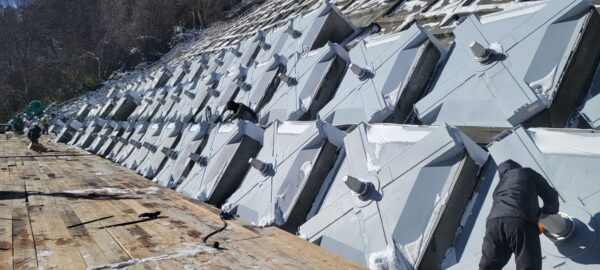
What Is Ground Anchor Construction? | The Basics
Ground Anchor ConstructionIn a nutshell, that means
「A construction method in which anchors are installed in stable deep-seated soil and the structure and slope are supported by tensile force transmitted through prestressed concrete steel tendons."."
Preventing slope failures, landslide mitigation, retaining wall reinforcement, measures to counter tensile forces on bridge abutments, etc.,The pinnacle of slope stabilization methods used at sites requiring large-scale construction and high load-bearing capacityThat's it.
It is widely used in public works projects undertaken by the Ministry of Land, Infrastructure, Transport and Tourism, NEXCO, and prefectural governments.
The Three Major Features of Ground Anchor Construction
- ✅ Strong Tensile Force — Capable of withstanding high loads ranging from several hundred to over 1,000 kN per unit
- ✅ Supported only by the anchoring section — Unlike rebar insertion workers, it becomes integrated with the natural ground solely at the anchorage point at the tip
- ✅ Active Reinforcement Due to Tension — Apply an initial load using the design tensile force to secure the structure
Differences from Reinforcing Bar Installers
Although they are often confused, ground anchor installation and rebar insertion areThe mechanisms are completely differentThis is the construction method.
| Item | Ground Anchor Construction | Reinforcement Installer (Rock Bolt Installer) |
|---|---|---|
| Fixing Method | Adhesion area only (tip only) | Full-Length Anchoring (Full Length of Rebar) |
| Nerves | Yes (tensioned by the design tension) | None (Tighten just enough so it doesn't come loose) |
| Pull-out Test | Acceptance testing at approximately 1.20 Td | Just to confirm that it won't come out |
| Pressure-receiving plate | A large pressure plate is required | A square washer measuring approximately 150 × 150 is sufficient. |
| Main Uses | Measures Against Large-Scale Landslides and Seismic Reinforcement | Preventive Reinforcement of Cut Slopes and Existing Slopes |
| Drill Hole Diameter | φ90–φ165 | Approx. φ45 to φ90 |
| Load Capacity | Several hundred to 1,000 kN or more | Approximately 50 to 150 kN |
▶ What Is a Reinforcement Installer (Rock Bolt Installer)? | Practical Q&A: Complete Edition with 46 QuestionsPlease also take a look at this.
Construction Sites Where Ground Anchor Systems Are Chosen
- Measures to Prevent Large-Scale Landslides — Sites where the sliding surface is deep and significant resistance is required
- Tensile Strength Measures for Abutments and Piers — Support and Reinforcement of Large-Scale Structures
- Earthquake-Resistant Reinforcement in the Red Zone (Special Landslide Hazard Area)
- Reinforcement of Existing Retaining Walls — Preventing the Collapse of Large Retaining Walls
- Full-Scale Reinforcement of Cut Slopes — Construction sites where rebar insertion work results in insufficient bearing capacity
▶ List of All Articles in the Ground Anchor Construction Category
Drilling, Grouting, and Stress Management | 23 Practical Q&As
Below, I’ve compiled a list of questions I’m often asked on the job, along with their answers, in no particular order.
From quality control in public works projects to the detailed know-how of skilled craftsmen,The reality of the field that isn't found in other literatureI'm writing this.
*This page is updated regularly. Please feel free to send us any questions or comments.
-
What is the height of the scaffolding from the drilling location?
Although it depends on the drilling angle, this is generally a good guideline.
Skid-type 1.5-metric-ton-class core drill = 30–50 cm
Skid-type 2.5-metric-ton-class core drilling rig = 30–60 cm
Lightweight drilling machines (such as spring drills) = 20–30 cm
Crawler-type core drill = -20 to -30 cm (soil foundation)
-
Is caulking necessary for the head section?
It is necessary.
There's a reason for this, and...
These days, hard-type rust-preventive oil is used, so it’s generally fine, but,
The head, exposed to the scorching summer sun.
The internal rust-preventive oil may dissolve and seep out from areas such as the back of the pressure plate.
As a countermeasure, caulking is required around the pressure-bearing plate and the cap.
Please use weather-resistant caulk.
-
What changes if the anchor material is different?
Basically, there isn't much of a difference, but,
It's just a matter of how you manage your nerves in the end, or how your approach to dealing with nerves changes.
Since we work in a field known as "anchor installation," we handle just about every type of anchor installation, so
I'm almost certain we can carry out the work.
However, please note that some methods involve specialized construction techniques.
-
"Grand Anchor"? "Ground Anchor"?
The official term is "ground anchor work."
In Japanese, it's read as "Grand Anchor."
It’s fine as long as the other person understands, but if you’re writing it down, please use the term “ground anchor.”
-
"Why does the strength of the cement slurry vary?"
Rest assured when conducting compressive strength tests on cement slurry test specimens!There's definitely going to be some variation!!!!!
In addition, because it has a small cross-sectional diameter (φ5–100 mm) and high strength (24 N or more),
The results will vary depending on how it breaks.
-
"If I drill a hole and inject material as shown in the book's illustrations, does the diameter of the hole increase?"
It won't work at all.
When the drilling diameter is φ65, the hole diameter is 65 mm.
Even if you inject fluid and apply pressure, the diameter will not change.
If pressure high enough to cause the diameter to expand were applied, the peak would likely collapse.
-
"Are grout and cement slurry the same thing?"
In the case of grout, the suspensions and solutions used for grout injection are also considered grout.
Water glass and CB injection are also types of grout.
In other words, it refers to a fluid that is injected to fill cavities, voids, gaps, and the like. (wiki)
That would be what’s known as “cement milk.”
By the way, cement slurry is a mixture of cement and water.
-
"Can't we reduce the variation!?"
It's not that it can't be done.
PreviouslyThe Ambiance of Fiber-Reinforced Cement Milk
As you can see, the fiber really adds some chewiness!
I've had experiences where the strength became relatively stable.
(Since there is only five days' worth of data, its reliability is questionable.)
I'd like to have a little more experimental data.
-
Can a packer be used with a borehole diameter of φ90?
If the borehole diameter is φ90, it may not be possible to use a packer.
Depending on the type of anchor, placing a packer over it causes the anchor body to,
It may be larger than the inner diameter of the outer casing.
In that case, it will be necessary to change the drill hole diameter to φ115.
In fact, it’s highly likely that all manufacturers will switch to φ115.
-
The Drilling Slime isn't coming back.
This is common depending on the condition of the natural ground.
It’s likely that the area around the drill hole is crumbly (prone to crumbling and full of voids), and,
It is believed that the drilling fluid and drilling air are also being lost in volume within that space.
There is no solution for the "Slime Return" issue.
Please check the condition of the fixed section more carefully than that of the free section.
-
What should I do if I can't drill a hole (or the drilling progress is slow)?
Assuming the drilling is done by a professional with at least five years of experience.
An Easy Way
1. Upgrade the machinery. (Upgrade from a 1.5-metric-ton class drilling rig to a 2.5-metric-ton class drilling rig.)
Drilling Power (Machine Power) – It really gets the job done!2. Change the bit. (If it’s too hard, switch to a softer bit; if it’s too soft, switch to a harder bit.)
If you're not sure, go with the double conical for now.3. Increase the pump size (increase the volume of drilling fluid)
Pumps that are easy to use for standard drilling include the MG-5 through MG-10 (with inverter).4. Try using compressed air. (About 50 horsepower is sufficient.)
Things to Try (For Advanced Users) *This is too difficult for beginners.
1. Cementing Drilling (Mixing cement into the drilling fluid)
(Washing Instructions for Each Area)2. Mud-water drilling (using mud as the drilling fluid)
(Do not use from the attachment section; ensure the hole is thoroughly cleaned)3. Super Coat Drilling (Add a small amount of Super Coat to the drilling fluid)
(Borehole cleaning and borehole wall cleaning are essential) -
What are the load settings for the qualification test?
The Japanese Geotechnical Society’s Standards for the Design and Construction of Ground Anchors, and the Commentary Thereon
Examples include
Cycle Test Load Load Holding Time (min) Rank B Rank A Rank B Rank A Sandy soil-rock formation Cohesive Soil Sandy soil-rock formation Cohesive Soil 1 0.40 Td 0.40 Td 1 1 15 15 2 0.60 Td 0.60 Td 1 1 15 15 3 0.80 Td 0.80 Td 5 5 30 60 4 1.00 Td 1.00 Td 5 5 30 60 5 1.10Td 1.25Td 30 60 60 180 It says so.
The load shall not exceed the following:
Rank A Design Anchor Force (Td) × 1.25
Rank B Design Anchor Force (Td) × 1.10
It says so.
At our company, we generally use a value of 1.20 Td based on the ground conditions and drilling conditions.
The table above is for illustrative purposes only.
1.20 is enough.
1.1 is enough.
The most important thing about anchor bolts is that they don't come loose.
-
Is it acceptable to reduce the holding load during testing?
The "Design and Construction Standards for Ground Anchors" and the accompanying commentary state that
Pull-out Test P182
Cycle Test Load Load Holding Time (min) Sandy soil-rock formation Cohesive Soil 1 0.40 Tp 15 15 2 0.55 Tp 15 15 3 0.70 Tp 30 60 4 0.80 Tp 30 60 5 0.90 Tp 30 60 6 1.00 Tp 60 180 Aptitude Test, p. 189
Cycle Test Load Load Holding Time (min) Rank B Rank A Rank B Rank A Sandy soil-rock formation Cohesive Soil Sandy soil-rock formation Cohesive Soil 1 0.40 Td 0.40 Td 1 1 15 15 2 0.60 Td 0.60 Td 1 1 15 15 3 0.80 Td 0.80 Td 5 5 30 60 4 1.00 Td 1.00 Td 5 5 30 60 5 1.10Td 1.25Td 30 60 60 180 It says so.
However,You can shorten both of them.
It says...
Based on my roughly 20 years of experience, for loads in the 1,000 kN class,
It takes about 30 minutes for the creep to stabilize,It takes about 15 minutes at the earliest.
The smaller the load, the shorter the time.
It's fine to maintain the holding load as planned, but,A waste of timeThat's it.
-
Stress Management: Not Within the Upper and Lower Limits?
Lower limit = Theoretical value × 0.9
Upper Limit = Theoretical Value × 1.1
The Main Reason for Not Falling Within the Range
Measurement errors (mostly this)
Misreading, misspelling
Calculation Error
Don't worry!
Fundamentally, it is not possible to take measurements at a scale of 1/100 on-site.
It's very difficult.
As long as the structure being measured is sturdy, calipers are the best tool for the job.
How to Conduct Suitability Tests for Ground Anchor Construction
How to Conduct Suitability Tests in Ground Anchor Construction (Part 2)
It's Super Easy! Tips for Tension Management in Ground Anchor Construction
-
Do I need to collect the slimes?
Consultants working on government contracts often tell us to collect the samples.
In a sense, for those working on a contract basis,
There are areas where people can say whatever they want (though in reality, it’s because the construction management work is broad but not very deep), but,
Basically, even if you collect a Drilling Slime and take a picture of it,
I don't know anything. (I can't determine the soil type.)
Ultimately, it isn't required for the exam, and you're almost never asked about it.
Over the past 20 years, I’ve been asked twice whether I’ve ever picked up a slime to check it out.
I told them I hadn't taken any samples, and when they asked why, I replied that you can't determine soil type based on slime.
As a result, I wasn't asked, lol.
The ultimate problem is that this slime, once placed in a specimen jar, becomes trash that nobody wants.
It's a waste of time to collect Drilling Slimes.
-
What happens if you change the drill hole diameter?
If the bore diameter is changed using a packer or similar device, the circumferential frictional resistance will be greater than originally designed.
Since the circumference of φ115 is larger than that of φ90, friction increases.
Since increased friction means the anchor body will be overdesigned,
The fixing section needs to be shortened.
However, it will never be shorter than the minimum anchorage length of 3 meters.
Regarding design changes, such as increasing the bore diameter,
Design consultants or specialized contractors (Our Company) Please contact us.
-
What is the bore diameter?
Common bore diameters are φ90, φ115, and φ135.
The industry standard is φ90.
φ135 is commonly used for temporary anchors these days.
Also, since this is strictly the nominal diameter, the circumference of the casing rod will be larger, and
The bore diameter will be larger than that.
Nominal Diameter ⇒ Measured Diameter ⇒ Drilled Diameter
φ90 ⇒ φ96 ⇒ φ102
φ115 ⇒ φ118 ⇒ φ125
φ135 ⇒ φ133 ⇒ φ140
φ140 ⇒ φ146 ⇒ φ157
φ165 ⇒ φ165 ⇒ φ172
-
Should the injection be from the top? Or from the bottom?
Grout injection is
Always start from the bottom. Always.
Even if there is no water or anything else inside the casing, start from the bottom.
The rule is to start from the bottom. There are no exceptions.
-
Is borehole cleaning necessary?
During drilling, slurry can accumulate or adhere to the inner and outer casings.
You need to blow that away with water and air.
In particular, gravel and soft rock come up without much trouble, but
Cohesive soils, silt, and sandy soils mixed with silt tend to adhere to the inner and outer casings.
Fill the casing with water and rotate the inner liner to remove any caked-on residue.
After that, blow it away with air and water.
If the water is extremely viscous, you'll need to continue this process until the water runs clear.
The reason why this is necessary is that,
I'll be picking up the inner layer first, so I'm not worried about it, but,
If there are a lot of stains on your outerwear,When inserting an anchor,
There is a risk that slime may adhere to the anchor mounting area.
Even if grout is applied over it, the bond between the prestressed steel strands and the grout remains intact, and
There may be insufficient friction.
As a result, there is a possibility that it could come loose.
We need to reduce that possibility as much as possible.
-
Is it possible to change the anchor material?
Yes, that's possible.
These days, it doesn't matter which anchor material manufacturer you use.
Call the manufacturer you want to use directly, and
If I just say, “I want to use this, so please change the design,”
Most manufacturers will accommodate this request.
However, when it comes to price, we can't match the prices offered by association members.
Also, the requirements for membership are surprisingly strict, so it's hard to get in.
-
How often should a drilling machine be greased?
We do this every morning.
You shouldn't put too much in, but,
Just 2 to 3 pumps per grease nipple each day is sufficient.
Around the gasket of the swivel cleaning adapter is
Please fill it up until it's full.
It's best to perform maintenance on the rotating and striking parts every day to prevent problems.
If the machines don't break down, it will lead to cost savings.
-
What is the minimum residual tension?
PC steel strand
The standard distance is approximately 1.0 m from the pressure plate.
The minimum is 0.7 meters.
If it's any lower than this, the tension becomes almost unbearable.
To be precise, while you can still feel nervous, it becomes difficult to manage that nervousness.
Apartment Building
Is 10 cm the standard for SEEE anchors?
I think at least 7 cm is required.
Since the screws in the head assembly are fine-threaded, once they’re tightened to a certain extent, they can’t be pulled out.
*Please be careful—it can be quite dangerous.
PC Steel Bars (Gebindestab)
This is an anchor I used quite a bit a while back.
You don't see them much these days, but they are sometimes used as rock bolts.
Like the apartment building, this one is also about 10 cm.
If it's too short, I can't get nervous.
Since these are coarse-threaded screws, you need to tighten the tension bar coupler all the way in.
*There is no standard for "coarse-threaded screws."
This is a term coined by Enta. There are two types: "standard" and "fine."
-
What are the tips for making it stick?
About half the initial load
(Just before the jack is fully raised)
Check the position of the pressure-receiving plate, the position of the angle adjustment base, and the position of the pressure-receiving plate.
Initial Load
Double-check the position and level of the pressure plate
Static Load
I take a deep breath and tense up.
For ring heads + wedges, apply a single unloading cycle at the set load (to drive the wedge in).
After that, reapply the holding load and rotate the ring.
The nut-type fastener also secures firmly after being tightened twice.
Use a chisel and hammer to tap it firmly into place.