New! Enta's Slope Management Schoolis an information site dedicated to slope construction, by slope construction professionals, and for slope construction professionals.
"What Is the Moldam Method? | A 20-Year Slope Specialist Explains: Costs of Stone Masonry Reinforcement, Comparisons with Other Methods, and Construction Examples [Complete Edition]"
"What Is the Moldam Method? | A 20-Year Slope Specialist Explains: Costs of Stone Masonry Reinforcement, Comparisons with Other Methods, and Construction Examples [Complete Edition]"
Summary in 4 lines
The Moldam method involves injecting a special adhesive into the interior of an existing stone wall to integrate the entire structure into a single, solid unit.Patented Method for Reinforcing Masonry.
This method requires no demolition, preserves the existing landscape, and can be installed at one-third to one-fifth the cost of demolition and reconstruction. Due to the recent increase in damage from earthquakes and heavy rains, we’ve seen a surge in inquiries.
In this article, drawing on my experience as a slope engineer who has worked on-site for 30 years and has been implementing the Mormudam method for the past 10 years,
Actual Costs, Construction Method Comparisons, Eligibility Assessments, and Tips for Choosing a Contractor—Information You Won’t Find on Other WebsitesI'll explain everything honestly.
Click here for the app that calculates construction costs based on photos of stonework
Hello, everyone. This is Enta.
In a nutshell, the Moldam Method is “a patented masonry reinforcement method that, without demolishing the existing masonry, injects a special adhesive into the interior to integrate the entire masonry structure into a single, solid unit.”That's right.
The official name is "Masonry Bonding and Reinforcement Method」。Kyushu Disaster Prevention Maintenance Co., Ltd.This is a patented technology (Patent No. 5686466) developed by [Company Name], and it is also registered with the Ministry of Land, Infrastructure, Transport and Tourism’s NETIS (New Technology Information System).
The Three Major Features of the Moldam Method
✅ No dismantling required — The existing stonework can be left as is
✅ The scenery remains unchanged — It preserves the traditional charm of the stone walls
✅ Significant Cost Reduction — Can be constructed at 1/3 to 1/5 the cost of demolition and reconstruction
At first glance, this might seem like a “dream construction method.”
It is, in fact, a truly excellent method, but of course...There are also cases where this is not appropriate.. That isSection 6So I'm going to write this from the heart.
2. Why Are Inquiries About the Moldam Method Surging Right Now?
Over the past few years, inquiries about the Moldam construction method have really increased.
Based on my own observations, the number of inquiries from the private sector since 2024 hasThree to four times as much as before...is the case.
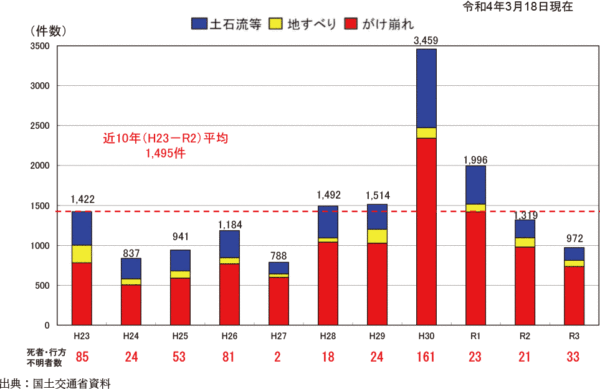
The reason is simple:Because earthquakes and heavy rain are becoming more frequent,That's it.
Reiwa 4 Edition of the Disaster Prevention White Paper | Appendix 20: Trends in the Occurrence of Sediment-Related Disasters
The 2024 Noto Peninsula Earthquake and the torrential rain damage caused by linear precipitation zones across the country in 2025.
For old stone retaining walls, these events can prove fatal.
A particular concern is “Dry-Stone Retaining Wall"It is a traditional stone masonry technique known as [...], in which the stones are not bonded together with mortar or concrete."
Risk of Collapse Even During a Moderate Earthquake with a Seismic Intensity of 5 UpperThere are cases where...
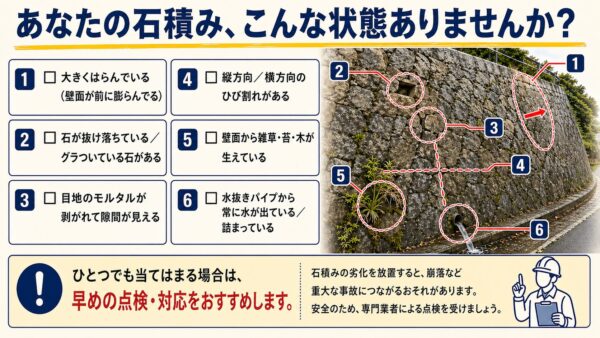
Even if you think, “Our stone wall is fine,”
Joint Misalignment
Stone Falling Out
Bulge in the wall
Vertical and Horizontal Cracks
If you notice any of these signs, it’s already a warning sign.
Every year, I receive reports saying, “One day, out of the blue, the stone wall collapsed.”
If you wait until it collapses to fix it,In addition to reconstruction costs, damage to the building and compensation to neighbors...can occur.
Preemptive reinforcement is truly the most cost-effective disaster preparedness measure.
▶ Is Your Retaining Wall Safe?Checklist for Our Home's Retaining Wall
*Ministry of Land, Infrastructure, Transport and Tourism
3. How the Construction Method Works | Why Does the Stone Masonry Become a “Solid Monolith”?
The core of the Moldam method is “Moldam Ace" (and "Moldam G Hyper") is an adhesive specifically designed for stone masonry.
The process consists of 5 steps
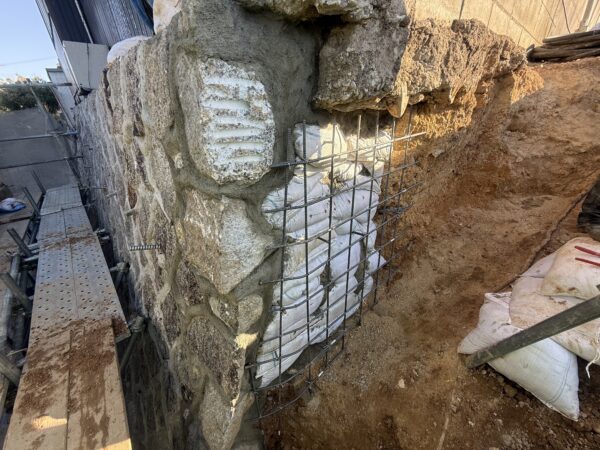
Chisel out and clean the joints (gaps) in the stone masonry to remove the deteriorated mortar and soil from inside.
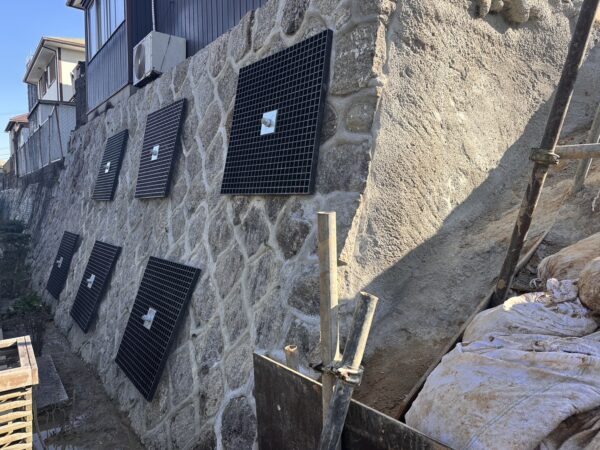
Install one "drainage sheet" per square meter ← This is the key to ensuring proper drainage.
Injecting Moldam Ace (Moldam G Hyper) into the interior of the stone masonry using a pressure pump
Stone Piling, Stone Filling, and Backfilling Combined into a Single Process
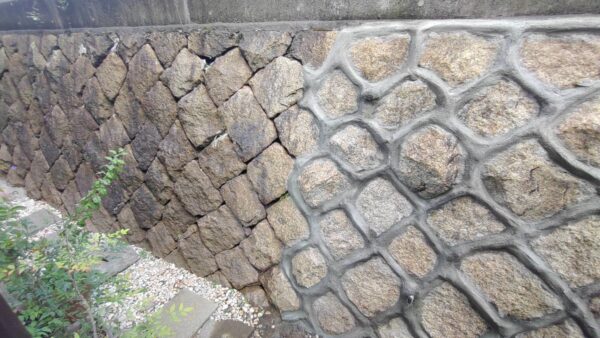
Finish the surface with a trowel or brush
How the Moldam Method Differs Fundamentally from Other Cement Injection Methods
The key point is,Reinforce only the interior while preserving the drainage functionHere’s the thing.
If you seal everything off with ordinary cement mortar, rainwater can’t drain away, and the retaining wall will eventually collapse under water pressure. This is an approach you absolutely must avoid (though it was actually quite common in the past…).
The Mordam method solves this problem by combining the system with a “drainage sheet.”
Its performance as an adhesive is also remarkable, andSignificantly superior in both strength and adhesion compared to conventional cement mortarThat's right. The specific figures areSection 8We will publish it there.
Click here for the app that calculates construction costs based on photos of stonework
4. Average Costs of the Moldam Method | Actual Cost Ranges by Case Type
Based on actual projects I’ve worked on, I’m sharing this for your reference.
4-1. Estimated Costs by Scale (for Moldam Ace)
Scale of the site
Approximate Height × Length
Estimated Cost Range
Conditions
Construction Period
Single-Family Homes and Small-Scale Projects (No Scaffolding Required)
Single-Family Homes and Large-Scale Projects (Scaffolding Required)
Over 3 meters × 15 meters or more
Starting at 2,698,655 yen
Joint depth: 10 cm
Joint ratio: 25%
10th–14th
Public Works and Road Retaining Walls
Based on the unit price per 100 square meters
44,415 yen per square meter
Joint depth: 10 cm
Joint ratio: 25%
Straight Work
*Please note that these prices do not take into account on-site conditions or other factors.
4-2. Six Factors That Affect Costs
Height and Area of the Stone Wall — It simply increases based on square meters
The Need for Scaffolding — If the building is tall, scaffolding costs can increase by 100,000 to 300,000 yen or more.
Convenient Access — For remote areas inaccessible to pressure pumps, a surcharge applies for manual transport
Degree of Deterioration of Stone Masonry — A New Approach to Cleaning and Chipping
Large injection volume — Depth, extent of soil and sand runoff within the stone wall
Whether a Combined Construction Method Is Used — Combination with dewatering drilling and rebar insertion work
4-3. How Much Cheaper Is It Compared to “Demolition and Reconstruction”?
This is the greatest economic benefit of the Moldam method:
Compared to the cost of demolishing and rebuilding a retaining wall, the Mouldam method costs about one-third to one-fifth as much.
For example, for a site where demolition and reconstruction would cost 5 million yen, using the Moldam method wouldApproximately 1 to 2 million yenIn many cases, that’s all it takes.
What’s more, since the construction period can be significantly shortened, it’s possible to have the work done while you continue living in the home. For residents, this is a much bigger benefit than you might imagine.
5. Comparison Chart with Other Construction Methods | Which Method Should You Choose?
I understand the temptation to write, “Our construction method is the best,” for marketing purposes, but in reality, the optimal method varies depending on the conditions at the job site. I’ll be honest here.
Comparison Table of Major Construction Methods
Construction Method
Costs
Construction Period
Landscape Preservation
Strength
Scope of Application
Well-suited for this type of work site
Moldam Method
◎ Cheap
◎ Fast
◎ Remains as is
○ High
Existing Masonry
I want to preserve the existing stone wall / I want to keep costs down
Deconstruction and Reconstruction
✕ Expensive
✕ Too long
✕ Lost
△ Strong
If it's spacious and there's nothing on top,
In cases where the building is completely destroyed and reconstruction is unavoidable
New RC Retaining Wall Construction
✕ Expensive
✕ Too long
✕ Lost
◎ The Strongest
If it's spacious and there's nothing on top,
Large-scale, public, and requiring absolute strength
Mortar Spraying Worker
○ Moderate
○ Fast
△ The surface changes
○ High
For Large Areas
The slope is wide, providing ample space for construction
Moldam + Rebar Insertion Work
△ Slightly high
△ A little long
◎ Remaining
◎ The Strongest
High-Risk Sites, Confined Spaces, Red Zones
Maximizing the Safety Factor · Earthquake Preparedness
Moldam + Rebar Insertion Work + Drainage Drilling
○ Moderate
○ Moderate
◎ Remaining
◎ The Strongest
Red Zone · Narrow · Collapsing
Measures Against Heavy Rain and Earthquakes: The Most Effective
Criteria for Choosing a Construction Method (The Honest Opinion of a Site Supervisor)
"We want to preserve the scenery," "We want to keep costs down" → Moldam Method
"It has already collapsed or tilted significantly" → Demolition and Reconstruction or RC Retaining Wall (with no structures, etc., above it)
"There's a wide slope with plenty of space for construction." → Sprayed mortar is also an option
"Special Landslide Hazard Zones (Red Zones)" and "Areas Prone to Frequent Heavy Rainfall" → Combined use of Mouldam, rebar insertion, and dewatering drilling
Actually, at my workplace,The combination of Mouldam, rebar insertion, and dewatering drilling is the most common.That's right.
It's not just about increasing resistance to landslides; it's about combining these measures based on a "preventive" approach—one that allows water to drain away in the first place to prevent landslides from occurring.
⚠️ There is a large tree at the top of the retaining wall. — Mordam is primarily composed of strongly alkaline cement. If roots have grown into the masonry, there is a risk that the plants will die (it’s fine if there are no issues).
⚠️ Differential settlement is currently underway — At construction sites where the foundation continues to shift, cracks may form even after injecting Moldam.
⚠️ The entire stone wall is leaning significantly. — Minor bulges can be addressed, but if they exceed a certain limit, they cannot be restored using Moldam alone (though it is possible to ensure overall stability by inserting rebar).
6-3. Cases Where Application Is Not Possible (Demolition and Reconstruction Required)
❌ Collapse has already begun, and large amounts of stone are falling away (this might be possible if combined with other construction methods)
❌ The foundation has been completely compromised (scouring, insufficient bearing capacity) (possible if bearing capacity is restored through other construction methods)
❌ The entire structure violates the Building Standards Act to such an extent that safety cannot be guaranteed (according to the client’s assessment)
6-4. Self-Assessment Checklist
Does your stone wall look like this?

□ It’s bulging outward (the wall surface is protruding forward)
□ Stones are missing or loose
□ The mortar in the joints is peeling away, revealing gaps
□ There are vertical or horizontal cracks
□ Weeds, moss, or trees are growing out of the wall
□ Water is constantly flowing from the drainpipe / the drainpipe is clogged

→ If any of these apply, we recommend having a professional conduct an on-site inspection.
7. Construction Process | An Explanation of the 8 On-Site Steps
Step 1. On-site Survey and Assessment
Surveying, ground deformation surveys, photography, and drawing preparation (elevation drawings, cross-section drawings, and detailed drawings).This is important
Step 2. Protective Covering and Preparation
Consideration for neighbors, waterproofing measures, and equipment delivery. The pressure pump requires a space of approximately 3 meters in total length.
Step 3. Trimming and Washing
Remove deteriorated joint mortar, weed roots, and soil and debris. Use a torch to burn through the plant roots.This surface preparation is important。
Step 4. Surface Preparation (Application of Water-Absorption Control Agent)
Apply a water-absorption control agent (such as Unirex 3) to prevent the injection surface from absorbing too much water.
Step 5. Installing the Drainage Sheet
The standard is one outlet per square meter. This is the drainage function—a mechanism that allows only water to flow out without any sediment.
Step 6. Injection Using a Pressure Pump
Pour Moldam Ace into the joint from the inside.Inject the material continuously from the back to the front, ensuring there are no gaps.
Step 7. Surface Finishing
Trowel finish or brush finish. (You can adjust the color slightly by adding color pigment. However, this will increase the cost 👆👆.)
Step 8. Protective Measures and Final Inspection
The required strength is achieved 7 to 14 days after construction. The final inspection verifies the finished work and quality.
8. Strength Verification Data | 40–50 N/mm² in on-site compression strength tests
Just hearing the phrase “high strength” doesn’t really mean much, does it?
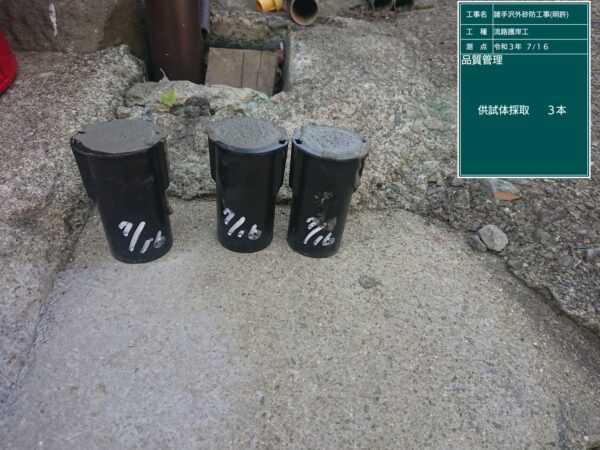
So, I’m going to share the results of compression strength tests conducted on samples I collected from an actual construction site.
Comparison Criteria
Compressive Strength
Notes
Standard In-Situ Concrete
18–24 N/mm²
Design Strength
Standard Cement Mortar (Plain)
15–20 N/mm²
For Comparison
Moldam Ace (Measured at one of our construction sites)
40–50 N/mm²
Compression Test Results
Conventional in-situ concreteAbout twice as strongThat's right.
Compressive strength tests are standard practice in public works projects, and Moldam consistently delivers reliable results every time.
It’s easy to say “strong,” but our strength lies in being able to quantify it.That's it.
The design strength is strictly 18 N/It's rated at ㎟, but it's actually more than twice as strong. (However, this is not guaranteed.)
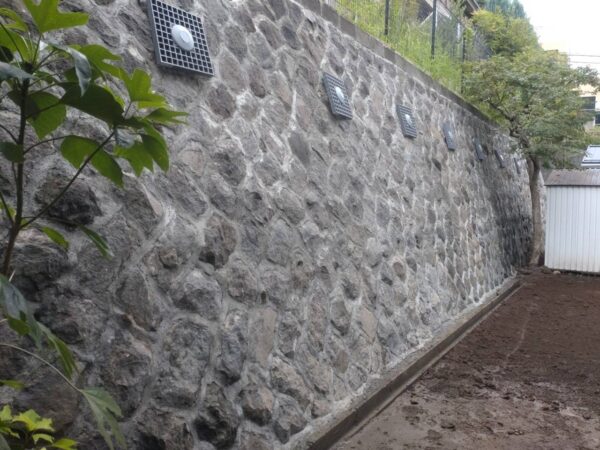
Here are some examples of projects we’ve completed. Please see the individual blog posts for more details.
Examples of Private Residences
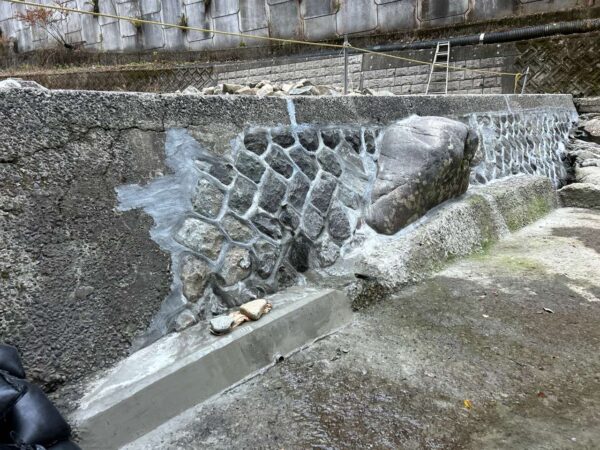
Ganta-style stone masonry before constructionGanta-style stone masonry after construction
Examples of Public Works Projects
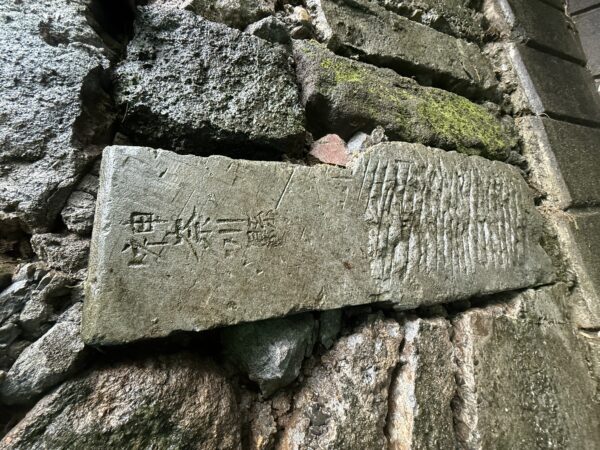
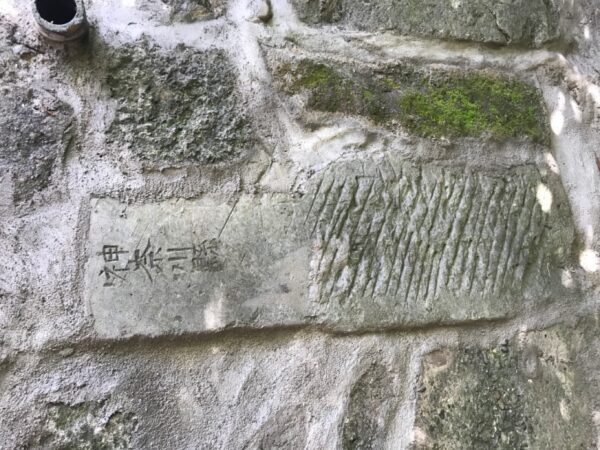
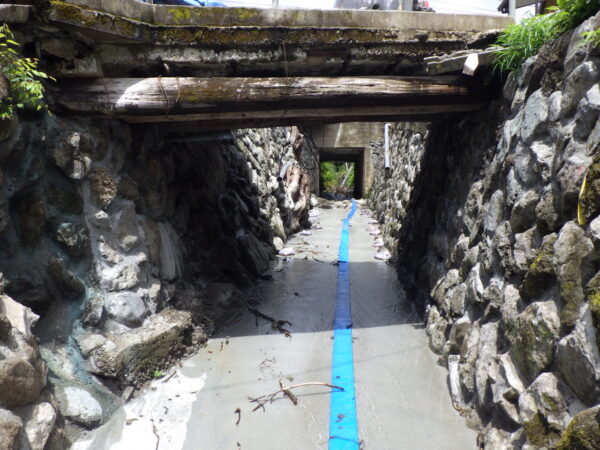
Install the Moldam without demolishing the stone masonry along the canal, and continue to use it as a canal as is.Moldam Project: River Weir Repair Work
10. NETIS Registration and Application to Public Works Projects
The Moldam method is,Technologies registered in the Ministry of Land, Infrastructure, Transport and Tourism’s New Technology Information System (NETIS)That's it.
✅ In public works bidding,Eligible for Bonus Pointsbecome
✅ Technical proposals are more likely to be accepted by clients
✅ Objective Proof of Technical Reliability
✅ Applicable to construction projects contracted by the Department of Land Development (roads, rivers, dams, ports, coastlines, erosion control, landslides, and steep slopes)
This is why we receive more inquiries from the public sector than from the private sector.
We encourage representatives from architectural firms, general contractors, and local government civil engineering departments to check the NETIS number and registration information.
NETIS Number: [QS-220012-VR]Click here for the app that calculates construction costs based on photos of stonework
11. 7 Things to Keep in Mind to Avoid Making a Mistake When Choosing a Contractor
In recent years, there has been an increase in the number of contractors promoting “stone wall reinforcement methods.”
While that in itself is a good thing,Unfortunately, the reality is that there are also some unscrupulous operators and those lacking in knowledge and skill mixed in among them.That's it.
① Don’t trust contractors who give you an estimate without inspecting the site.
The cost of the Moldam method varies significantly depending on site conditions.Contractors who give an immediate estimate over the phone or by email...may result in additional charges later.
② Be wary of contractors who claim “absolute safety” or “100% is fine.”
Even we professionals can’t say for sure what will happen in the event of a natural disaster. “We can reduce the risk to this extentChoose a service provider that explains things like this: "..."
③ There are quite a few contractors who don't fully understand what "draining" means.
Drainage is extremely important, but contractors who don’t understand why it’s necessary are just construction workers. Theory is important.
④ Be wary of contractors who do not provide photo or video records of their work
Since much of the construction work takes place underground and is out of sight, ultimatelyA vendor that provides documents such as photos as part of its reportingLet's choose one.
⑤ Contractors who cannot provide compressive strength test data are suspicious.
Any contractor with experience in public works projects will definitely have test data.It’s unthinkable for a service provider to say, “We don’t have any data.”。
⑥ Check whether you are a member of the “Research Society for Disaster Prevention Methods for Stone Masonry”
There is a list of member companies certified by the patent holder (Kyushu Bosai Maintenance Co., Ltd.).Non-member companies should exercise cautionThat's it.
List of Research Society Members (External Link)
⑦ Be careful of YouTubers
Please be wary of contractors on YouTube who offer advice on stone wall reinforcement and attract customers by sharing amateur-level know-how.
Although they appear on camera and market their services publicly, they are essentially amateurs.
12. Frequently Asked Questions (FAQ)
Q1. Is there a warranty period for the Moldam method?
A. Generally speaking, there is no warranty. However, I’ve heard that some contractors offer insurance. (While there’s usually no problem with construction meeting public works standards, there is no 100%.)
Q2. Is maintenance required after installation?
A. No special maintenance is required, but it’s a good idea to check the surrounding conditions after heavy rain or an earthquake (the reinforced areas are strong, but the rest is extremely weak).
Q3. Is it possible to use the Moldam method for a DIY project?
A. No, that’s not possible. Moldam Ace must be injected using a dedicated pressure pump, and the quality of the work depends heavily on the technician’s experience. It is also not available for general sale.
Q4. Can construction be done even on rainy days?
A. It is possible in light rain, but the work will be canceled in case of heavy rain. For damp and underwater sections, use Type S (designed for underwater installation).
Q5. How long will the construction take?
A. 5 to 10 days for private homes; longer for public works projects. This may vary depending on the weather.
Q6. What will happen to the existing plants?
A. Unless the plants at the top of the retaining wall have roots extending into the stonework, the impact will be limited. We will verify the details during the on-site survey. If the roots have penetrated deeply, we will explain the risk of the plants dying (though this is only a possibility).
Q7. Can I use a grant?
A. Depending on the municipality, you may be eligible for subsidies such as the “Slope Stabilization Subsidy” or the “Retaining Wall Renovation Subsidy.” Please check with your local municipality.
Q8. Do you offer installation services outside the Kanto region?
A. We'll go anywhere in the country! Please feel free to contact us.
Q9. Can this method be used for stone masonry in underwater areas (such as riverbank reinforcement)?
A. Yes, it is possible. By using “Moldam Ace S-Type,” which is designed for underwater application, you can also repair underwater sections. This is common in public works projects.
Q10. Can I continue living in my home while construction is underway?
A. Generally, you can continue living there. There is also less noise and vibration compared to demolition work. It will be a little noisier only during the few days of chipping work.
13. Related Articles
We have compiled articles on specific case studies and technical explanations of the Moldam method here:
"I’d like you to take a look at our stone masonry."
"I’d like to know if the Moldam method can be used for this project."
"I’d like to have our proposal accepted as a NETIS technology for a public works project."
If any of these apply to you, please feel free to contact us.Let's start with a site survey.That's right. You can contact us by phone, email, or by sending photos—any method is fine.
Shioda Development Co., Ltd.
[* Address, Phone Number, Email, Business Hours — Added by Enta]
Official Website:http://enta-d.co.jp/
15. Author Profile
Takao Shioi
Representative Director of Shioda Development Co., Ltd. Has dedicated over 30 years to slope construction.
Operator of the “New Enta’s Slope Management School.” Contributor to industry magazines “Isabou Net” and “Tell Me, Enta-san!”
Has a track record of numerous Moldam Method projects nationwide. Has also carried out many projects combining this method with rebar insertion and dewatering drilling.




Click here for the app that calculates construction costs based on photos of stonework
 Click here for the app that calculates construction costs based on photos of stonework
 The design strength is strictly 18 N/It's rated at ㎟, but it's actually more than twice as strong. (However, this is not guaranteed.)