Hello, everyone.
This is Enta.
This is a continuation of the previous post.
This Is Probably the Typical Salary for Slope Workers! We're Revealing Everything! (Part 1)
Once again, this is strictly about money from the craftsman’s perspective.
It's not the face value. How much is it after taxes?
Even if you say, “My monthly income is XX ten thousand yen,” that’s not the full amount that actually ends up in your pocket, right?
A hefty amount gets deducted every month.
Health Insurance, Employees' Pension Insurance, Unemployment Insurance, Income Tax, and Resident Tax.
I'll try listing them all.
Assumptions: Single, no dependents, Aichi Prefecture, under 40 years old (no long-term care insurance)
Income tax and resident tax vary depending on family composition and various deductions, but here we have standardized the figures using approximate values based on a single person with no dependents.
| Types of Deductions | Amateur 241,500 yen |
Third Year 273,000 yen |
5th year 315,000 yen |
10th Year 378,000 yen |
Foreman 420,000 yen |
|---|---|---|---|---|---|
| Health Insurance Premiums (Employee Share)Aichi Association of Health Insurance, Fiscal Year 2024 / Half of 9.971 TP3T | 11,964 yen | 13,958 yen | 15,952 yen | 18,943 yen | 20,439 yen |
| Employee Pension Insurance Premiums (Employee Share)Half of 18.31 TP3T (9.151 TP3T) | 21,960 yen | 25,620 yen | 29,280 yen | 34,770 yen | 37,515 yen |
| Employment Insurance Premiums (Employee Share)0.61 TP3T (Construction Industry, Reiwa 6) | 1,449 yen | 1,638 yen | 1,890 yen | 2,268 yen | 2,520 yen |
| Income Tax (Estimated Tax and Withholding) | 3,300 yen | 4,800 yen | 7,400 yen | 12,700 yen | 16,100 yen |
| Resident Tax (Estimated Amount, Monthly Installments)Based on the previous year's income / Tax rate: 10% + flat-rate tax | 16,000 yen | 18,500 yen | 21,500 yen | 26,500 yen | 30,000 yen |
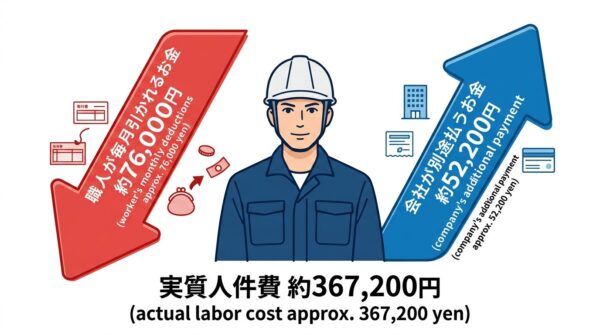
| Total Monthly Deductions | Approximately 54,700 yen | Approximately 64,500 yen | Approximately 76,000 yen | Approximately 95,200 yen | Approximately 106,600 yen |
| 🟢 Take-home pay (monthly, approximate) | Approximately 187,000 yen | Approximately 208,500 yen | Approximately 239,000 yen | Approximately 282,800 yen | Approximately 313,400 yen |
*Health insurance premiums are calculated based on the standard monthly remuneration (brackets: 240,000 / 280,000 / 320,000 / 380,000 / 410,000 yen). Income tax is calculated based on the National Tax Agency’s Withholding Tax Table for Salary Income (Reiwa 6 fiscal year, Column A, 0 dependents). Resident tax is an estimate based on taxable income after social insurance premium deductions. (Sources: National Health Insurance Association, Reiwa 6 Insurance Premium Rates; Japan Pension Service, Employees’ Pension Insurance Premium Table; National Tax Agency, Reiwa 6 Withholding Tax Table)
Even for a layperson, about 55,000 yen disappears every month.
When you become a foreman, about 107,000 yen disappears from your paycheck every month. (From the company’s perspective, it’s really infuriating! No matter how much they raise our pay, they just keep deducting more and more!)
That feeling of, “I’m getting paid, but I never seem to have anything left”—you’ll totally get it when you see these numbers, lol.
Things might be different if you have the qualifications
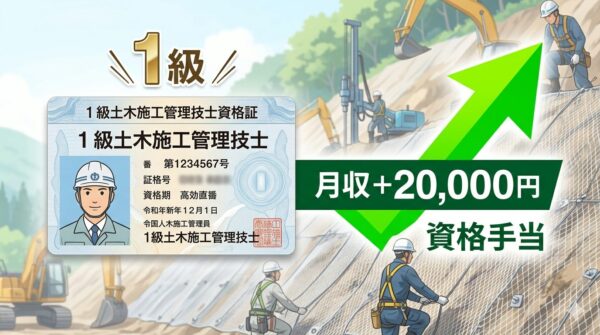
If you hold a Level 1 or Level 2 Civil Engineering Construction Management Technician certification, your salary may change.
As a rough estimate, you can expect to earn about +20,000 yen per month. (There are also many companies that pay nothing.)
In terms of annual income, that amounts to an increase of about 240,000 yen.
The reason for such a large difference is that,
Having a certified construction management engineer on site gives the general contractor and its higher-level clients the impression that there is a person (or company) on site who understands construction management.
If you're a general contractor, you'll be even more valued! (This relates to bidding.)
So, they’re directly tied to whether the company can land a job, right? (Well, if it’s just a construction company, you could say they’re not really necessary.)
Depending on the contract amount, you might not be able to secure a job site if you don't have the necessary qualifications.
If you’re capable of construction management, you can expect an additional annual salary increase of around 500,000 yen.
What Are the Upper Limits on Annual Income by Job Category?
So, if we aim for the top, how far can we go?
This is just based on my gut feeling, but here's the gist of it.
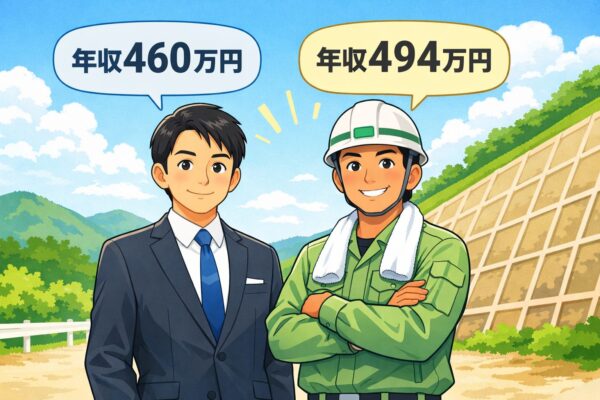
| Position | Estimated Annual Income (Maximum) |
|---|---|
| Master Craftsman (Capable of Construction Management · Maximum Level) | Around 8 million yen |
| Major Local Company (Construction Management Position) | Around 7 million yen |
| Upper-level positions for small and medium-sized enterprises (construction management) and general tradespeople | Around 6 million yen |
| A contractor with only one crew (sole proprietor/small-scale) | 5 to 6 million yen |
8 million is a very rare occurrence.
Only when you’re proficient in engineering, construction management, sales, and on-site management can you achieve those numbers.
However,"The limit of what one can achieve as a slope engineer with 30 years of experience"That being said, this figure does exist in reality.
It’s not about having any special talent—it’s the result of all my hard work.
I think this is one example of the results that come from the work of a craftsman.
People often say that scaffolding workers make 10 million yen a year, but that figure usually refers to a sole proprietor’s annual revenue.
This includes expenses, so I think the actual take-home pay, after deducting those expenses, would be around 600 to 700.
The table above shows the annual income of craftsmen working as company employees, so I think it’s obvious at a glance which option is better.
What Exactly Is CCUS? Here’s the Real Deal from the Field
The government has announced a policy to "raise the salaries of mid-level artisans with 3 or more years and 5 or more years of experience."
That'sConstruction Career Advancement System (CCUS)That's it.
I’ve written about this topic several times on this blog, so some of you might already be familiar with it, but here’s a quick recap lol
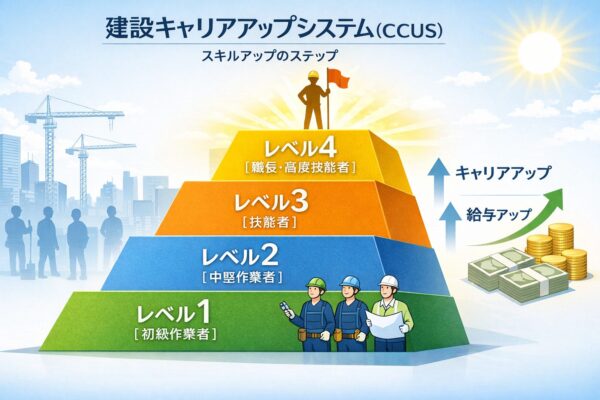
It's a system designed to evaluate skilled workers on a four-tier scale (Levels 1–4) and establish a corresponding wage structure.
The Ministry of Land, Infrastructure, Transport and Tourism has set the following annual income targets.
| Guidelines for Skill Levels | Annual Income Target Set by the Government | |
|---|---|---|
| Level 1 (White) | Trainees and New Hires | Approximately 3 million yen |
| Level 2 (Blue) | Mid-level Skilled Workers | Approximately 4 million yen |
| Level 3 (Silver) | Supervisor Level | Approximately 5 million yen |
| Level 4 (Gold) | Registered Core Technician | Approximately 6 million yen or more |
(Source: Ministry of Land, Infrastructure, Transport and Tourism, Competency Assessment System for Construction Workers, Skill Level Evaluation Criteria)
If you just look at the numbers, you’d think, “Oh, the slope construction company isn’t so bad after all,” right? ♥
That's right!
Slope-work companies are actually pretty good!!
But here's the thing.
Here's what people on the ground are really thinkingHowever,
I think CCUS has already become a dead letter, lol.
"A hollow shell" means that while a system exists, it isn't actually functioning.
Both our construction company and our craftsmen,"No one really understands what has actually changed as a result of downloading or registering this."That's the situation.
I don't think I'm the only one who feels this way.
Isn't that how all the contractors and tradespeople you meet on site are?
To begin with, it costs money to register with CCUS.
| Types of Expenses | Amount | Payer |
|---|---|---|
| Skilled Worker Registration Fee (Initial Application, Online) | 2,500 yen | Skilled Worker or Company |
| Business Registration Fee (Capital of Less Than 5 Million Yen) | 6,000 yen per year | Company |
| On-Site Usage Fee (Employment History Records) | 10 yen per day per person | On the site management side |
| Card Reissue Fee | 1,200 yen | Skilled Worker |
Some of you might be thinking, “It’s not that much money, is it?”
But the problem isn't the amount itself.
Neither the construction company nor the craftsmen can see any return that justifies the costs they’ve incurred.
Let's say you register, get a card, build up your work history, and level up...
Is that actually reflected in unit price negotiations and wages?
As far as I can tell from looking around me, the answer is “almost no,” or rather,NOThat's right lol
Has anyone ever heard a general contractor say something like, “Since this is CCUS Level 3, we’re raising the unit price”? lol
The Nation's Ideal vs. Actual Number of Bankruptcies
The government has set forth the ideal of "raising workers' wages through CCUS."
But what is the current situation in the construction industry?—
According to a survey by Teikoku Databank, the number of bankruptcies in the construction industry in the first half of 2024 was 957 (up 22.8% from the same period last year).
This figure is among the highest seen in the past 10 years.
This figure will be updated in 2025, andI'll post more updates in 2026That's what they say!!
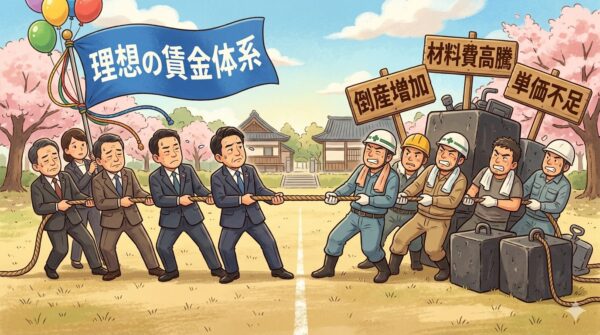
The cost of materials has skyrocketed.
Labor costs are rising.
The burden of social insurance premiums just keeps increasing.
Yet, the increase in unit purchase prices hasn't kept pace.
In a situation like that, even if I’m told, “If you improve your CCUS skills, you can earn 6 million yen a year,”…
"Won't the company go under before that happens?"
That's what you'd think, right? lol
To be honest, it's a reality that's no laughing matter.
The number of CCUS subscribers is estimated to be approximately 1.8 million as of the end of March 2026, but
Since there are approximately 3.3 million construction workers in total,The adoption rate has not yet reached 40 percent.
(Construction Industry Promotion Fund: CCUS Registration Status)
Even if we try to make it mandatory, the front-line staff can't keep up.
The reason the front lines can't keep up is that they don't see the benefits.
This is spinning around and around.
So, does that mean there are a ton of government officials who’ve been placed here after retiring from their posts?
My conclusion is that,
I don't deny the "system" of CCUS itself.
As employment history accumulates, it may serve as an evaluation criterion in the future.
However, the current situation is"They're just charging fees for registration, and that doesn't directly translate into wages."I believe that's the reality.
Don't rely too much on the government system, but be sure to keep records. (At workplaces where this is the case)
I think that kind of approach is probably the most realistic one right now.
Once the system catches up, there’s a chance that “people who’ve built up a solid track record” will have an advantage, so let’s just wait without getting our hopes up lol
The pay for slope maintenance workers is tough at first.
But it's the kind of job where you get back exactly what you put in.
Regardless of the system, I think the best approach is to become someone who can make money on the job.
The reality is that in today’s industry, being recognized on-site as “someone who can get the job done” carries far more weight than having a CCUS certification.
By the way, at Enta, we use an annual salary system.
This figure includes all bonuses.
See you later.