Hello, everyone.
This is Enta.
In the last two posts, I listed all the salaries for the craftsmen at the slope construction company.
This Is Probably the Typical Salary for Slope Workers! We're Revealing Everything! (Part 1)
This Is Probably the Typical Salary for Slope Maintenance Workers! We're Revealing Everything! (Part 2)
Starting with this issue,From the Construction Manager's PerspectiveI'll list the salaries below.
How much do site managers who oversee slope construction sites actually make, to be honest?
We'll cover everything—from new hires to veterans with over 10 years of experience—including the differences between local small and medium-sized businesses and major general contractors.
Of course, this varies significantly depending on regional differences, company size, and whether or not you hold a certification. Please consider this merely as a rough guide.

Let's review the premises first.
Before presenting the numbers, let's standardize the conditions.
・Annual income isTotal gross pay (including bonuses)That's it.
・Bonuses are500,000 yen per yearis assumed as a general premise.
・Monthly income is calculated as “(annual income – 500,000 bonus) ÷ 12 months.”
・Local businesses = small and medium-sized enterprises (with capital of less than 50 million yen and 50 or fewer employees)
・Major companies = General contractors and major specialty contractors with annual sales of 10 billion yen or more.
・AllFull-time office workerNote: This does not include sole proprietors or subcontractors.
While some companies offer annual bonuses of more than 500,000 yen and others offer less, we’ll use a standard figure for comparison purposes.

Actual Salaries of Construction Managers (Annual Income Including Bonuses)
First, here’s a breakdown based on annual income.
There is a difference between local contractors and major general contractors, but this is my understanding of the situation.
← You can scroll horizontally →
| Class | Small and Medium-Sized Enterprises: Annual Income | Major Companies: Annual Income |
|---|---|---|
| Newcomer | 3.5 to 4.0 million yen | 4.5 to 5.0 million yen |
| Mid-sized | 4 to 5 million yen | 5.5 to 6.5 million yen |
| Veteran | 6 to 9 million yen | 7 to 11 million yen |
Next, I subtracted the annual bonus of 500,000 and divided it by 12 months.Amount Equivalent to Monthly Base PayLet's try printing it out.
← You can scroll horizontally →
| Class | Small and Medium-Sized Enterprises: Annual Income (Median) | Small and Medium-Sized Businesses (Monthly Income Equivalent) | Major Companies: Annual Income (Median) | Major Companies (Monthly Salary Equivalent) |
|---|---|---|---|---|
| Newcomer | 3.75 million yen | Approximately 271,000 yen | 4.75 million yen | Approximately 354,000 yen |
| Mid-sized | 4.5 million yen | Approximately 333,000 yen | 6 million yen | Approximately 458,000 yen |
| Veteran | 7.5 million yen | Approximately 583,000 yen | 9 million yen | Approximately 708,000 yen |
| *Formula for calculating monthly income: (Annual income − 500,000 yen bonus) ÷ 12 months *The annual income used is the midpoint of each range. *Actual salary varies depending on the company, region, qualifications, and the scale of the projects you are responsible for. |
||||
A new hire at a small or medium-sized company earns a little over 270,000 yen a month. A veteran at a major company can earn over 700,000 yen a month.
That's quite a difference, isn't it?
Even when doing the same “slope construction management” work, the company’s reputation makes such a big difference.
There's only one reason!
Working at a major company is grueling!
It's really overwhelming—there are more internal documents than field documents.
And it’s not just about focusing on that specific task—you also have to look out for your juniors and subordinates, so it’s really tough, isn’t it?
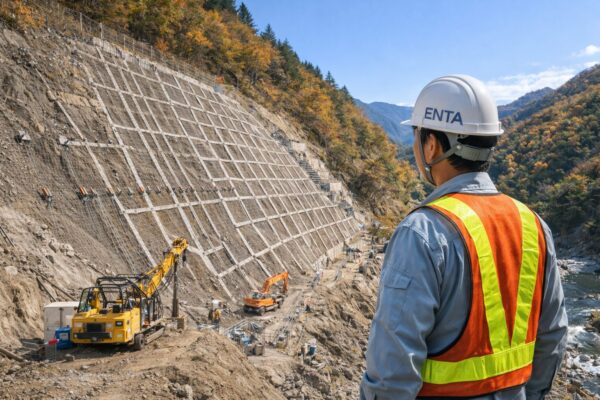
Compared to the national average,
According to the National Tax Agency’s “Survey on the Actual Conditions of Private-Sector Salaries for Reiwa 5,” the average annual income for all salaried workers isApproximately 4.6 million yenThat's it.
When you compare this with the figures from the construction manager—
← You can scroll horizontally →
| Comparison Criteria | Estimated Annual Income | Compared to the national average |
|---|---|---|
| Average for All Salaried Employees (National Tax Agency, Reiwa 5) | Approximately 4.6 million yen | Criteria |
| Construction Supervisor, Entry-Level (Small to Medium-Sized Company) | Approximately 3.75 million yen | ▼ Approx. 181 TP3T |
| Construction Manager, Entry-Level (Major Company) | Approximately 4.75 million yen | △ Approx. 3% |
| Construction Manager, Mid-Level (Small to Medium-Sized Companies) | Approximately 4.5 million yen | ▼ Approx. 2% |
| Construction Manager, Mid-Level (Major Company) | Approximately 6 million yen | △ Approx. 301 TP3T |
| Construction Manager, Experienced (Small to Medium-Sized Companies) | Approximately 7.5 million yen | △ Approx. 631 TP3T |
| Construction Manager, Experienced (Major Company) | Approximately 9 million yen | △ Approx. 961 TP3T |
| National Tax Agency, “Reiwa 5 Survey on Actual Conditions of Private-Sector Wages” | ||

New small and medium-sized businesses fall below the national average. This is the toughest period. It’s just like when I was a craftsman, lol.
But once you become a veteran, it’s a different story.
Even at small and medium-sized companies, the figure is 1.6 times the national average. At large companies, it’s about twice as high.
The perception that “salaries in the construction industry are low” often doesn’t apply to mid-career and veteran workers.
The question is, how many years will it take to get there? lol
Even a veteran who's a bit of a slacker can still make a decent living, but if you're a real slacker, it's safer to stick with a major company—even if the pay is a little lower!
You know the type, right? lol
But it’s always the people who say things like that who don’t realize it, isn’t it…
In my next post, I’ll discuss “Why Is There Such a Big Gap Between Local Small and Medium-Sized Companies and Major General Contractors?,” “The Key Differences Between Construction Managers and Tradespeople,” and “How Having a Certification Affects Your Annual Salary.”
See you later.