




Causes and Solutions for Static Blasting Agents That Fail to Break or Erupt | Preventing On-Site Problems Through Temperature Control
Hello, everyone. This is Enta. It’s October already!!! That’s practically three whole months! This year is almost over!! Starting around this time of year, you really need to be careful about accidents. Let’s take our time, double-check everything, and proceed carefully! But enough of that. Today, I’d like to talk about a problem with static blasting agents. The procedure…

What Is the Pinning Effect (Root-Peg Effect) in Reinforcement Bar Installation? | Understanding Movable and Immovable Soil Masses and Design Concepts—Even for Beginners
Hello, everyone. It’s Enta here. Today marks the end of September. Before we know it, it’ll be the end of the year!!! The year has flown by in the blink of an eye… It’s fast! Way too fast!!! It really feels like a split second, doesn’t it? I feel like I say the same thing every year around this time lol. I’m well on my way to becoming a grumpy old person… lol. Anyway, moving on… This time…
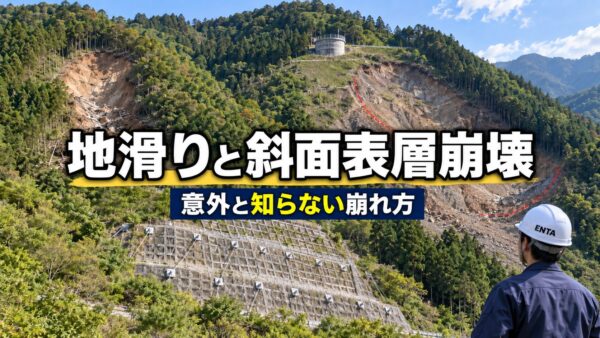
What’s the Difference Between a Landslide and a Slope Collapse? | “A Guide to Mitigation Strategies” Even Young Professionals Can Understand
Hello, everyone. This is Enta. Even though we’re already in the second half of September, it’s still pretty hot during the day. Since this is the season for autumn rains and typhoons, let’s be extra careful to thoroughly inspect slopes after it rains. But enough of that. You often hear the terms “landslide” and “slope collapse” on the news, don’t you? Well…
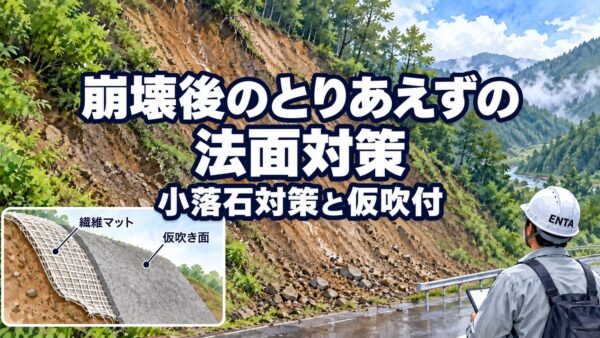
Temporary Repairs to a Slope Where the Surface Has Collapsed Due to Heavy Rain | Precautions for Small Rockfall Mitigation and Temporary Mortar Spraying
Hello, everyone. This is Enta. A slope where the topsoil has been washed away by heavy rain. How are you handling the work after that? With the grass and topsoil gone, the surface is smooth and seems like it would be easy to work on, right? But in reality, the small stones are a problem. They keep falling down. When you’re working below…
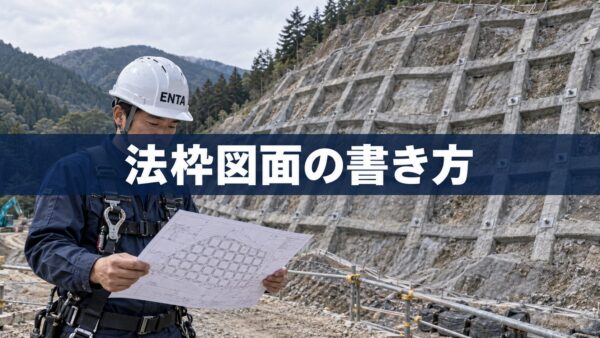
How to Draw Legal Boundary Plans in CAD | The Complete Guide: From Survey Point Management to Drawing Steeply Undulating Mountains
Hello, everyone. This is Enta. The other day, while teaching some of the younger staff about legal frame drawings, I remembered, “I think I wrote about this on my blog a while back,” so I dug up the old post. But it turned out I’d written it in three separate parts, and when I reread it now, there were a few spots where I hadn’t explained things clearly enough, lol. I thought I’d combine this into a single post…

What Does “Treating Backfill as Natural Ground” Mean? | An Easy-to-Understand Explanation for Young People
Hello, everyone. This is Enta. Now that Obon is over, things are getting hectic again at the slope construction site. It’s still hot during the day, but I feel like the air has changed a bit in the early morning… Not at all. It’s still fucking hot… I’m hoping it’ll start feeling better in about a month…

Why Unit Prices for Ground Anchor Drilling Vary So Much Depending on Soil Conditions | How Cost Estimation Works and Quotations
Hello, everyone. This is Enta. A while back, a young site supervisor from another company asked me, “Do you pay attention to the soil conditions when drilling holes for ground anchors?” (Well, you better pay a lot of attention to them, lol.) If you underestimate the soil conditions when preparing a cost estimate, you’ll be the one crying about it later. But anyway…
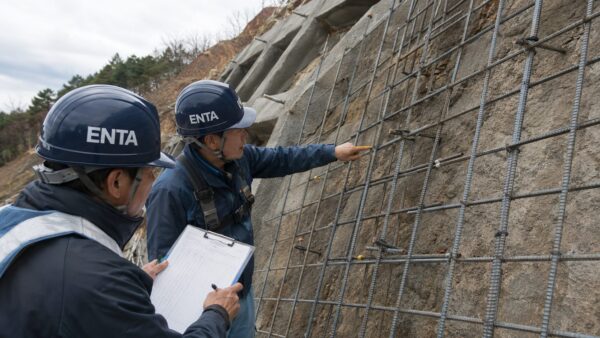
Why Are Lap Joints in Reinforcing Bars Unsuitable? | Offset Provisions in the Concrete Standard Specifications and Workarounds
Hello, everyone. This is Enta. This happened a while back, but I was on-site at a construction project overseeing an assembly inspection when the person in charge pointed out, “Oh, this is a T-joint,” and the whole site went dead silent lol. Since T-joints are generally prohibited under the Japan Society of Civil Engineers’ Standard Specifications for Concrete, it’s only natural that when one is found…
What Is the Earthwork Regulation Act? | An Explanation of How the "Permit Required/Not Required" Status Affects Slope Construction Projects
Hello, everyone. This is Enta. The rainy season has begun, and it’s that time of year when news of heavy rains is reported from all over the country. Every year around this time, we hear stories from somewhere about “embankments collapsing” or “slopes shifting.” One incident that’s still fresh in my memory is the debris flow that struck Atami City, Shizuoka Prefecture, in July of Reiwa 3…