Hello, everyone.
This is Enta.
Today, I’d like to give you a realistic account of “slope maintenance workers’ salaries,” based on everything I know.
"How much money do slope maintenance workers actually make?"
I think this is something that everyone—not just people outside the industry, but also those who are new to the field and those thinking about changing jobs—is curious about.
It varies completely depending on your position, and it also changes significantly depending on your years of experience.
With that in mind, I'll go over the details using specific numbers.
And please compare that to your own salary.
Is it high? Or low?
*Note: Regarding the figures, in this case,Standard Unit Price × Number of Working Days (21 days per month)We use this format consistently.
The number of operating days varies depending on the site, but when averaged over the course of a year, 21 days per month is a realistic average.
Based on my experience, I estimate that actual annual operating days—including days with rain and non-working days—are around 210 to 230.
The number of annual holidays has increased recently and is believed to be around 110 to 120 days.
And please keep in mind that I’m, after all, just a salaried craftsman!
So, as for things other than my salary (work gear, all my tools, and my car),On the condition that it is provided by the companyThat's it.
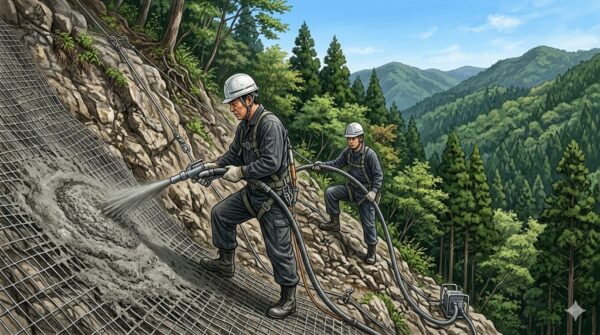
First, the starting line!
If a complete novice were to start working at a slope construction company, how much would they earn on their first day?
That's the part that's on your mind, isn't it?
The minimum wage in Aichi Prefecture is 1,077 yen per hour (revised in October 2024; Ministry of Health, Labor and Welfare)That's it.
Converted to a daily wage, that’s 8 hours × 1,077 yen = 8,616 yen! That’s the minimum! (In Aichi Prefecture)
And for a novice working for a modern slope construction company, the pay on their first day is actually higher than this.
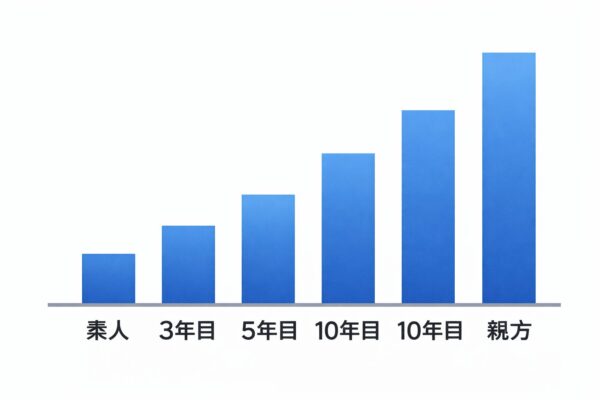
| Career Stage | Daily Rate (Estimated) | Monthly Income (21 days × daily median) | Bonus |
|---|---|---|---|
| Starting as a Beginner | 11,000–12,000 yen | Approximately 241,500 yen | None to a small amount |
| Third Year | 12,000–14,000 yen | Approximately 273,000 yen | 200,000 to 400,000 yen |
| Year 5 and beyond— | Starting at 15,000 yen | Starting at 315,000 yen | 200,000 to 400,000 yen |
| 10th Year and Beyond~ | Starting at 18,000 yen | Starting at 378,000 yen | 200,000 to 600,000 yen |
| Master Class | Starting at 20,000 yen | Starting at 420,000 yen | 200,000 to 600,000 yen |
That's the general idea.
You’re probably wondering, “How does this compare to other industries?”
Published annually by the Ministry of Land, Infrastructure, Transport and Tourism"Labor Rates for Public Works Design"In (Reiwa 6), the labor unit rates for all trades, based on the national weighted average, were25,834 yen...and has been rising until [date].
(Labor Rates for Public Works Design)
However, please note that this is strictly the labor rate used in the design phase of public works projects.
The actual amount that goes into a craftsman’s take-home pay varies greatly depending on the company, the general contractor’s role, and the region, but it’s estimated to be roughly 0.6 times this amount.
It seems the government's policy goal is for this 25,000 yen to go toward the craftsmen's wages... (Isn't that a bit of a stretch? lol)
If you convert that to an annual income!
Just looking at the monthly income doesn't really give you a clear picture, does it?
Assuming there is a bonus, I'll add it to the average and convert it to an annual income.
| Career Stage | Monthly Income (Median) | Bonus (Average) | Annual Income (Estimated) |
|---|---|---|---|
| Starting as a Beginner | 241,500 yen | 0 yen | Approximately 2.9 million yen |
| Third Year | 273,000 yen | 300,000 yen | Approx. 3.58 million yen ⤴ |
| Year 5 and beyond— | 315,000 yen | 300,000 yen | Approx. 4.08 million yen ⤴⤴ |
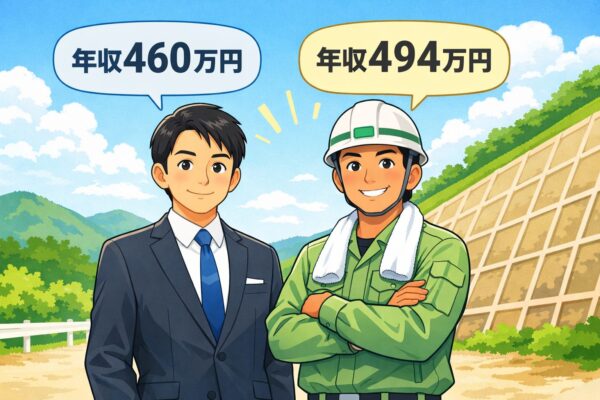
| 10th Year and Beyond~ | 378,000 yen | 400,000 yen | Approx. 4.94 million yen ⤴ |
| Master Class | 420,000 yen | 400,000 yen | Approx. 5.44 million yen ⤴⤴ |
According to the National Tax Agency’s “Reiwa 5 Survey on the Actual Conditions of Private-Sector Wages,” the average annual income for all workers is reportedly 4.6 million yen.
Once you've been in the league for 10 years, your stats tend to exceed the average.
People often talk about the construction industry as having “low wages,” but,The annual income of a craftsman with 10 years of experience is well above the Japanese average.That is a fact.
That said, the first three years—from when you're a beginner—are the toughest.
My pay is lowest during the time when I'm most exhausted, both mentally and physically.
I think this is one of the fundamental reasons why people aren't entering the slope construction industry (the construction sector).
But, to be honest, the fact is that we can't afford to spend that much on people who don't bring in money...
(Although prices used to be higher, the fact is that due to the prolonged recession and the backlash against the construction industry, companies can no longer afford to pass on those costs to young people.)
So, how much is my actual take-home pay? After all the monthly deductions...
All those figures like “XX ten thousand yen per month”Face valueThis is about...
The actual take-home pay that ends up in your account is even less.
I'll list everything—what's being deducted each month and how much—by year.
Prerequisites:Single, no dependents, Aichi Prefecture, under 40 years old (no long-term care insurance)
*Income tax and resident tax vary depending on your tax status and family composition. The figures provided here are approximate estimates based on a single person with no dependents.
| Types of Deductions | Amateur Monthly income of 241,500 yen |
Third Year Monthly income of 273,000 yen |
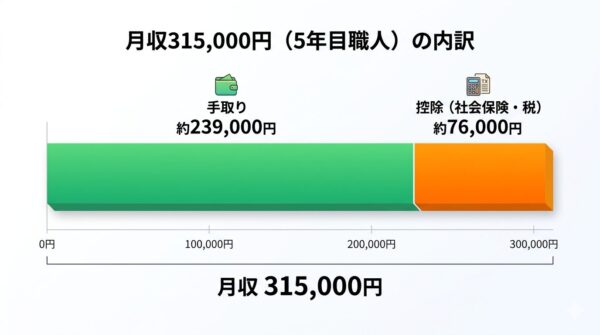
5th year Monthly income of 315,000 yen |
10th Year Monthly income of 378,000 yen |
Foreman Monthly income of 420,000 yen |
|---|---|---|---|---|---|
| Health Insurance Premiums (Insured Person)Aichi Association of Health Insurance: FY 2024 Premium Rate—Half of 9.971 TP3T | 11,964 yen | 13,958 yen | 15,952 yen | 18,943 yen | 20,439 yen |
| Employee Pension Insurance Premiums (Employee)Half of the rate of 18.31 TP3T (9.151 TP3T) | 21,960 yen | 25,620 yen | 29,280 yen | 34,770 yen | 37,515 yen |
| Unemployment Insurance Premiums (Employee)0.61 TP3T (Construction Industry, Reiwa 6) | 1,449 yen | 1,638 yen | 1,890 yen | 2,268 yen | 2,520 yen |
| Income Tax (Estimated Tax and Withholding)After Social Insurance Premium Deduction · 0 Dependents | 3,300 yen | 4,800 yen | 7,400 yen | 12,700 yen | 16,100 yen |
| Resident Tax (Estimated Amount, Monthly Installments)Based on the previous year's income; tax rate: 10% + flat-rate tax | 16,000 yen | 18,500 yen | 21,500 yen | 26,500 yen | 30,000 yen |
| Total Monthly Deductions | Approximately 54,700 yen | Approximately 64,500 yen | Approximately 76,000 yen | Approximately 95,200 yen | Approximately 106,600 yen |
| 🟢 Take-home pay (estimate) | Approximately 187,000 yen | Approximately 208,500 yen | Approximately 239,000 yen | Approximately 283,000 yen | Approximately 313,000 yen |
*Health insurance premiums are calculated based on the standard monthly remuneration (for each of the following brackets: 240,000 yen, 280,000 yen, 320,000 yen, 380,000 yen, and 410,000 yen). Income tax and resident tax are approximate figures based on taxable income for a single person with no dependents, after social insurance premium deductions. Actual amounts may vary depending on family composition and various deductions.
National Health Insurance Association: Reiwa 6 Insurance Premium Rates / Japan Pension Service: Employees' Pension Insurance Premium Schedule / Ministry of Health, Labor and Welfare: Reiwa 6 Employment Insurance Premium Rates
As an amateur, per monthAbout 55,000 yen...will disappear.
Once you reach the master level,Over 100,000 yen per monthis drawn.
That feeling of, “I’m supposed to be making 420,000 yen a month, but I’m not seeing any of it”? This is why, lol.
But actually, that's not the end of the story.
The section below is one of the reasons why salaries aren't going up!
Your company is paying this much more in taxes on your behalf!
This is for all company employees:There’s something you absolutely need to knowThat's the thing.
Social insurance premiums consist of the portion you pay andThe company also pays an amount that is roughly the same or more, separately.
Furthermore,The company is fully responsible for workers' compensation insurance premiums.That's it.
Not a single yen will appear on your pay stub.
But the company makes monthly payments to the government in your name.
← You can scroll horizontally →
| Item | Amateur | Third Year | 5th year | 10th Year | Foreman |
|---|---|---|---|---|---|
| 💰 Payments to Craftsmen (Monthly Income)Money That Goes to the Artisans | 241,500 yen | 273,000 yen | 315,000 yen | 378,000 yen | 420,000 yen |
| ↓ This is...Whatever, social insurance premiums paid directly by the company to the government | |||||
| Health Insurance Premiums (Employer's Share)Aichi Association of Health Insurance 2024 Fiscal Year 4.985% | 11,964 yen | 13,958 yen | 15,952 yen | 18,943 yen | 20,439 yen |
| Employee Pension Insurance Premiums (Employer's Share)9.15% | 21,960 yen | 25,620 yen | 29,280 yen | 34,770 yen | 37,515 yen |
| Employment Insurance Premiums (Employer's Share)Construction Industry 1.05% | 2,536 yen | 2,867 yen | 3,308 yen | 3,969 yen | 4,410 yen |
| 🔴 Workers' Compensation Insurance Premiums (paid in full by the company)Civil Engineering Construction 0.79% Zero Burden on Workers | 1,908 yen | 2,157 yen | 2,489 yen | 2,986 yen | 3,318 yen |
| Child and Child-Rearing Contribution (Fully Paid by the Company)0.36% Zero Burden on Artisans | 864 yen | 1,008 yen | 1,152 yen | 1,368 yen | 1,476 yen |
| Total insurance premiums paid separately by the companyMoney separate from payments to the craftsmen | Approximately 39,200 yen | Approximately 45,600 yen | Approximately 52,200 yen | Approximately 62,000 yen | Approximately 67,200 yen |
| 🏢 Total Actual Labor Costs for the CompanyMonthly Salary + Separate Insurance Premiums | Approximately 280,700 yen(241,500 + 39,200) | Approximately 318,600 yen(273,000 + 45,600) | Approximately 367,200 yen(315,000 + 52,200) | Approximately 440,000 yen(378,000 + 62,000) | Approximately 487,200 yen(420,000 + 67,200) |
Source: National Health Insurance Association, Reiwa 6 Insurance Premium Rates / Japan Pension Service, Reiwa 6 Employees’ Pension Insurance Premiums / Ministry of Health, Labor and Welfare, Reiwa 6 Employment Insurance Premium Rates (Construction Industry) / Ministry of Health, Labor and Welfare, Reiwa 6 Labor Insurance Premium Rates (Civil Engineering Industry: 0.79%) / Children and Child-Rearing Support Act Contribution Rate (Cabinet Office, Reiwa 6: 0.36%)
In the fifth year, the company provides the craftsman withPaid 315,000 yen, On a separate note,We pay 52,200 yen in insurance premiums to the government.
The point is that a total of 367,200 yen will be paid out by the company.
At the foreman level, in addition to a monthly salary of 420,000 yen,An additional 67,200 yen will be paid as an insurance premium.
A total of 487,200 yen.
There's this much of a difference between the face value and the actual value.
Of course, this is something that everyone on the management side is well aware of.
Office workers are surprisingly unaware of this. Or rather, they’re almost completely unaware...
When you ask for a raise, the outcome will be totally different depending on whether you bring it up knowing this number or just going off your emotions without knowing it, right? lol
As a business owner, I really, really want to raise salaries, but the reality is that insurance premiums are just too high...
No matter how much they raise my salary, in the end, almost all of it gets taken away in taxes...
That’s exactly why you can really see how important elections are, right?
This story is getting too long, so I'll save the rest for next time.
See you later.