

Hello, everyone. This is Enta.
I saw a site where there were fine cracks in the joints of the window frames.
"Is this okay?" asked a member of the public who was with me (not a slope maintenance worker).
I explained the reasons in detail right then and there, but later I thought, “Wouldn’t it be easier to understand if I wrote this up on my blog?” lol
But that's beside the point.
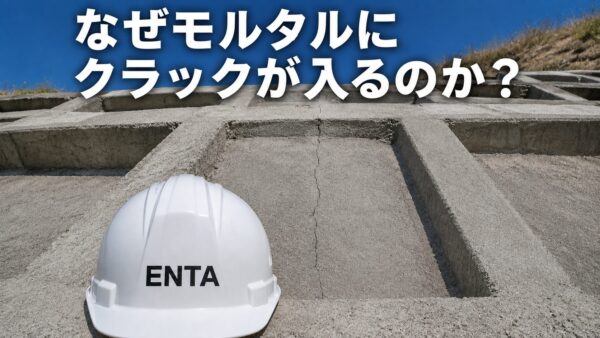
In this post, we'll discuss "Why Do Cracks Form in Mortar?"
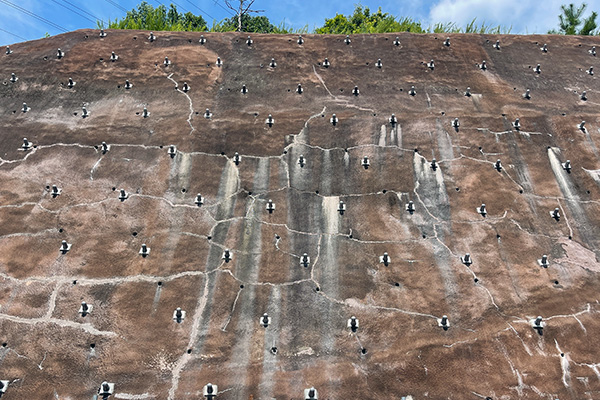
Fine cracks appear in formwork and sprayed mortar shortly after installation. Well, there isn’t just one cause for that.
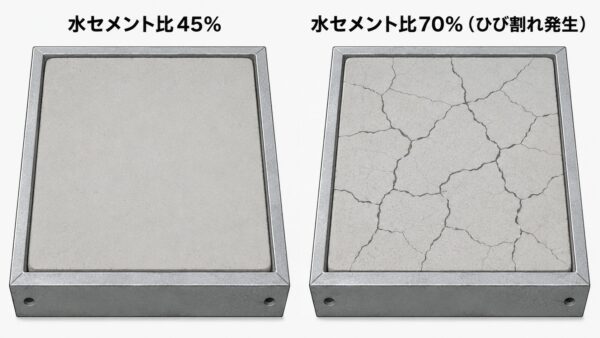
Cause 1 | The water-to-cement ratio is too high
To put it simply, mortar with too much water is prone to shrinkage.
The Guidelines for Cut Work and Slope Stabilization in Road Earthworks state that, regarding the mix design for sprayed mortar, the cement content typically ranges from 360 to 420 kg/m³, and the water-cement ratio typically ranges from 45 to 60%.
Regarding the mortar used in formwork construction, the mix design requirements based on the Draft Guidelines for Shotcrete [Slope Edition] are as follows:
The manual for ground reinforcement soil specifies a water-to-cement ratio of 60% or less, a cement content of 400 kg/m³ or more, and an air content of approximately 4%.
The reason the water-to-cement ratio is an issue is that excess water is expelled as the mortar sets.
The mortar shrinks by the same amount as the water that has been lost.
So, when this shrinkage (drying shrinkage) is no longer balanced by the structural constraints, it manifests on the surface as cracks.
There are times on the job site when you might be tempted to casually say something like, “Tell the ready-mix concrete supplier to make it a little softer today,” but adding too much water can lead to cracks later on, so it’s best to stick to the specified mix design as much as possible.
Cause #2 | Bleeding and Insufficient Curing
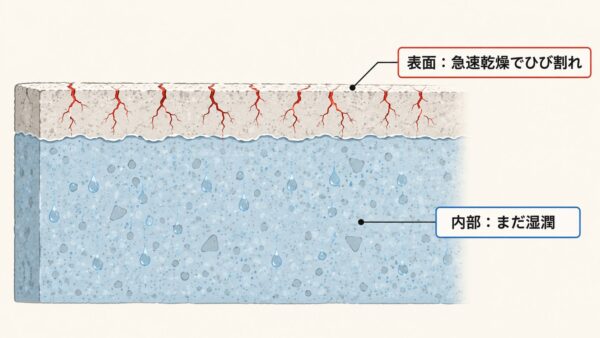
Another culprit is inadequate curing.
The Road Earthwork Guidelines clearly state that mortar and concrete are highly susceptible to rapid drying and freezing, and that insufficient curing can cause cracks and delamination on the sprayed surface.
The surface has dried first, but the inside hasn't fully set yet.
So that difference in drying speed is what causes the cracks, right?
The guidelines also list conditions that restrict the construction work itself.
When strong winds significantly hinder normal spraying operations; when the temperature is near freezing and proper curing cannot be achieved; when heavy rain washes the cement off the sprayed surface; or when it is sunny, windy, and the surface dries out rapidly.
As a general rule, spray application should not be performed under these circumstances.
If you force the application on a windy day under the blazing midsummer sun, the surface will dry out and become rough, making it prone to cracking.
Conversely, the same thing happens if you leave it out without a protective cover on a freezing winter morning.
That said, on a hillside, the wind blows when it's sunny, and it picks up as soon as the rain stops.
Civil engineering never really goes quite the way you expect, does it? lol
Furthermore, according to the Manual for Natural Ground Reinforcement, a standard of a bleeding rate of 3% or less is also used for the daily management of anchoring materials (mortar-based) in rebar insertion work.
Bleeding is a phenomenon in which mixed water separates and rises to the surface; it is said that if this occurs extensively, the area near the surface after hardening becomes weak and is prone to cracking.
Cause 3 | Seam Welding and Joint Treatment
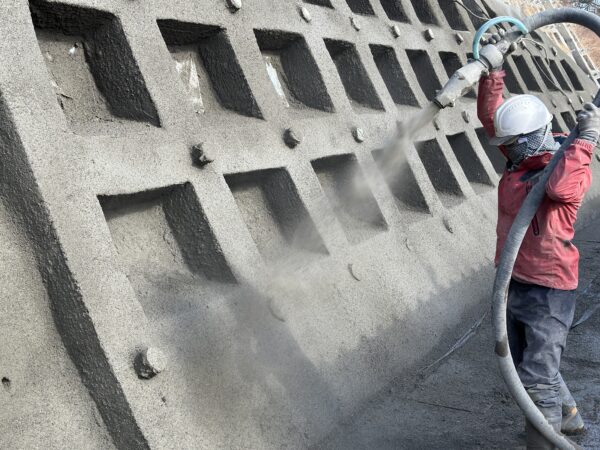
With formwork and sprayed mortar, it’s not possible to finish the entire surface in a single pass. Seams and joints are inevitable.
The Road Earthwork Guidelines state that sprayed concrete joints should be placed at the center of the cross beams whenever possible, and that joint treatment must be performed to prevent a significant decline in quality.
Similarly, when it comes to concrete jointing, if the surface preparation before construction is incomplete, voids are likely to form between the concrete and the subgrade, and
It has been noted that plants sprouting from joints and other openings can facilitate the infiltration of rainwater.
It is also recommended to construct joints vertically or in a hook shape and to place reinforcement bars at the joints. (Sprayed concrete cross-sections and the interface between concrete and sprayed concrete)
The joint is the boundary between the fresh mortar and the mortar that has already set.
If you keep applying layers without cleaning the surface thoroughly, that area becomes structurally weak and is more likely to develop cracks later on.
It's the same at any construction site—construction joints are prone to cracking, aren't they?
No matter how carefully you clean it with compressed air or apply primer, cracks will usually form anyway!
With sprayed coatings, the cross-section itself is thin, so cracks tend to form more easily.
Cause 4 | Stress Concentration (Reinforcement Insertion Work and Around Anchors)
Finally, there’s a crack where the force is concentrated.
According to the design and construction standards for ground anchors, it is stated that stress concentrations at the interface between the tension member and the anchor body may cause cracking in the grout or damage to the corrosion-resistant coating.
This means that "points where forces converge"—such as the junction between the head and the anchor—are prone to cracking, regardless of the type of mortar or grout used.
In anchor maintenance and inspection procedures as well, cracks in the concrete head, as well as cracks and fissures in the bearing plate and structural components, are clearly identified as inspection items, and
Cracks wider than 1 mm are classified as Rank II (high likelihood of structural integrity issues).
In other words, the fact that cracks may form is already factored in to some extent; what’s important is to continuously monitor their “width” and whether they “progress.”
Follow the mixing ratios, take weather conditions into account, and work on the joints with moderate care.
Even so, cracks are bound to form where stress is concentrated.
No matter how well you do the work, cracks are bound to appear 100% of the time when you factor in issues with the materials and weather conditions, so personally, I think we should just accept it!
That's the best, lol
It’s part of the director’s job to explain that clearly to the government, but it’s tough, isn’t it?
Even when the mix, application, and weather conditions are all good, you still need to explain the reason, so...
See you later.