Hello, everyone.
This is Enta.
The rainy season has begun, and it’s that time of year when news reports of heavy rain are coming in from all over the country.
Around this time of year, there are always reports from somewhere about “embankments collapsing” or “slopes shifting.”
What’s still fresh in our memories is the mudslide that occurred in Atami City, Shizuoka Prefecture, in July of Reiwa 3, isn’t it? It’s said that that event had a major impact on society.
But that's beside the point.
In this article, we’ll discuss the “Embankment Regulation Act,” which is said to have been enacted in response to the disaster in Atami.
Since this is a legal matter, it’s easy to think, “We’re just contractors, so it doesn’t apply to us,” but no, this is actually a crucial issue—especially for those of us who work on slopes and embankments.
This time, rather than discussing how to memorize the provisions word for word, I’ll give a rough overview of “what will change on the ground” from a practical perspective.
However, since I’m not a legal expert, please keep in mind that this is based solely on what I’ve learned through my own research.
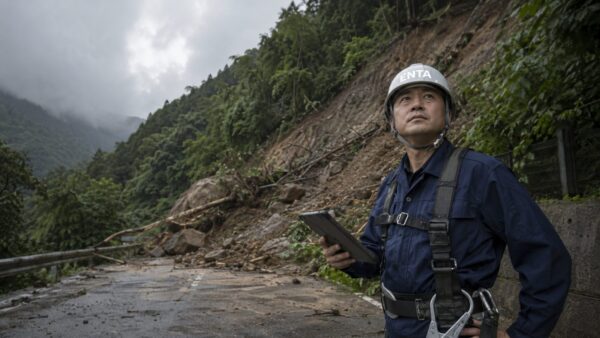
To begin with, what exactly has changed with the Landfill Regulation Act?
Apparently, the official name of the Landfill Regulation Act is the “Act on the Regulation of Residential Land Development and Specified Landfills, etc.”
Since it's so long, everyone just calls it the "Embankment Regulation Act."
According to documents from the Ministry of Land, Infrastructure, Transport and Tourism, this law was enacted following the debris flow disaster in Atami City in July of Reiwa 3, as a fundamental revision of the previous “Act on the Regulation of Residential Land Development, etc. (formerly the Residential Land Development Act),” and came into effect on May 26, Reiwa 5.
As far as I can tell from my research, the biggest change is that “regulations are now applied uniformly nationwide, regardless of land use.”
It seems that the old land development laws basically applied to the creation of “residential land.”
But this new law regulating landfilling applies regardless of whether the land is residential, forested, or farmland.
Furthermore, the article stated that regulations now extend beyond land development to include even “simple soil disposal” and “temporary stockpiling of soil and rock.”
Basically, it seems that “dangerous ways of piling things up or disposing of them are off-limits no matter where you do them.”
Where Is the Line Between "Permission Required" and "Permission Not Required"? Let's Look at the Numbers
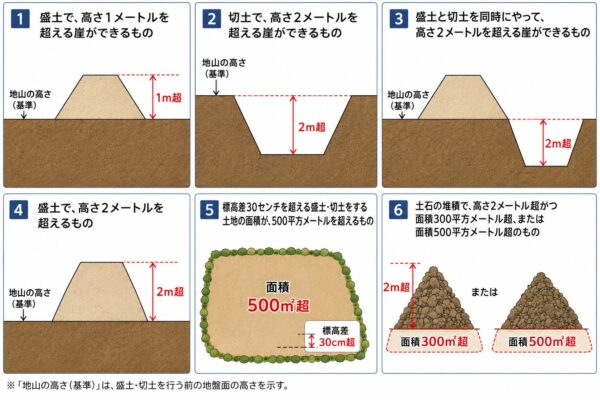
This is the part that people are most curious about—"So, at what scale does it become a problem?"
If you look at the guidelines published by various local governments, such as Yokohama City and Sagamihara City, you’ll see that within “Regulated Areas for Residential Land Development and Similar Construction,”
It appears that, generally speaking, if a project falls under any of the following categories, permission from the governor or mayor is required before work can begin.
- Earthworks that result in a cliff exceeding 1 meter in height
- Cuttings that result in a cliff exceeding 2 meters in height
- A project that involves both embankment and cut work simultaneously, resulting in a cliff over 2 meters high
- Earthworks exceeding 2 meters in height
- Land where the area requiring embankment or cut work with an elevation difference exceeding 30 centimeters exceeds 500 square meters
- Accumulations of soil and rock that are over 2 meters high and cover an area of more than 300 square meters, or those covering an area of more than 500 square meters
To be honest, I think this is the kind of line that gets caught up pretty quickly on-site, even with just a little grading or moving dirt.
A 1-meter-high embankment? If you've ever worked on slope stabilization, isn't that just... Seriously?? It just feels like, "Who cares?"...
By the way, here’s a tip that’ll come in handy.
According to guidelines issued by Yokohama City and others,
In cases where construction work such as residential land development is carried out in accordance with the terms of a development permit issued under Article 29 of the Urban Planning Act, a permit under the Landfill Control Act may not be required.
In other words, it seems the point is that “for construction projects where safety has already been ensured through a development permit, there’s no need to obtain a second permit.”
In other words, it seems that cases such as doing a little digging outside the scope of a development permit or building a retaining wall on your own are actually more likely to run afoul of the Earthwork Regulation Act.
This is just based on my experience in the field, but I feel that the more I think, “It’s a small job, so it should be fine,” the more likely it is that I’ll later realize, “Oh, this actually required a permit.”
It might be safer to narrow down your options at the very beginning.
Even for subcontractors like us who specialize in specific types of construction work, the project comes to a halt if the general contractor fails to obtain the necessary permits. So it’s not just someone else’s problem, haha.
*The figures above were provided as general guidelines for areas subject to regulations on land development and related construction work.
Since the specific implementation details may vary depending on the type of zone and the local government, please be sure to check the latest guidelines issued by the relevant local government when applying this in practice.
I haven't personally cross-checked the original documents of every local government. These are simply representative standards that I found during my research.
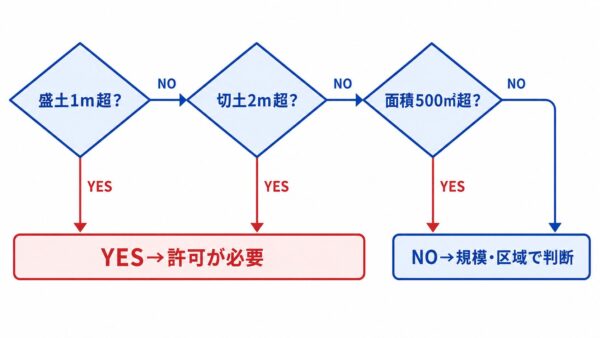
For slope engineers, this means “you can’t get away with temporary solutions.”
The reason slope stabilization contractors should be concerned about this law is that, for projects subject to permitting, there is a possibility that they will be required to “use proper, permanent structures to stabilize the soil.”
According to the guidelines issued by Meguro Ward and other local governments, it appears that for construction projects involving earthwork that exceeds the permitted scale and is halted midway, a permit under the Earthwork Regulation Act is required, and the installation of concrete retaining walls or similar structures may be necessary.
And the point where it stated, “It is not possible to hold back the soil using temporary structures such as retaining walls.”
In other words, it seems that the approach of “just putting up a temporary solution for now and figuring it out later” doesn’t really work anymore.
I'm like, "Whaaaaaaat?!" Seriously??
From our perspective as slope engineers, it seems this means there will be strict requirements for “work that permanently protects slopes,” such as retaining wall construction, mortar spraying, vegetation restoration, and drainage work....
Furthermore, it appears that there is also a type of regulated area known as a “Specified Embankment, etc. Regulated Area.” According to documents from the Ministry of Land, Infrastructure, Transport and Tourism, this designation applies to areas such as slopes that, even if located away from urban areas, could cause damage to residential properties due to topographical conditions.
In short, it seems that even a slope in the mountains could be a candidate.
It’s getting harder to say that this has nothing to do with us, since we’re always out in the mountains…
It appears that the technical standards themselves (such as slope gradients, drainage facilities, bench cuts, and compaction standards) are specified in detail in Cabinet Orders, Ministry Ordinances, and the technical standards of individual local governments.
I think it's good that my workload is increasing in various areas, but it does feel like I'm taking on too much...
Common Pitfalls on Site (Permits Before Work Begins, Inspections, Record-Keeping, and Maintenance Obligations)
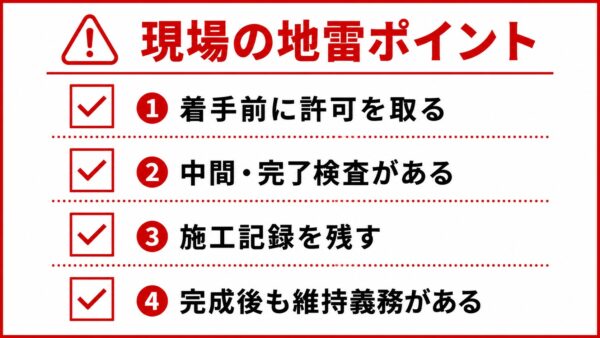
When legal issues come into play, the construction process itself becomes more problematic.
Here are some points to pay special attention to on-site:
First of all, it seems that you need to obtain permission “before starting work.”
This might seem obvious, but when things come up suddenly, there’s a chance you might just “get it done first,” right?
Proceeding without permission is definitely the worst-case scenario.
If you suddenly find yourself with excess soil, should you get a permit first, or just spread it out flat so it’s less than 1 meter thick?! lol
Next, I was told that there would be inspections, such as interim inspections during construction and a final inspection upon completion.
Therefore, keeping detailed records of the construction work—including compaction control, the status of drainage installation, and the finished condition—should help prevent problems later on.
And penalties.
According to explanations provided by local governments and the Ministry of Land, Infrastructure, Transport and Tourism, malicious violations—such as unauthorized construction—are punishable by imprisonment or heavy fines, and
It seems the system is designed to impose particularly heavy fines on corporations.
Another thing that’s easy to overlook is what happens after the construction is finished.
It is said that owners, managers, and occupants of land within regulated areas are obligated to maintain that land in a safe condition at all times.
I've heard that if a structure is deemed unsafe, authorities may issue a recommendation or order to install or modify a retaining wall.
In other words, we need to adopt the mindset of “building structures that will be properly maintained afterward,” rather than just “building them and calling it a day.”
Up to this point, I’ve been writing things that might sound like threats—like “regulations have gotten stricter” and “there are more things to watch out for”—but to be honest...
I think that, for those of us who work to protect slopes, this isn't all bad news.
Construction projects that don’t rely on temporary fixes but instead incorporate proper retaining walls, slope protection, and drainage systems will become the “norm.”
We need structures that aren't just built and then forgotten, but that can be maintained.
Unlicensed operations and substandard work—the "cheap but shoddy" kind—will be weeded out through penalties and inspections.
Ultimately, this leads to a situation where “contractors who do quality work get more jobs and are properly recognized.”
As natural disasters become more frequent, the importance of the work involved in protecting slopes continues to grow.
It is said that this law was enacted in response to the disaster in Atami, but it is a system designed to prevent such incidents from ever happening again.
If that’s the case, wouldn’t it be us—the people on the front lines who know the field—who can do the job most effectively within that system?
Do you view regulations as “cumbersome restrictions” or as “an opportunity to put our skills to good use”?
I'm thinking I'd like to go with the latter, lol.
But I end up piling up a huge mound of sprayed sand... lol
See you later.
Drainage Boring Is the Primary Method for Addressing Existing Embankments | Countermeasures