Hello, everyone.
Hello, everyone.
This is Enta.
I didn't mention one more thing at the CSPI-EXPO the other day, so...
Personally, this was actually the main point, lol.
But that's beside the point.
This time, I’d like to talk about a machine I saw at that venue that really caught my eye.
The Drilling Machine That Caught My Eye at CSPI-EXPO
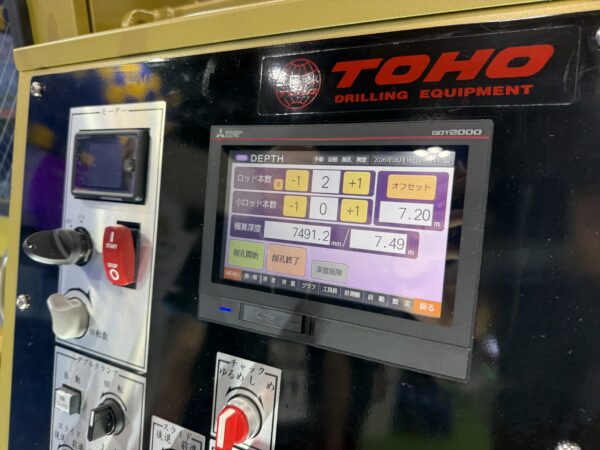
This is a machine that was on display at the Toho Chika Koki booth.
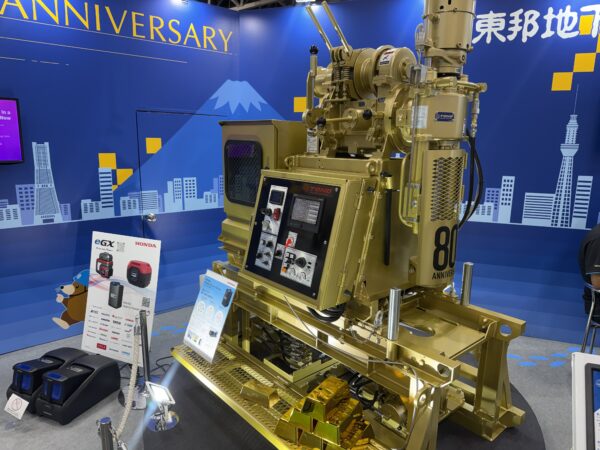
Take a good look at this machine!
He's dressed just like C-3PO!!!!
It looks pretty funny at first glance, lol.
It catches people's attention.
After all, it's a trade show—you've got to stand out!
Plus, it's C-3PO, whom everyone loves.
I'm sure everyone knows this by now, right...
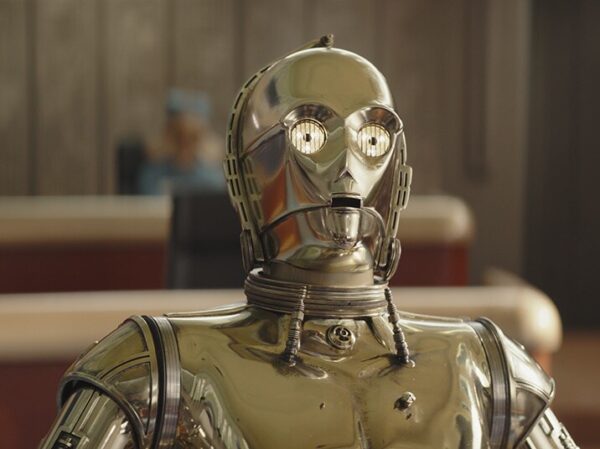
Just to be clear, C-3PO is a golden humanoid droid that appears in the movie *Star Wars*.
That's the chatty robot that's been around since the first movie in 1977, isn't it?
He was such a goofy but charming robot, wasn't he? lol
By the way,Toho Underground Construction MachineryThe company is involved in a wide range of activities, from the manufacture and sale of equipment such as boring machines, pumps, and grout mixers to slope stabilization projects and landslide prevention work.
This manufacturer needs no introduction in our industry.
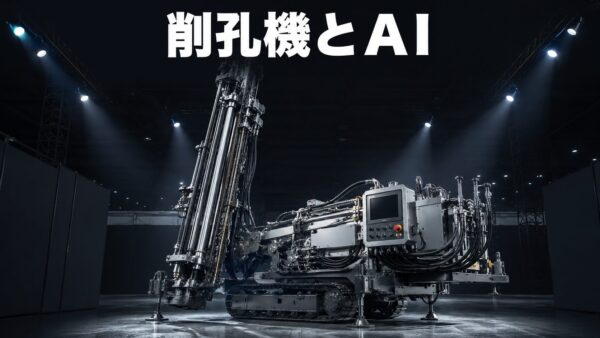
The possibility that AI will be incorporated into drilling machines equipped with control panels in the future
Now, please take another close look.
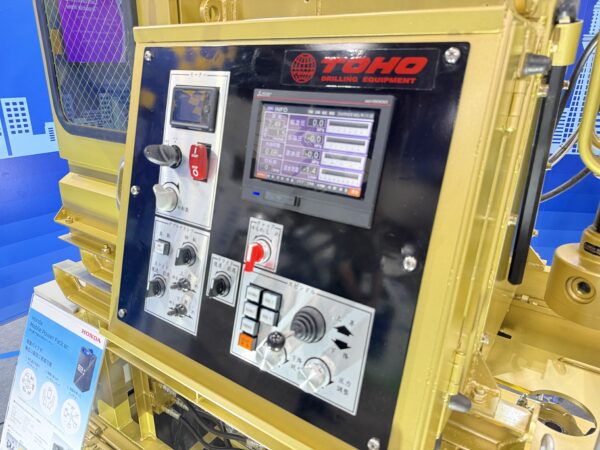
It has a panel attached.
A method of controlling machinery electrically rather than mechanically.
What this means is that there’s a high likelihood that AI will be incorporated in the future.
This isn't about whether it's currently installed on this machine or not.
The story is that it’s now ready to be published.
The reason is simple: when something is controlled electronically, that control is entirely represented as data.
As long as you're moving the lever by hand, the nuances of that movement remain only within the operator's body.
The moment it passes through the panel, it is output as a numerical value.
When it comes to drilling, it’s a task where it’s easy to collect data in the first place.
Progress, the force applied, rotation, and the behavior of the returning water or wind.
All of them are easy to quantify.
And—this is an important point—I believe that the shift to AI will begin with rotary-style systems.
Since the rotary type relies mainly on rotation, it doesn't vibrate much.
Without vibrations, machinery is less likely to break, and sensors will survive.
Once the percussion kicks in, it all falls apart in an instant, lol.
It’s honestly going to be tough to fully protect the electronic components from the impact.
Well, sooner or later—or rather, it’s only a matter of time before AI is integrated into rotary percussion as well.
After all, the major companies have been working on this for several years now.
That is, if everything goes well, lol.
Will Automating Drilling with AI Really Improve Conditions on Site?
That said, is it really necessary to go so far as to incorporate AI from now on?
Especially when it comes to construction.
Will we end up short on staff??
Well, even if that were to happen, I think I could at least assist an inexperienced surgeon.
Even just letting a young operator know things like, “The soil type has changed here,” or “The casing is tight,” while drilling is a huge help.
I'm honestly grateful for that.
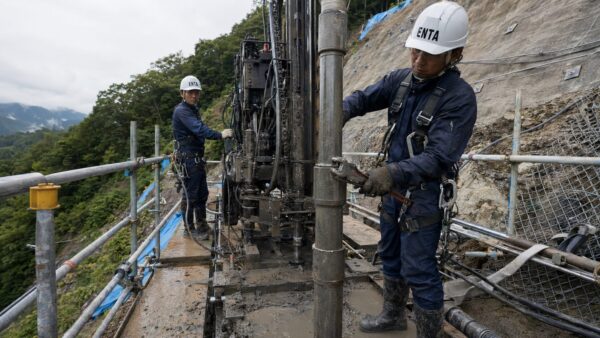
Still, removing and reattaching the casing is a bit scary because it can be dangerous.
Since that’s a task that requires a person to handle the rod or casing, it’s over the moment the machine starts running on its own.
Well, if that were to be automated too, that would change things, wouldn't it?
Like, press the button when someone lets go?
However, construction capacity will definitely decline.
The speed at which AI performs construction work is vastly different from the speed at which humans do it.
People tend to move their hands first, thinking, "This part is probably hard."
The AI checks first before taking action.
If that difference adds up with each and every one, it’ll make a significant difference in the total number per day, won’t it? (Especially in the early days.)
Of course, if we could keep working nonstop even in the middle of the night, that would be a whole different story—but that’s still a long way off.
Running it unmanned at night means you have to figure out who’s going to go check on it if it stops, lol.
I guess someone's gonna have to babysit them the whole time, huh? lol
I want to make full use of AI for the future of the slope stabilization industry
What does the future hold for the adoption of AI in slope construction?
To be honest, I don't know the answer either.
However, it's true that no one is going to make it just because we wait around.
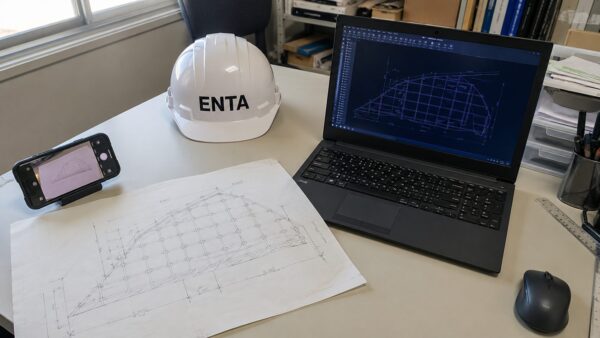
By the way, right now I'm working on tension control charts, stability calculations, slope frame calculations, and rock bolt tension control charts in CAD.
And so on—I'm thinking of trying to make some paid software free... lol
I can only make them gradually, so please bear with me a little longer.
We're about 80 percent done with the CAD software for slopes.
Now it's just a matter of experimenting.
It's a tool that lets you take a photo of a hand-drawn slope development diagram with your smartphone, and when you import it, it turns into a drawing.
Also, the smartphone version is one where you can create a net diagram by plotting the endpoints.
LRTKIf you combine this with a method to accurately obtain the coordinate values, it seems like you could use it as is.
Manufacturers will handle the integration of AI into the machines.
But if you were to ask whether someone could simplify the development diagrams and control charts we draw every day, the answer is probably no.
In that case, we'll just have to make it ourselves.
Even so, after giving all these things some thought, I’d like to make use of AI for the future of the slope stabilization industry.
At the end of the day, no matter how smart machines become, it’s still a human who has to reach in to remove the casing.
People who understand the risks involved must decide what AI should and shouldn't be allowed to do.
The manufacturer will probably say, “It can be done,” but whether it’ll actually work on-site is another matter entirely.
That's why I think it's important for us to have a solid grasp of the areas where we need to make decisions.
See you later.