

Hello, everyone.
This is Enta.
When you’re working on a slope and think, “The mortar feels unusually runny today,” before you start questioning the mix design,Surface moisture content of sandIt's standard practice to be skeptical. (I even doubt the craftsman's water-to-flour ratio, lol.)
Even if you think you’ve followed the mix ratio listed in the table—“W/C=50%”—if the sand contains more moisture than expected,
Since the actual water-to-cement ratio is actually higher, that’s why you end up with super runny mortar lol
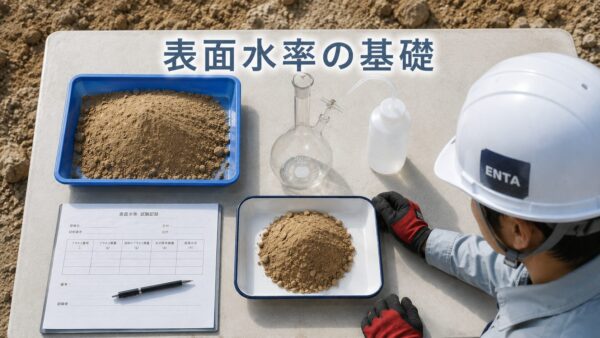
This time,Basic Knowledge of the Surface Moisture Content of Fine AggregatesI’ll cover everything from the four moisture content states of aggregates to the measurement methods specified by JIS standards and the calculations for on-site mix adjustments—all from a practical, on-site perspective.
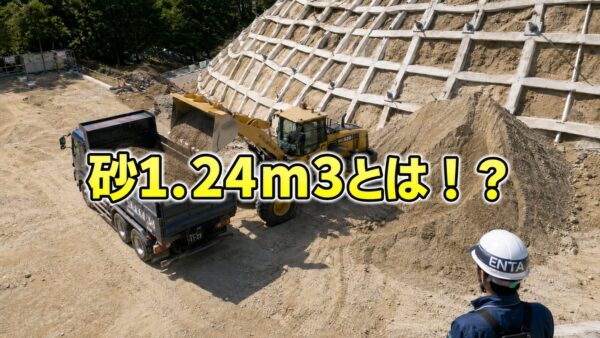
From the same "Sand Series"What Is a Chapman Flask?・What Does "1.24 m³ of Sand for Sprayed Mortar" Mean?If you read this along with the other material, you'll get a complete picture of formulation management.
The moisture content of aggregates is classified into four levels
In civil engineering mix design calculations,Classify the moisture content of aggregates (especially sand) into four categoriesThat's the basic principle.
| Status | Name | Description |
|---|---|---|
| ① | Absolutely Dry(Completely Dry) | Dried at 105°C until all moisture is removed. For testing purposes. |
| ② | Air-dried | A state in which the substance has been left at room temperature indoors and has reached equilibrium with the air |
| ③ | Surface Dry, Saturated(Surface-dried) | The interior of the granules is filled with water, while only the surface is dry. Basis for formulation calculations |
| ④ | Moist | The surface is also wet. This is what the sand at the site usually looks like. |
In the field of mix design calculations, the dry condition shown in Table ③ is treated as the “reference.”
The "apparent dry density," which is used to calculate the absolute volume of sand, is also the value obtained by dividing the mass of the sand in its apparent dry state by its apparent dry volume.
This is specified in JIS A 1109, “Test Methods for Density and Water Absorption of Fine Aggregates.”
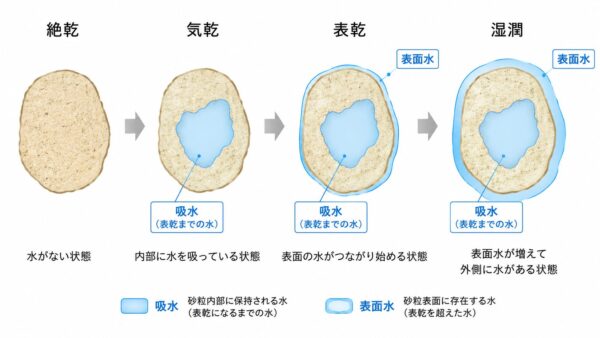
What Is Surface Moisture Content?
「Surface moisture content" is based on the surface-dry state,The excess moisture contained in the sand at the job site (in a moist state) compared to the surface-dry conditionThe percentage.
In mathematical terms,
Surface Moisture Content (%) = (Wet Mass – Surface-Dried Mass) / Surface-Dried Mass × 100
For example, if you measure 100 g of sand from the site using a Chapman flask and the surface moisture content is 51 TP3T, that means approximately 4.8 g of surface water is adhering to that 100 g of sand.
(Strictly speaking, the surface-dry mass is approximately 95.2 g per 100 g of wet mass, and the surface water is approximately 4.8 g)—that’s the general idea.
How much sand is typically used on a construction site?
The sand at the slope construction site had just been delivered from the sand supplier’s plant, andGenerally within the range of 3 to 81 TP3T surface moisture content. Exceeds 101 TP3T first thing in the morning after rain or in uncovered stockyards.That can happen sometimes.
Conversely, based on our experience in the field, when the air dries out on a midsummer afternoon, the humidity drops to around 1–31 TP3T.
Since it fluctuates throughout the day depending on the season and weather,Measure twice a day—once in the morning and once at noon...is the standard procedure for quality control.
Generally speaking, covering the area with a blue tarp at all times makes a better impression on the inspector.
If you measure it every day and gain some experience, you'll come to realize, "Oh, so this is just how it is," lol.
Two Test Methods in the JIS Standard
The method for measuring the surface moisture content of sand is specified in the JIS standardTwo methods are specified in parallel...is being done.
| Specifications | Test Method | Equipment | Features |
|---|---|---|---|
| JIS A 1111:2015 | Volume Method / Mass Method | Chapman flasks, etc. | Can be measured instantly on-site in about 5 minutes |
| JIS A 1125:2015 | Dry Weight Loss Method | Electronic Balance + Drying Oven | For Laboratory Use · High Precision · Time-Consuming |
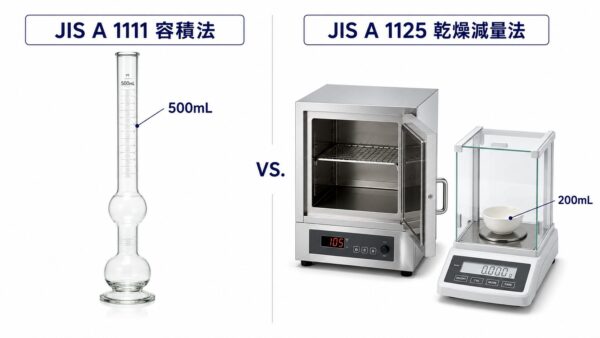
In the field, the Chapman method specified in JIS A 1111 is the most widely used.
At the slope construction site,I want results right awayTherefore, the volumetric method using a Chapman flask in accordance with JIS A 1111 is used.
The test procedure is as follows:
- In a 500-mL Chapman flask,Distilled water up to the 200 mL mark
- SandAdd 500g, remove air bubbles
- Calculate the surface moisture content based on the flask reading (V₂) and the mass of sand
For detailed instructions, seeWhat Is a Chapman Flask? | Surface Moisture Content Test for Fine AggregatesPlease refer to the section where this is written.
Precision measurements for laboratories are specified in JIS A 1125
If accuracy is a priority, refer to JIS A 1125, “Test Methods for Moisture Content of Aggregates and for Surface Moisture Content Based on Moisture Content,”Dry Weight Loss MethodUse it.
A method for determining the surface moisture content by oven-drying a moist sample (at around 105°C) to determine its moisture content, then subtracting the water absorption rate calculated separately.
Specific Examples of Formulation Adjustments
What Is the Purpose of Measuring Surface Moisture Content?=On-Site Formulation AdjustmentsThis is about...
Examples of Formulation Guidelines
Example of a mix design written according to the traditional standard specifications:
Mix Proportions: C:S = 1:4, W/C = 55% (per 1 m³ of mortar)
| Ingredients | Mass | Volume Relationships |
|---|---|---|
| Cement (C) | 420 kg | — |
| Sand (S) | 1,640 kg | Loose volume: approx. 1.24 m³ |
| Water (W) | 231 kg(W/C=55%) | — |
Correction Calculation for a Surface Moisture Content of 5%
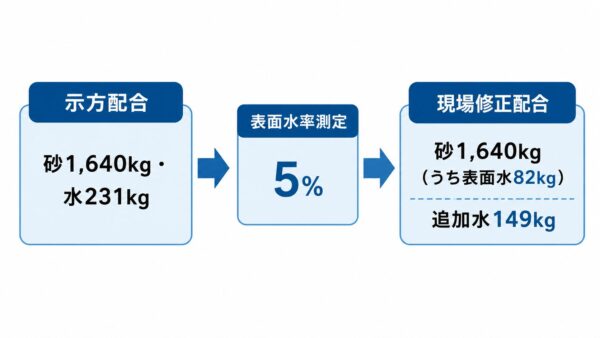
Corrected mix design when the surface moisture content is 5% using on-site sand:
- Total mass of sand = 1,640 kg (of which, surface-dry equivalent + surface water)
- Volume of surface water = 1,640 × 5% = 82 kg
- Adjustment for mixing water = 231 kg – 82 kg = 149 kg
In other wordsWhen adding 1,640 kg of sand according to the mix design, reduce the mixing water from 231 kg to 149 kg.The point is that this allows us to maintain the original W/C=55%.
Conversely, if you were to fill it with 231 kg of water without making any adjustments,
- The actual W = 231 + 82 = 313 kg
- Actual W/C = 313 / 420 = Approx. 741 TP3T
As a result, the mortar ends up containing about 20% more water than expected.
This is a problem because it deviates from the design mix ratio.。
Relationship Between Water-Cement Ratio and Compressive Strength
This is one of the most basic principles of civil engineering, but,Lowering the water-to-cement ratio increases compressive strength.(Cement-to-water ratio rule / Abrams' formula).
On the contrary, As the W/C ratio increases, strength decreases.。
| W/C ratio | Strength Trends |
|---|---|
| 40% | High strength (workability may need to be adjusted) |
| 50% | Balance Standard |
| 55% | It's a bit on the low side, but it's easy to work with. |
| 65% or higher | High Risk of Strength Reduction |
For the surface water content setting, we generally set the W/C ratio to approximately 50% based on site conditions.
For this reason, if the weather is extremely sunny, it’s easier to manage if you leave it at a level where you can add a little water if needed.
Controlling Surface Moisture Content = Controlling Final StrengthIt's connected to that, so please pay a little attention to it lol
Tips for Managing Surface Moisture Content "With Confidence" on Site
Three Tips for the Field.
- Measure twice a day—morning and afternoonMake it part of your daily routine at the same time every day (first thing in the morning or first thing in the afternoon)
- Place the lab equipment (Chapman flask, electronic balance, distilled water) near the sand pile.StockPut them in a sturdy case and store them there (which makes the whole process a little less of a hassle, lol)
- I'm going to make sure Chapman doesn't go down! 👇👇👇👇 Recommended!
Just this alone will help reduce the hassle and stress of managing ingredient ratios, even if only slightly.
To be honest, if the mix proportions don’t change that much, I’m concerned about the strength, but occasionally there are fine aggregates that don’t develop strength very well.
Please be careful about that.
See you later.
[Related Articles]
- What Is a Chapman Flask? | Surface Moisture Content Test for Fine Aggregates
- The Meaning of 1.24 m³ of Sand for Sprayed Mortar | Bulk Volume and True Volume
- Standards for Cement Slurry Compressive Strength Tests | Why Three Tests in the Morning and Three in the Afternoon?
[References and Sources]
- JIS A 1109 "Test Methods for Density and Water Absorption of Fine Aggregates" (Specifications for Table-Dried Density and Water Absorption)
- JIS A 1111:2015 “Test Method for Surface Moisture Content of Fine Aggregates” (Volumetric Method and Gravimetric Method)
- JIS A 1125:2015 “Test Methods for the Moisture Content of Aggregates and for Surface Moisture Content Based on Moisture Content” (Loss on Drying Method)
- The Japan Society of Civil Engineers, *Standard Specifications for Concrete*, Construction Volume (Chapter on Mix Design)
- JSCE.jp for Engineers: “Regarding the Calculation Formula for the Surface Moisture Content Test of Fine Aggregates”