Hello, everyone. This is Enta.
Today, I’d like to talk about a somewhat sensitive topic.
Since this is a story about human life—and specifically about “how much it’s worth in monetary terms”—you might find it a bit unsettling to read.
However, for those of us in the construction industry, this is a topic we simply cannot avoid if we are to truly understand the gravity of safety management.
If a Japanese national dies in an accident, how much compensation will be paid?
And what about overseas?
I'll be writing this in two parts: Part 1 and Part 2.
How much compensation is paid if a Japanese national dies in an accident?
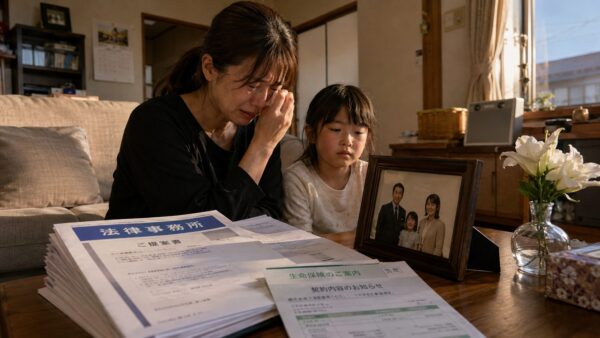
It is sometimes said that, in Japan, if an average office worker dies in an accident or disaster, the amount paid to the surviving family members is roughly "200 million to 300 million."
However, this applies only to extreme cases involving a young person who is the primary breadwinner, has a solid annual income, and where the other party bears the greater share of fault.
When viewed through the lens of practical judicial standards, the figures turn out to be a bit more moderate.
Case Study: A 35-Year-Old Single Man with an Annual Income of 4.5 Million Yen
- Loss of Earnings Due to Death: Approximately 45.87 million yen
- Compensation for pain and suffering due to death: 20–28 million yen (based on court standards)
- Total: Approximately65 to 75 million yen
For a 37-year-old earning 6 million yen a year who is the primary breadwinner, the loss of earning capacity alone amounts to approximately 82.32 million yen.
This figure may vary by about 1.5 times depending on family composition, age, and annual income.
"Lost earnings" refers to the amount the deceased would have earned from now until retirement.
It seems the structure is such that compensation for emotional distress is added on top of that.
(Reference: Atom Law Office—Explanation of Compensation for Pain and Suffering and Lost Earnings Due to Death / 2024 Edition)
What Is the International Index for Comparing the "Value of Life" Around the World?
So I wondered, “What’s it like overseas?” and decided to look into it—and guess what!?
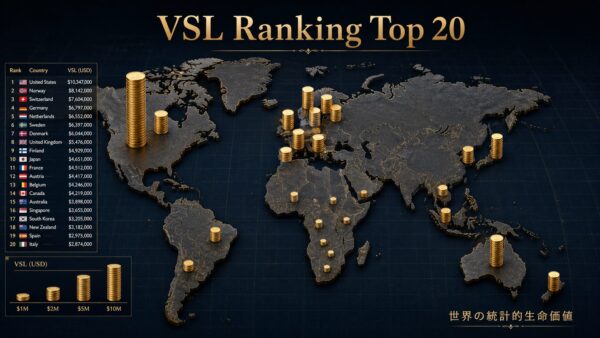
The indicators used in international comparisons are VSL (Value of Statistical Life)That's right. (It sounds a lot like the name of an anchor material...)
This serves as a benchmark for governments around the world to determine “how much tax revenue to allocate to policies aimed at saving a single life,” and
I just learned that this is apparently a globally recognized indicator used by organizations like the OECD and the World Bank!
From our perspective as civil engineers, this is a concept we’re not very familiar with, but it’s a figure that governments around the world use when considering the cost-effectiveness of safety investments,
If you think of it that way, it might be a little easier to understand.
Based on an analysis of 277 studies compiled by the OECD in 2024 and Viscusi’s (2020) income elasticity model, let’s first take a look at the Top 20.
(I don't really understand this part, so I'm just copying and pasting it as is.)
Top 20 Countries by the Cost of Life
| Rank | 国 | VSL (in millions of USD) | Conversion to yen (150 yen/$) |
|---|---|---|---|
| 1 | United States | 11.8 | Approximately 1.77 billion yen |
| 2 | Luxembourg | 10.5 | Approximately 1.58 billion yen |
| 3 | Switzerland | 10.0 | Approximately 1.5 billion yen |
| 4 | Norway | 9.5 | Approximately 1.43 billion yen |
| 5 | Ireland | 9.0 | Approximately 1.35 billion yen |
| 6 | Singapore | 8.9 | Approximately 1.34 billion yen |
| 7 | Denmark | 8.5 | Approximately 1.28 billion yen |
| 8 | Iceland | 8.3 | Approximately 1.25 billion yen |
| 9 | The Netherlands | 8.0 | Approximately 1.2 billion yen |
| 10 | Sweden | 7.8 | Approximately 1.17 billion yen |
| 11 | Australia | 7.5 | Approximately 1.13 billion yen |
| 12 | Germany | 7.3 | Approximately 1.1 billion yen |
| 13 | Canada | 7.0 | Approximately 1.05 billion yen |
| 14 | Austria | 6.8 | Approximately 1.02 billion yen |
| 15 | Belgium | 6.5 | Approximately 980 million yen |
| 16 | Finland | 6.3 | Approximately 950 million yen |
| 17 | United Kingdom | 5.5 | Approximately 830 million yen |
| 18 | France | 5.0 | Approximately 750 million yen |
| 19 | Japan | 4.5 | Approximately 680 million yen |
| 20 | Italy | 4.0 | Approximately 600 million yen |
* The U.S. Federal Emergency Management Agency (FEMA) adopted $7.5 million for 2020, and the U.S. Department of Transportation adopted $11.8 million for 2021.
Source: OECD (2024 meta-analysis) / Viscusi & Masterman (2017) / U.S. Department of Transportation, 2021.
Japan ranked 19th with approximately 680 million yen.
You might find yourself thinking, “Wait, is Japan really that low?”
However, this is strictly an indicator used for policy cost-benefit analysis, and it is a separate matter from the actual amounts of compensation awarded in court (ranging from 65 million to 100 million yen, as mentioned earlier).
Japan's safety management is actually among the best in the world
At this point, it has become clear that the value of a Japanese life ranks “in the middle among developed nations.”
However, in terms of on-site safety management standards, Japan ranks among the best in the world.
Mandatory use of full-body harnesses, training for new employees, KY activities, scaffolding inspections, restricting work to certified personnel, special training, risk assessment, foremen's meetings.
Compared to overseas sites, there are even aspects that feel excessive.
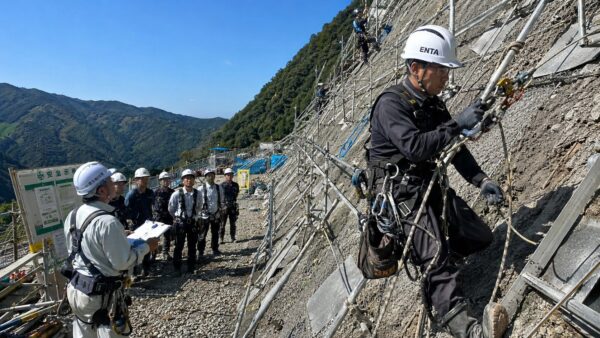
Slope construction, in particular, is a line of work that involves working at heights using ropes on steep slopes.
Lowering the main rope to the base of the structure, managing how the main rope is tied, the start and end dates for using the main rope and safety harness, and so on,
It is the accumulation of these individual safety management measures that underpins the high level of safety at work sites in Japan.
According to the Ministry of Health, Labor and Welfare’s statistics on workplace accidents, the number of fatal accidents in the construction industry has fallen significantly, from 377 in 2014 to 223 in 2023.
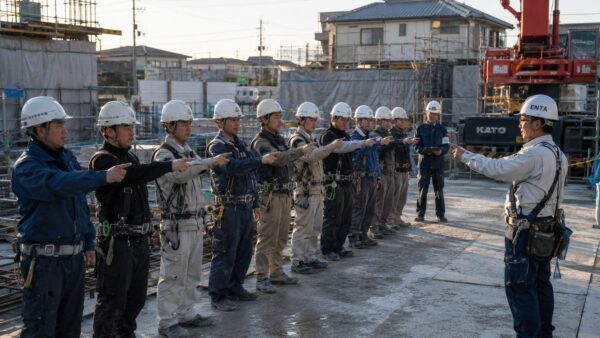
This means that what may seem like excessive oversight is, in fact, saving lives.
It’s so over the top, it’s almost like they’re saying, “We’re so focused on safety that we’re not even doing our jobs!” lol
So what about developing countries?
So, why does this story have such a direct impact on the management of small and medium-sized construction companies?
Rankings for All 188 Countries in the WorldSo, this is about the reality of workers’ compensation in developing countries, as well as the business perspective that “a single workplace accident can easily bankrupt a company.”
See you later.