Hello, everyone.
This is Enta.
I've been swamped with all kinds of stuff lately, and I'm insanely busy.
Especially regarding estimates...
It was like, "Ugh, I'm so over this!"...
We're heading toward the end of the fiscal year, aren't we?
But that's beside the point.
The other day, an article appeared in Tokyo Shoko Research’s “TSR Data Insights” stating that bankruptcies in the scaffolding industry are occurring at a record-high pace.
We specialize in slope stabilization, but we also install temporary scaffolding.
The reason is that, for some reason, even when we’ve tried to hire a scaffolding company over the past few years, they’ve been slow to show up, so we’ve ended up doing the work ourselves.
Why Are Scaffolding Companies Disappearing?
To state my opinion right off the bat,Because it's easy to start your own businessThat's it.
I think that really sums it up.
I’ll write about what I’ve seen and felt on construction sites—including media coverage, the regulations under the Construction Industry Act, and the trend of scaffolding companies going out of business.
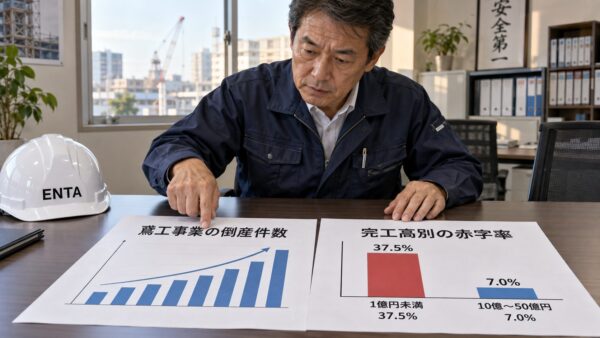
Number of Bankruptcies in the Scaffolding Industry and Analysis by Tokyo Shoko Research
According to Tokyo Shoko Research, there were 110 bankruptcies (with liabilities of 10 million yen or more) in the scaffolding industry from January through August 2026, representing a 26.4% increase compared to the same period last year.
This is the first time in 16 years—since 2010—that the number has exceeded 100 from January through August.
If this pace continues, it is estimated that the annual total could reach as high as 170 cases.
The scaffolding industry includes not only companies that set up scaffolding but also those that install steel frames and support columns—and that includes us, the slope stabilization specialists.
Please be aware that this figure does not represent the number of cases involving only scaffolding contractors.
It's easier to understand when you look at the contents.
- The causes were poor sales in 78 cases and accumulated losses in 24 cases, with poor business performance accounting for more than 90 percent of the total.
- There were 98 companies with capital of less than 10 million yen and 101 companies with fewer than 10 employees.
- There were 19 bankruptcies due to labor shortages—about twice the number from the same period last year—and 9 bankruptcies due to rising prices—three times the number from the same period last year.
Most of the companies that have gone out of business are small businesses with fewer than 10 employees.That's the point.
On the other hand, looking at the combined figures for the 15,941 scaffolding contractors for which performance data is available, revenue has increased for four consecutive fiscal periods, and net income has risen by 24.4 percent compared to the previous period.
So, as a whole, there's an absurd amount of work in this industry.
Despite this, 37.5 percent of companies with annual construction revenue of less than 100 million yen are operating at a loss.
The loss rate for companies with annual revenue of 1 to 5 billion yen is 7.0%, so there’s a clear difference based on size!!
It's tough even in terms of population numbers.
According to the same article, while the Ministry of Health, Labor, and Welfare’s job openings-to-applicants ratio for all industries in July was 1.18, the ratio for workers in structural construction—including scaffolders—was 7.94.
That works out to nearly eight companies competing for each job seeker.
If a small scaffolding company lets one of its workers go, it will be nearly impossible to find a replacement.
Even though there are jobs available, it’s only the small companies that are going out of business.
The bottom line is, we just can't keep things running on the ground.
Why It's Too Easy for Scaffolding Contractors to Start Their Own Businesses
Here’s an overview of the workflow of the scaffolding crews I’ve observed on-site.
To be honest, a lot of the guys who work in scaffolding are pretty rowdy (though there are quite a few from the slope stabilization crews too, lol).
Thanks to an introduction from a former delinquent senior and an invitation from some local friends, I casually walked into a nearby scaffolding company.
Work is tough.
Still, compared to others my age, even though the work is tough, I make a decent amount of money.
After about five years, differences begin to emerge among colleagues who started at the same time.
- Be able to review drawings and prepare a bill of materials (calculate the quantities of required components)
- Highly rated by customers and often requested by name
When this happens, I usually start to feel the following:
"Even I can do it!"
"Why am I only getting this much when I'm working so hard!?"
That's when I completely forget about the company's reputation and start thinking it's all down to my own ability.
And then came independence.
Scaffolding is a line of work where the barriers to starting your own business are low.
With one 2-metric-ton truck and a crew of three to four workers, we can at least set up the scaffolding.
For temporary scaffolding for slope construction projects like ours, that many people are more than enough to handle the job.
If it's a large-scale apartment building renovation, even more manpower will be needed.
However, I get the impression that small-scale private construction projects are often handled by sole proprietors who round up a group of young people they know.
Anyone can start a company at any time.
The problem is,The knowledge you’ll need after you’ve created something—something no one has ever taught you beforeThat's it.
I spent five years as a craftsman, during which I learned how to select materials and assemble them. I can handle work on-site.
But no one on the job site teaches you how to prepare estimates, manage costs, handle social insurance procedures, or manage cash flow.
The moment you become independent, all the consequences of not having studied up until then come crashing down on you at once.
This is exactly when what you learn in school really pays off! Japanese, math, science, social studies, and art! This is what happens when you think it’s a waste of time.
Being able to compile a list of materials and being able to prepare a quote are two different things.
The initial estimate focuses on “how many of each item to use,” while the final estimate covers “how much to pay to rent them for how many days, how many man-days to allocate, and at what price to sell them.”
There are quite a few apprentices who strike out on their own without ever having prepared a single estimate while working alongside their master.
Conversely, there are certainly plenty of areas where we’re being taken advantage of by major general contractors and local general contractors offering low rates.
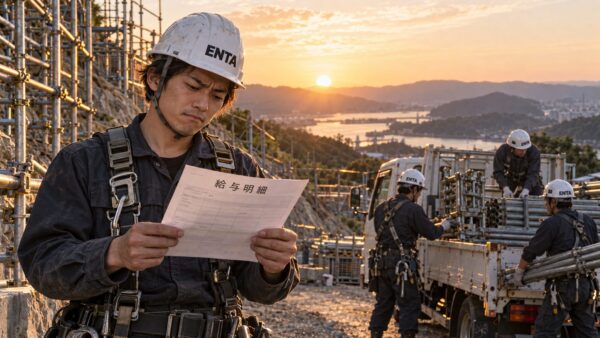
Construction Licenses and Social Insurance Pose Challenges After Becoming Self-Employed
One of the first hurdles you’ll face when starting your own business is obtaining a construction business license.
Under the Construction Industry Act, construction work that can be undertaken without a construction business license is classified as “minor construction work,” and as long as it is not general building construction,The contract price for a single project is less than 5 million yenThat's it.
People often misunderstand this to mean “up to 5 million yen per month,” but this amount applies to each individual transaction, not per month.
Furthermore, this 5 million yen includes consumption tax, and if the client provides materials, the cost of those materials will be included in the calculation.
Even for construction work costing 4.8 million yen before tax, the total amount exceeds 5 million yen when tax is included, so a permit is required.
Sometimes people say, “For a 6 million yen project, you can just split the contract into two 3 million yen contracts,” but that won’t work lol.
Splitting a single construction project into separate contracts to circumvent permitting requirements is considered a circumvention of the law, and even if the project is split, it will be evaluated based on the total amount.
If you undertake construction work worth 5 million yen or more without a license, you will be subject to penalties for violating the Construction Industry Act, and you will be barred from obtaining a license for the following five years.
Since the general contractor who places the order would also be in violation, any reputable general contractor wouldn't place such an order in the first place.
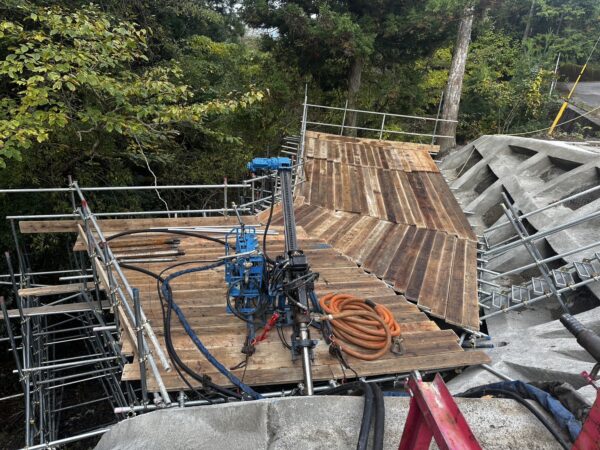
You might think, “Well, why not just get permission?” but it’s not that simple.
Legally, the following requirements are generally necessary to obtain a construction business license.
- The ability to properly manage business operations (such as experience managing a construction business)
- Each branch office must have an engineer with either the appropriate qualifications or relevant work experience.
- Have equity capital of at least 5 million yen, or the ability to raise at least 5 million yen in funds
- Enrollment in the appropriate social insurance program
Social insurance has been included as a licensing requirement since October 2020.
For corporations, even if there is only one representative, enrollment in health insurance and the Employees' Pension Insurance is required.
If you hire employees, the company will incur corresponding monthly expenses.
And when construction begins, you’re asked to confirm whether you have insurance and to submit the necessary documents, right?
That’s because, according to the Ministry of Land, Infrastructure, Transport and Tourism’s “Guidelines for Instructing Subcontractors on Social Insurance Enrollment,” prime contractors are responsible for instructing subcontractors regarding social insurance enrollment.
It is now standard practice for subcontractors working on public works projects or at major construction sites to have their social insurance enrollment status verified 100 percent.
Scaffolding contractors without a license or social insurance have no choice but to make a living doing private construction projects worth less than 5 million yen.Here is the translation.
What's more, they take on projects worth less than 5 million yen, with teams of three or four craftsmen moving from one job to the next.
Since the profit margin per bottle is so small, it’s extremely difficult to make up for a loss on just one bottle.
And when you factor in the cost of ingredients...
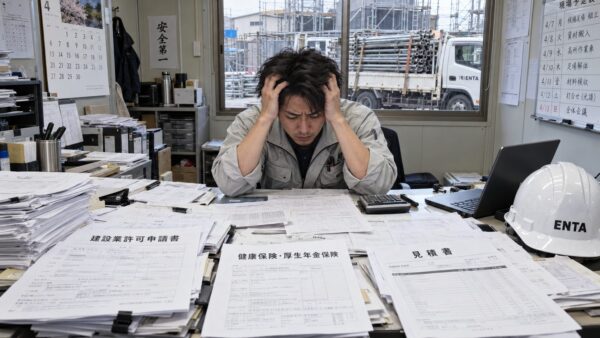
Cost Accounting: Profits Eroded by Scaffolding Rental Fees and Labor Costs
The main reason for bankruptcy is money.
Let's say there's a scaffolding company that has obtained a construction business license and operates with a staff of about five people.
Roughly speaking, the money that goes out of revenue breaks down as follows:
- Salaries for five craftsmen and the company’s share of social insurance premiums
- Cost of Scaffolding Materials
- Truck operating costs, fuel costs, and transportation costs
Scaffolding materials are not something a company that has just become independent can afford to purchase in their entirety.
That's why most companies start with a lease.
This lease payment is really a strain.
Since lease fees accumulate based on the number of days and the quantity leased, any extension of the construction period will directly increase costs.
When we first started working with scaffolding, we rented it, too.
When I actually rented it, in the end...Almost half of what I received went toward the lease payments, lol.
There's a reason for that: when construction is underway, stress is placed on certain parts, causing steel pipes to bend, scaffolding planks to crack, or clamps to go missing...
I'm getting charged a ton, lol.
So we're just buying everything up now, lol.
I went on a real shopping spree for scaffolding materials!!
With tears in my eyes and spitting up blood lol (just me, lol)
That's why I really want you to take good care of the ingredients! (I'm really hoping you will!)
That said, it would be ideal if we could set our rates after giving that kind of consideration, but in most cases, that’s not how it works.
Thinking, “If I take on the job, I’ll make money,” I just end up accepting it.
This is the most dangerous.
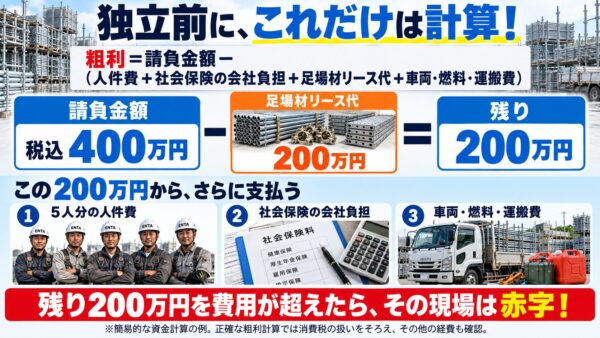
Here’s a formula I’d like you to be able to calculate before you go out on your own.
Gross Profit = Contract Amount – (Labor Costs + Employer’s Share of Social Insurance + Scaffolding Equipment Rental Fees + Vehicle, Fuel, and Transportation Costs)
This is just the bare minimum, lol.
Specifically, let's consider a project with a total cost of 4 million yen, including tax.
If the lease payment is 2 million yen—half the total cost—then the remaining amount is 2 million yen.
After paying the labor costs and social insurance premiums for five people, plus the truck rental fee, will there be anything left?
If there's no profit left over, that project is guaranteed to be in the red from the moment it's accepted.
Another thing that’s easy to overlook is when the money comes in.
It typically takes one to two months from the time the work is completed and the invoice is issued until payment is received.
In the meantime, we'll pay the workers' wages that month. I think it's fine to pay the lease fee next month.
The more sites we add, the more our upfront costs will increase.
Even though all our operations are profitable on paper, we don't have enough cash on hand to pay salaries.
This is the most common way small companies go out of business.
What's even more concerning is when the construction schedule is delayed due to rain or delays from other contractors.
The rental period for the erected scaffolding continues until it is dismantled.
Even on slope construction sites, it’s not uncommon for scaffolding to remain in place for a week while waiting for the spray-on work to begin.
According to data from Tokyo Shoko Research, 70 percent of bankruptcies were caused by poor sales, and 20 percent were due to accumulated losses.
I'm just guessing, but I think much of the content is,The result of continuing to accept low-priced work without knowing my own costThat's what I think.
Improving one's skills as a craftsman and ensuring the company turns a profit are two completely different things.
If you're going to start your own business, I'd like you to wait until you're able to calculate costs just as well as you can identify materials.
The slope maintenance industry is one where it’s relatively easy to go into business for yourself, but there aren’t many flashy people in this line of work!
That's why I think, conversely, they tend to be less likely to go bankrupt.
Scaffolding crews sure are flashy, aren't they? (That's the strong image I have of them, lol)
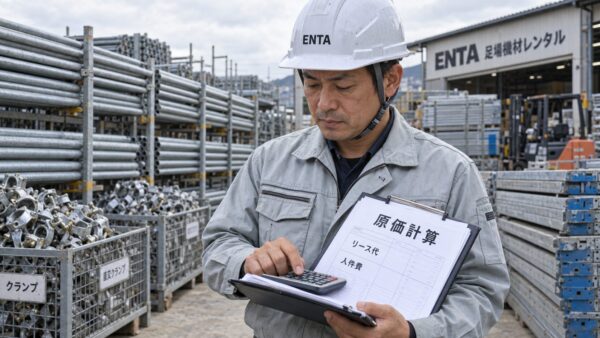
Scaffolding contractors are indispensable to our slope stabilization company.
Without scaffolding, the anchor won’t move even 1 mm.
That’s exactly why it’s so frustrating to see skilled craftsmen strike out on their own only to disappear within two or three years.
I don't think becoming independent is a bad thing in and of itself.
However, a company can't run on skill alone.
Construction business license, employee salaries, social insurance, lease payments, and my own costs.
If you start your own business without understanding this, no matter how hard you work, you’ll end up in debt.
If there are any young craftsmen out there who are thinking about going into business for themselves, please start by calculating the cost of one job site on your own.
It’s not too late to wait until you can determine a unit price that yields a profit.
If you want, I'll teach you everything!
How to Calculate Money.
At what price would I make a profit if I took on the job?
At what price per unit would the business start operating at a loss?
And the most important thing is not to get too cocky just because you did something well!
There was another incident involving a scaffolding company just the other day.
This is the result of never outgrowing his mischievous streak, failing to grow up, and acting out his frustration.
Is this the result of not learning proper ethics in school?
This is truly a regrettable incident.
To avoid this kind of situation, I think it’s best to get a solid education before striking out on your own!
I think the future for scaffolding contractors in the construction industry is pretty bright, but I don’t want them to do anything that would ruin their own business.
See you later.