Hello, everyone.
This is Enta.
This time, I'll be talking about this season.
What's happening at the "top" and "bottom" of the construction industry?
I came across an article like this the other day.
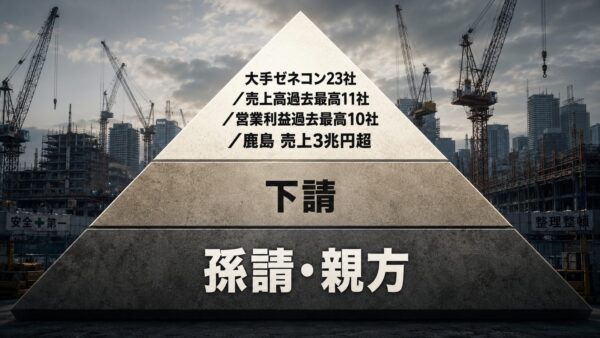
In the fiscal year ending March 2026 financial results for 23 major and mid-sized general contractors, 11 companies posted record-high revenue and 10 posted record-high operating income. Kajima became the first general contractor to surpass 3 trillion yen in revenue.
(Construction News, May 15, 2026 /Source)
On the other hand, here's this.
In April 2026, there were 185 bankruptcies in the construction industry, a 21.7% increase from the same month a year earlier, marking the third consecutive month of year-over-year growth. Small and medium-sized enterprises accounted for 100% of all bankruptcies for the 14th consecutive month.
(Tokyo Shoko Research, May 13, 2026 /Source)
The number of bankruptcies in fiscal year 2025 stood at 10,425, marking the second consecutive fiscal year that the figure exceeded 10,000. The number of bankruptcies caused by “rising prices” and “labor shortages” reached record highs, with the construction industry accounting for the largest number of bankruptcies due to rising prices.
(Teikoku Databank /Source)
Even though they’re both talking about the same industry, one says, “All-time high!” while the other says, “Record number of bankruptcies!”
Doesn't that seem a little off?
Let’s take a closer look at this distorted structure and consider how we—small and medium-sized contractor firms—can survive.
The reality: record-high bankruptcies among large companies and a record number of bankruptcies among small and medium-sized enterprises
First, let's list the numbers.
Financial Results for 23 General Contractors for the Fiscal Year Ended March 2026 (Construction News, May 15, 2026 /Source)。
- Record-High Sales: 11 Companies
- Record-High Operating Profit: 10 Companies
- Kajima's Revenue Exceeds 3 Trillion Yen (a First Among General Contractors)
- Gross profit margin for civil engineering operations (stand-alone): Kajima 24.6%, Taisei Corporation 23.0%
It is reported that the number of companies whose gross profit margin in the construction sector has recovered to around or above the target of 10% for the fiscal year ending March 2026 has risen to 16 out of 25.
To be honest, it's making so much money that it's almost enviable.
In contrast, small and medium-sized enterprises, according to Tokyo Shoko Research’s April 2026 survey (Source) These are the numbers.
- Construction Industry Bankruptcies: 185 cases (up 21.7% from the same month last year; the third consecutive month of increase)
- Percentage of Small and Medium-Sized Enterprise Bankruptcies: 100% for 14 Consecutive Months
- Small-scale bankruptcies with liabilities under 100 million yen: 76.7%
- Fewer than 10 employees: 90.4% (remaining in the 90% range for four consecutive months)
Furthermore, for the full fiscal year 2025, there were 2,041 bankruptcies in the construction industry (according to Teikoku Databank). This marks the first time in 12 years—since 2013—that the number has exceeded 2,000 (Diamond Online, February 5, 2026)。
These numbers aren't exactly something to laugh about, are they?
In the same industry, one company is raising a toast to “the best financial results ever!” while another is closing its doors, saying, “We can’t keep this up anymore...”
This is seriously out of control, isn't it?
Why Has It Become So Distorted? Uncovering the True Nature of the Structure Through the Numbers
You might say, “It’s only natural that the big companies make a profit,” but there’s a clear reason behind the gap widening to this extent.
① Unit prices are rising. But the rate of increase is different.
Labor unit rates for public works design, announced by the Ministry of Land, Infrastructure, Transport and Tourism, to take effect in March 2026.
The weighted average for all occupations nationwide was 25,834 yen, surpassing the 25,000-yen mark for the first time (Ministry of Land, Infrastructure, Transport and Tourism, announced on February 17, 2026). This represents a 4.5% increase from the previous year and marks the 14th consecutive year of increases.
I’ve been harping on this point every year, so I’m sure you all know what I mean, lol.
And the fact that the rise in unit prices hasn't kept pace with inflation...
So, our “slope stabilization work.”
This is actually priced as a separate job category. In our home prefecture of Aichi, the rate effective in March of Reiwa 8 is 34,600 yen!
The job description for slope construction work states: “Requires a considerable level of skill and high physical fitness, and involves operating mortar/concrete sprayers or seed sprayers, shaping slopes using pick hammers and breakers at high altitudes and on steep slopes, installing wire mesh and rebar, and finishing slopes by spraying mortar concrete.”
Basically, it's exactly what we do.
For comparison, here are the average daily wages for job categories in Aichi Prefecture that often work together on-site: specialized workers, 29,800 yen; scaffolders, 32,400 yen; and general laborers, 25,200 yen.
At 34,600 yen, the cost of slope stabilization work is on the high side even within this range.
This is proof that the job—which requires putting one’s life on the line at high altitudes and on steep slopes, as well as specific skills and physical fitness—is properly valued.
However, you can't just look at the numbers and say, "It's going up," and leave it at that.
Please note that these are, strictly speaking, unit prices used for government cost estimates.
The actual expenses required for an employer to hire a single worker, plus statutory welfare costs, labor management costs, safety management costs, and other expenses, total 38,234 yen (148%). This is the minimum amount required.
In other words, the design labor rate is a figure that essentially says, “This doesn’t include overhead costs—those are billed separately.”
Things get complicated because there are general contractors who, either unaware of this or choosing to ignore it, simply say, “We’ll go with the design-based labor rate.”
That is why the Ministry of Land, Infrastructure, Transport and Tourism has now begun implementing “standard labor costs” under the amended Construction Industry Act.
Like the reporting system for Construction Group Main and stuff.
② Those Who Can Pass On Price Increases and Those Who Cannot
In an article in the *Construction News*, an executive from a general contractor industry association stated the following:
"While small and medium-sized construction companies in regional areas are being severely affected, our loyal customers—the major general contractors nationwide—have not been impacted to the extent that their projects have come to a halt."
"Unlike during the previous period of soaring prices, this issue is being widely covered in the news, creating an environment where it is easier to gain the understanding of our clients."
(Construction News, May 15, 2026 /Source)
Is this really..."Are you being honest?!"That's what I thought, lol
Basically, “Since we’re a major company, we can negotiate directly with the client, so our price increases will be approved.”
"But he's basically admitting that the impact on small and medium-sized businesses in rural areas is severe, isn't he?" LOL
This might be a bit of a cynical view, but it feels a little—or maybe quite—like it’s none of my business, doesn’t it? lol
Teikoku Databank also notes regarding the background behind the more than 2,000 bankruptcies in the construction industry: “Amid prolonged cost increases due to high prices and labor shortages, a shakeout is underway, primarily affecting businesses with weak financial health” (Shinken Housing, April 8, 2026)。
The situation is such that we are unable to fully pass on the increases in material and subcontracting costs to the construction price.
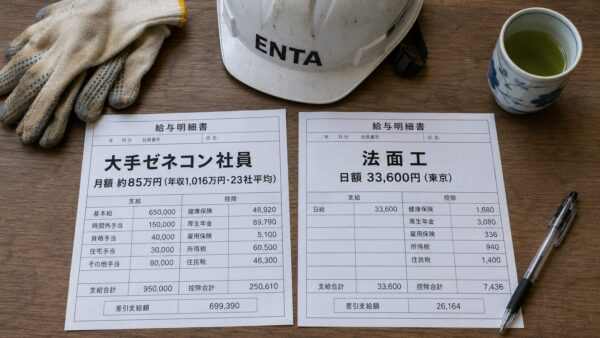
Salaries at Major Companies vs. Craftsmen’s Take-Home Pay
There's one more specific figure.
Average annual income based on securities reports from 23 major general contractors (archi-book.com)。
- Kajima Corporation: 11.847 million yen
- Obayashi Corporation: 11.404 million yen
- Taisei Corporation: 10.58 million yen
- Haseko Corporation: 10,579,000 yen
- Average for 23 companies: 10,163,000 yen
On the other hand, let’s calculate the annual income for “slope work” based on the labor unit rates for public works design.
The daily rate for slope work in the Tokyo area, effective in March Reiwa 8, is 33,600 yen.
Assuming 220 operating days per year, 33,600 yen × 220 days = approximately 7.39 million yen.
However, these figures represent the “design labor unit rates.” As mentioned earlier, they do not include necessary expenses such as statutory welfare costs, labor management costs, and safety management costs.
The actual expenses required for an employer to hire a single worker are approximately 148 percent of the standard labor rate.
Conversely, the take-home pay for workers on the slope construction site is determined by what remains after necessary expenses are deducted.
These are the figures for the craftsmen who are actually putting their bodies on the line working on-site.
Of course, employees at major companies handle management, sales, and design functions, and construction management involves both heavy responsibility and a demanding workload.
Based on a simple comparison, we cannot say that “the major companies are at fault.”
However, it’s important to keep in mind that there is a possibility the income gap between “those who actually make things on the production floor” and “those who manage them” has widened to this extent.
Back in the day, craftsmen actually made better money, lol.
As you probably know from the pay stub I posted earlier, the craftsmen were making 1.5 times that amount.
I think the boss was about three times as big (looking back now, lol).
I wonder if the situation has completely reversed by now.
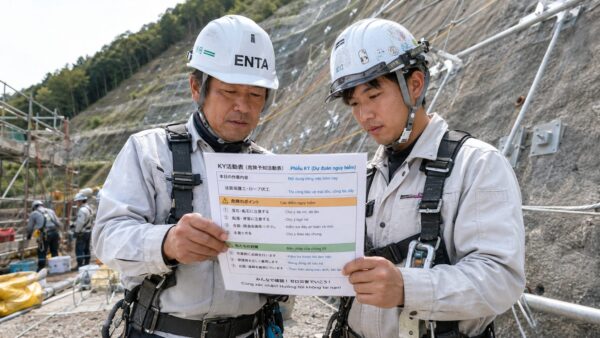
So, what are the three ways for small and medium-sized business owners to survive?
Complaining won't earn me a single yen, so I'll list some specific measures I think we should take.
① Making the Most of the “Standard Labor Costs” Under the Revised Construction Industry Act
The revised Construction Industry Act, which took full effect in December 2025, established guidelines for the use of “standard labor costs” to prevent bids with significantly low labor costs in private-sector construction projects.
For small and medium-sized businesses, this could serve as a useful tool for the time being.
Specifically, the Ministry of Land, Infrastructure, Transport and Tourism recommends that, when preparing estimates, the labor rates for design work and necessary expenses (statutory welfare costs, labor management costs, safety management costs, etc.) be presented side by side.
It's recommended, but this is such a hassle!
I just want you to understand that the more detailed you get, the more time-consuming it becomes, lol...
In short, it means issuing a quote that clearly states not just “labor cost,” but “labor cost plus necessary expenses.”
Just this alone might make a difference in how well we can resist dumping claims, but it's such a hassle lol
② Making Full Use of the “Sliding Scale Clause” in Public Works Projects
Even if material and labor costs rise after we’ve secured a project, we’ll negotiate as much as possible.
Public works projects include provisions for adjusting unit prices in line with inflation (sliding scale clauses).
The Cabinet decision in January 2026 also reaffirmed the policy of strengthening the pass-through of price increases in public procurement.
Having price increases after signing a contract reflected in the contract terms is not a favor—it is a right.
I wonder if there aren’t quite a few companies that give up just because “it’s hard to say”?
This is a place where you can confidently ask for what you're owed.
But that’s only if the prefecture, city, and municipalities handle it properly and the general contractor goes along with it, lol (The hurdles are incredibly high!)
③ Be prepared to distance yourself from general contractors who absolutely refuse to pass on price increases
"Can you really change customers that easily?"—You're absolutely right.
I agree.
However, both Tokyo Shoko Research and Teikoku Databank cite “difficulty in passing on price increases” as the main cause of bankruptcy.
In other words, if you only work with general contractors who refuse to pay even a fraction of the increased costs, your stamina will gradually be sapped, just as the data shows.
A comment from an executive of a general contractor industry association, as reported in the *Construction News*, stated, “Major companies can negotiate directly with clients.”
That means there’s a chance the price increase approved by the client and passed on to the major companies could trickle down to the lower tiers (at least in theory, lol).
I'm not saying you should cut off all your customers.
However, simply adding the question, “Does this company seem likely to allow us to pass on price increases?” as a factor in your decision-making when you receive a new inquiry can make a difference.
Once your stamina runs out, you won't even be able to make a choice.
From now on, we contractors will be the ones choosing our general contractors.
Profits for major general contractors and prime contractors have been skyrocketing in recent years.
This is actually a very good thing.
Isn't it our turn next?
It's about time they dripped a little surplus our way, lol.
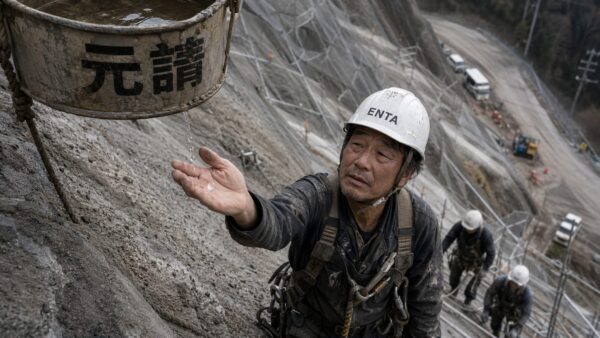
If we leave this distorted structure as it is, the site will disappear.
The major companies are making a profit. That in itself isn't a bad thing.
But we're the ones actually working up a sweat, clinging to the slope, drilling holes, applying the spray, and driving in the anchors.
As these key players continue to go out of business one after another, the ones who will ultimately suffer are the clients who commission the designs, the major general contractors who are awarded the construction contracts, and, ultimately, the public who use the roads.
Bankruptcies in the construction industry totaled 2,041 (FY 2025), the highest number in the past 10 years.
Bankruptcies due to labor shortages have reached a record high.
The construction industry has the highest number of bankruptcies caused by rising prices.
All of these are facts supported by the same data.
If anyone is mistaking news that “major companies posted strong earnings” for “the entire industry is doing well,” that’s not the case.
Only the top of the pyramid is doing well; the bottom is in total disarray.
We small and medium-sized contractors and foremen can’t just sit around complaining—we have no choice but to use our tools—one by one—such as the standard labor costs under the revised Construction Industry Act, the sliding scale clause for public works projects, and carefully evaluating our general contractors.
Gather information, incorporate it into the estimate, and turn down jobs where we can't pass on the cost.
I believe that this alone can make a difference in the probability of survival.
When you read financial results reports from major companies, I hope you’ll use them not just to think, “That’s great,” but to steel yourself and say, “We’re going to survive, too.”
Over the past decade, contractors and general contractors have been chosen by one another.
You'll definitely see this difference.
Furthermore, it is highly likely that major companies that lack popularity will be unable to continue operating.
See you later.