Hello, everyone.
This is Enta.
Lately, I've had the chance to look back at some of my old posts.
"Drilling Machines and Drilling Methods for Slope Anchoring," which I wrote in 2016, is already a post from nine and a half years ago.
When I reread it, there were actually quite a few parts where I caught myself thinking, “Hmm, that’s how it was back then, but things are different now…” lol
If you don't properly update old blog posts, they'll keep showing up in search results with the information from back then.
It's not a lie, but it's out of step with the times.
But that's beside the point.
So, in this post, I’ll rewrite my 2016 guide to core drills, drawing on my on-site experience as of May 2026.
What has changed and what hasn't over the past nine and a half years?
I hope this will be helpful to those who are about to begin designing or estimating slope anchor work or rebar insertion work, as well as to site supervisors who are unsure about which machinery to select.
I should point out up front that I haven’t been able to cross-reference all the original catalogs and specifications to verify the manufacturer’s latest model numbers, so please consider this information as a general trend.
For the first time in nine and a half years, I’m going to try rewriting my post about drilling machines.
In the original 2016 article, the drilling machine was
"Rotary Percussion: Skid-Type / Crawler-Type"
"Attach Drill"
"Suspended Drilling Rig"
"Rotary Drilling Machine"
"Spring Drill"
"Inverter Chisel"
"Slope Drill"
"Jackhammer"
"Scaffold-Free Anchoring Method"
I had divided them into 10 categories and written about them.
To put it simply,These 10 categories themselves have not changed as of 2026.
Rather than a new genre suddenly appearing, my impression is that trends like “electrification,” “noise reduction,” “scaffold-free construction,” and “the widespread adoption of self-drilling” have been gradually advancing within each existing genre.
That said, there have definitely been some changes.
The biggest factor is the prevalence of the scaffold-free anchor method.
In 2016, it was treated as “one of several specialized construction methods,” but as of 2026, it is common for designs to list this as the first option for projects such as anchor replacement on steep slopes, at high elevations, and in urban areas.
It seems that ground anchor systems are listed as a standard option in the technical information published by the Japan Association for Slope Disaster Prevention Technology (a general incorporated association) as well (*I have not personally cross-referenced and verified this by checking the relevant pages in the association’s publications. This is merely a general trend observed in industry materials).
Rotary Percussion | The Star of the Show Remains the Same
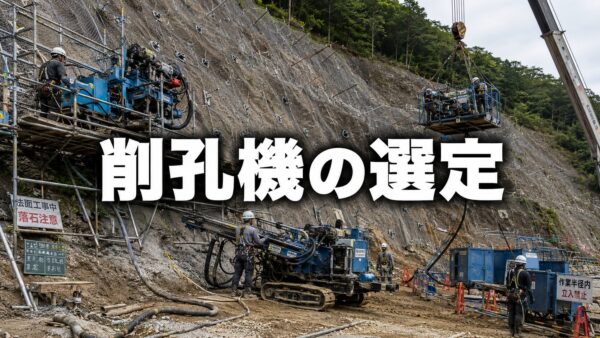
Rotary percussion remains the mainstay of ground anchor construction.
The skid-type (stationary) is used for construction on scaffolding, while the crawler-type (self-propelled) is used for construction on earthen embankments or for reverse-winding operations.
The basic structure here hasn't changed since 2016.
On average, the most common weight is around 1.5 metric tons; even the largest ones are in the 2.5-metric-ton class, and those weighing 3 metric tons or more are rarely used.
However, equipment is becoming smaller, and relatively short anchors are handled using smaller machines.
On the other hand, crawler-type excavators are mainly 13 metric tons or more, and it seems to me that large machines in particular have been accounting for the majority of construction work recently.
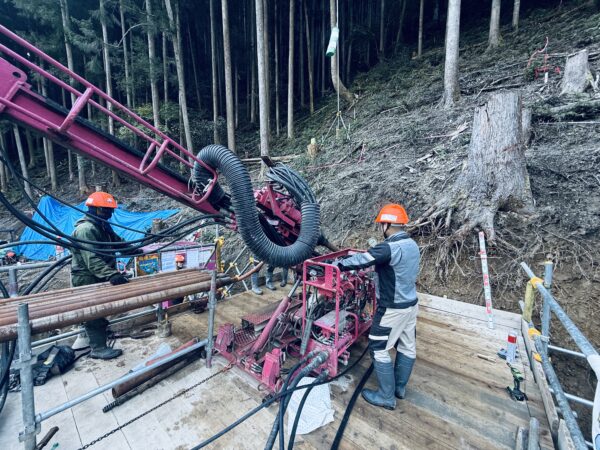
However, what has become apparent in recent years is that the proportion of models advertised as low-noise and low-emission has increased.
When it comes to temporary anchors for urban civil engineering projects or replacing anchors near residential areas, the ability to operate at night or in the early morning has a direct impact on costs, so there is a growing trend to specify “low-noise” equipment in the design phase.
Also, the fact that the standard borehole diameter is around 90 mm hasn’t really changed. In the past, there were anchors with diameters of 165 mm or more and lengths exceeding 20 meters, but you don’t see many 165 mm anchors these days. (You might find them in port-related projects.)
That’s when the large skids come into play.
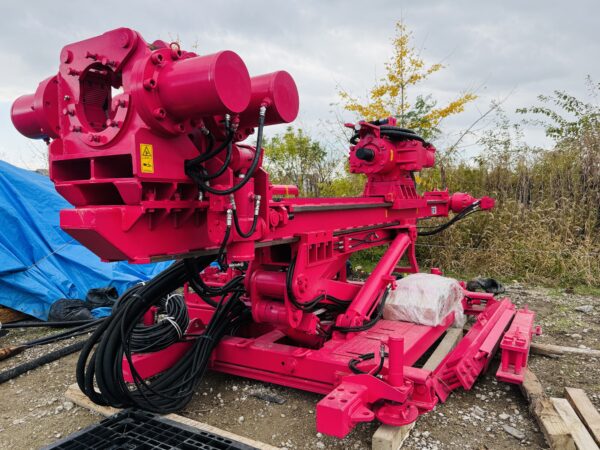
This is a 5.0-metric-ton-class drilling rig owned by our company, which corresponds to the 88-kW class in terms of rated power.
I wrote that “90 mm is the standard,” but I’d like to clarify that this is based on my experience with the diameters actually used on-site; it does not mean that 90 mm is the standard diameter listed in the catalogs for all anchor installation methods. Naturally, the diameter increases depending on the number of multi-axial strands and the embedment length.
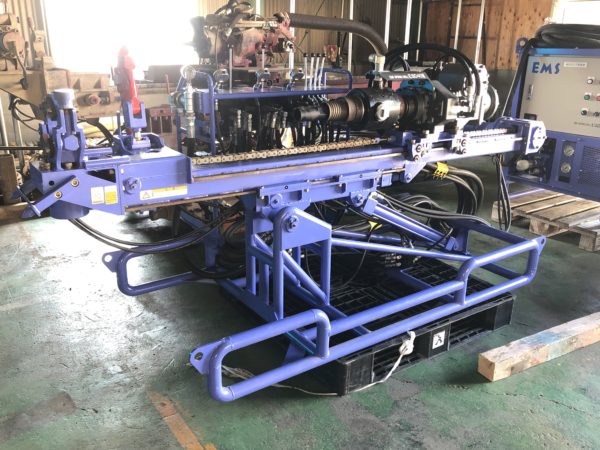
When it comes to ground anchor work or rebar insertion projects with a borehole diameter of 90 mm and a depth of 10 meters or less, it seems that M's Spring Drill 40III has already established a solid, unshakable reputation.
No matter where you go, you can’t help but see this machine.
We own three of them as well, and we use them far more often than the others.
I think it’s truly impressive in terms of being both lightweight and powerful.
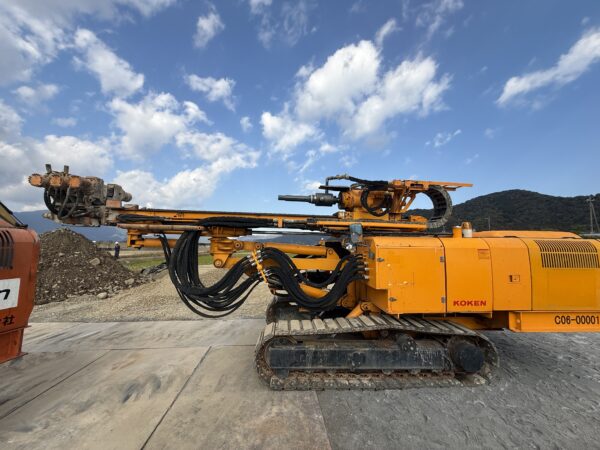
Conversely, when it comes to crawler core drills, the trend is toward larger models, led by Koken Kogyo’s RPD160C.
It's just huge!
And you absolutely must apply for a special vehicle permit to transport it.
But the power is incredible!
Since 90mm casing snaps easily, the key to installation is to be gentle, lol.
Attachable Drills and Suspended Drilling Rigs | Choosing Between BH-Mounted and Suspended Models
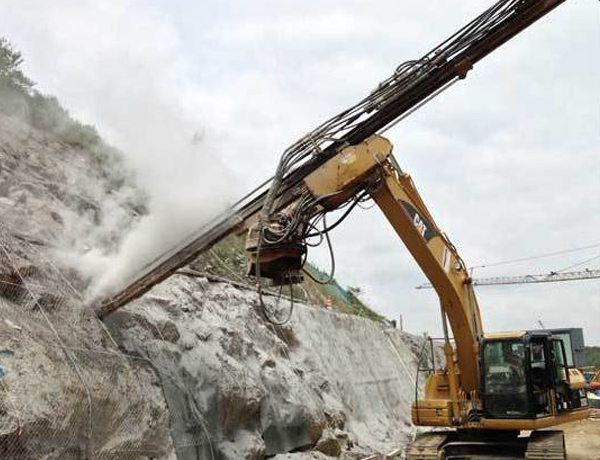
An attachment drill is a suspended drilling rig mounted on a backhoe (BH).
No external counterforce is required because the BH holds it in place. It can be set to 0.45BH–0.7BH, offers good productivity, and is easy to set up on the machine.
To be honest, as someone who works in the field, I think this is one of the most cost-effective construction methods.
When it comes to the "Drifter" segment, Yamamoto Rock Machine still seems to be the clear leader.
Our company uses the YD135, too. Even after 9 and a half years, I think there are still quite a few places that continue to use the YD135 series on-site lol.
It's easy to get replacement parts, lol.
After all, it just won't break!!
Basically, it's a huge rock drill, so the mechanism is simple—it's a really great machine.
It's just noisy, lol
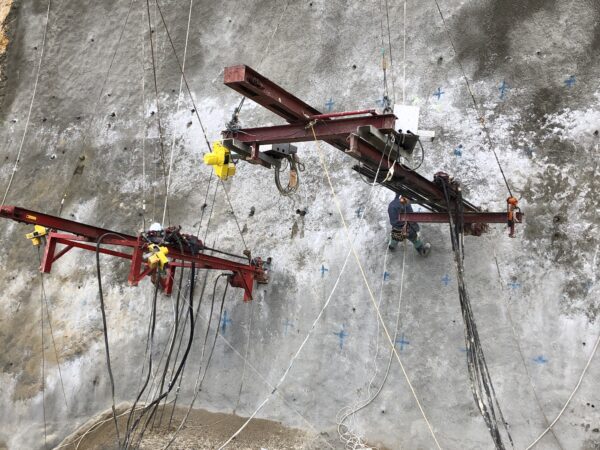
On the other hand, suspended drilling rigs are hoisted by a crane to drill holes.
This is the machine that comes into play when there’s no scaffolding, the pouring elevation is high, but a crane can be set up.
Let's talk about one important term here.
It’s often referred to collectively as a “sky drill,” but strictly speaking, that’s incorrect.
"Sky Drill" is actually the name of a construction method in which this drilling machine is mounted on the end of a crane for use, rather than a general term for the machine itself.
Whenever I explain “suspended drilling” to the general contractor’s supervisor, they often reply right away, “Oh, you mean a SkyDrill,” and every time I think to myself, “No, that’s not it…” lol
Since suspended work can be extremely dangerous when strong winds cause the equipment to sway, it’s important not to hesitate to call off operations in such situations.
They are small, so they weigh 700 kg or more, and even the largest ones weigh only about 1,100 kg.
The maximum drilling length is generally around 5 to 6 meters, and the standard length for drilling rods is 5.5 meters.
By the way, there are two types of rod diameters: the R32 rod and the 1600 rod. The R32 is a round rod, and the 1600 is a hexagonal rod.
Since the thicknesses are different, the 1600 is stronger, but it has certain characteristics, such as being heavier.
A Leading Example of Lightweight Drilling Machines | Rotary Drilling and Inverter Chisel
This is a genre where the lineup really hasn't changed at all since 2016.
Rotary drilling machines (Fuso Kogyo series) and inverter chisels—three types in total.
For cost estimation purposes, they both fall under the category of “lightweight drilling machines.”
M's Spring Drill 40 is very lightweight, but it does not fit into this lightweight drilling machine.
That would make it a 55-kW-class drilling machine.
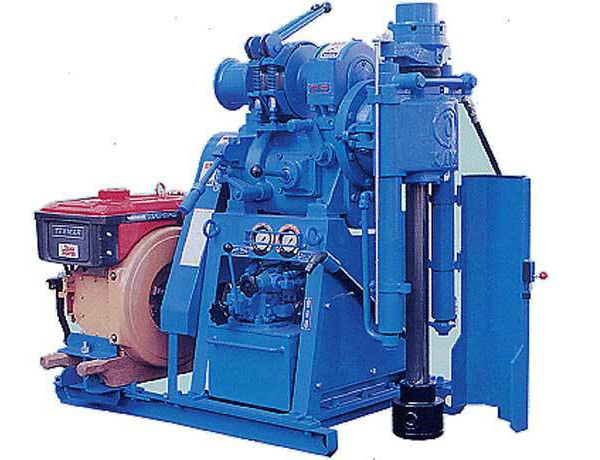
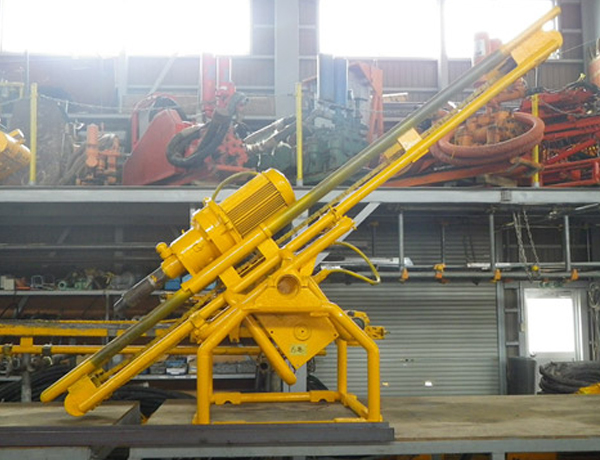
Rotary drilling machines drill holes using only rotational and thrust forces.
It's quiet because there are no impacts, and I rely on it constantly for chemical injection work.
The bit is a metal crown.
It is also used for large-diameter piles and hot spring drilling, in which case a down-the-hole hammer is used in conjunction with it.
The inverter chisel is electrically powered and, considering its size, delivers strong rotational torque and thrust.
Since the electrical control box is vulnerable to rain and dust, you really shouldn't skimp on protecting it here lol.
I once panicked when my car wouldn't start the day after it rained.
As of 2026, the keyword “electrification” has come into play here.
Even in other categories where air-powered tools are the norm—as opposed to machines like inverter chisels that are electrically powered from the start—there are electric-powered models designed to be used with an external power source, or
It appears that various automakers are developing hybrid models that combine an internal combustion engine with an electric motor.
I think Mr. M brought an electric crawler from Europe...
I wonder if electrification will gradually gain momentum from now on...
Electrification on construction sites isn't a bad idea, but since it's basically a constant battle against dust and water, it's hard to say just how widespread it will become.
Slope Drills and Jackhammers | The Role of Small Machinery Remains the Same
The slope drill, manufactured by Kyowa Bosai Construction, is a compact machine equipped with a YD100 rock drill.
It can be installed on small lots, and since it’s air-powered, piping is easy; it’s lightweight and offers outstanding workability.
That said, the impact is so strong that the rod coupler actually breaks quite often lol
We really have to operate under the assumption that we’ll be carrying extra spare parts. I don’t think that’s changed even after nine and a half years.
I haven't rented anything recently, so there are a few things I'm not sure about—if anyone knows, please let me know.
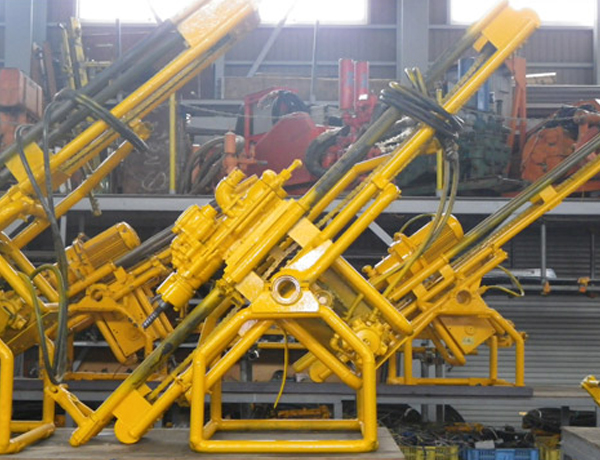
A jackhammer (a 15-kg rock drill) is used for what is known as manual drilling.
Self-drilling rods are connected one after another; in non-self-supporting ground, they are inserted directly in their self-drilling state, while in self-supporting ground, a hole is drilled using standard rods before insertion.
As I wrote in the original article back then, “It’s going to be a really tough job,” “Your hands will shake,” and “Your ears will ring,” but,
This hasn't changed one bit as of 2026, lol.
However, using a soundproof and vibration-dampening model makes a big difference!
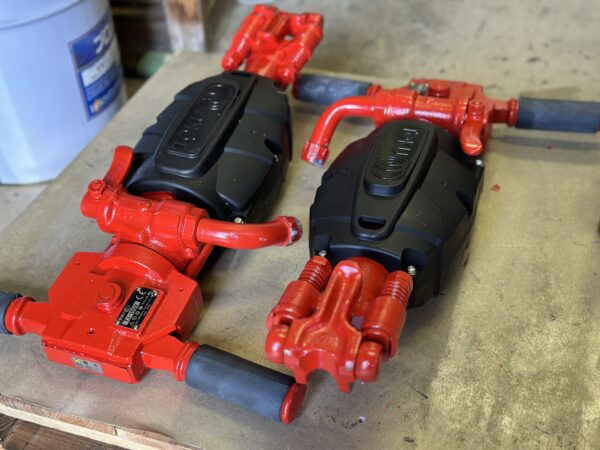
I think this has significantly reduced the workload for our employees.
With temporary scaffolding, the maximum drilling depth is 2.5 meters; anything deeper is difficult.
I'm pretty sure it was classified as unfeasible from a cost estimation standpoint as well.
I feel like the proportion of jackhammer drilling has definitely been increasing recently.
The reason is simple: there are more and more small-scale projects in the private sector. (Compared to our company's figures)
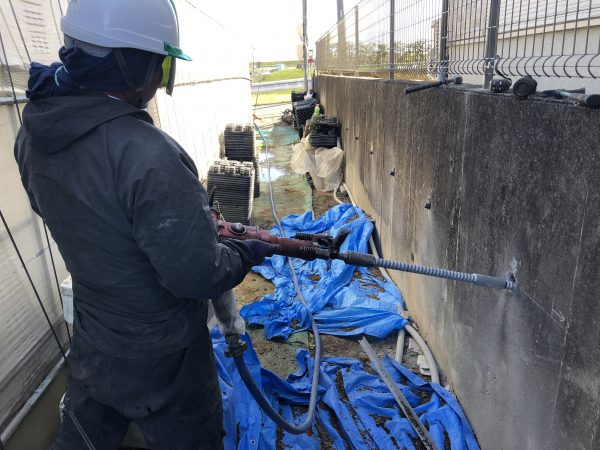
Scaffold-Free Construction Method | By 2026, It Will No Longer Be Classified as a “Special Construction Method”
I think this is the machine (construction method) that has undergone the most changes in its role over the past nine and a half years.
The Scaffold-Free SD Method is a drilling technique that uses wires to absorb reaction forces; it is particularly effective on steep slopes, at high elevations, in isolated locations, and in confined spaces where scaffolding cannot be erected.
Drilling is generally performed using a down-the-hole hammer.
I’ve heard that double-tube systems are now possible, but... (Opinions on this vary from person to person.)
The fact that drilling can be performed using wire reaction force is the biggest differentiating factor compared to other methods.
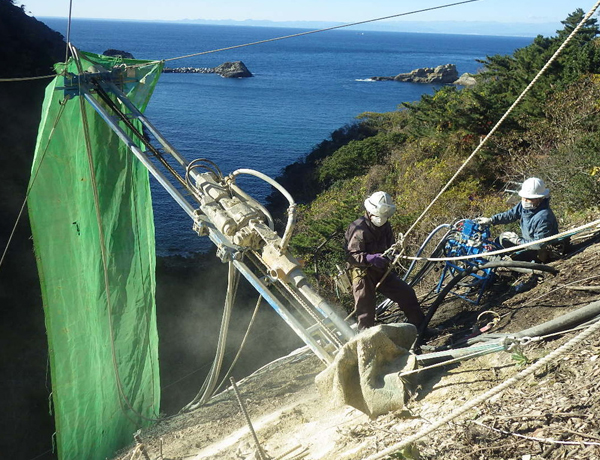
Back in 2016, it was treated as “one of several specialized construction methods,” and it was specified in the design documents for only a limited number of construction sites.
However, as of 2026, it has become common practice for designers to first consider scaffold-free anchor installation methods when installing anchors in areas where scaffolding cannot be erected.
It is registered with NETIS and has received a technical evaluation.
It has been incorporated into the technical information provided by the General Incorporated Association for Slope Disaster Prevention Technology, as well as into the sets of standard and recommended construction methods adopted by each prefecture.
(*Note: I have not personally cross-referenced this information with the relevant pages in the association’s original source or the specifications of each local government. This is provided solely as a general trend based on industry data.)
It seems to be very useful on job sites where scaffolding can't be set up.
Also, since there are companies like ours that build their own products, I think there will be companies in the future capable of handling a wide range of construction projects.
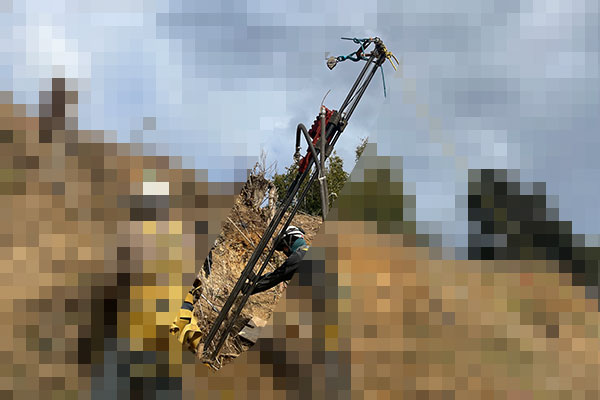
All things considered, if you ask me whether the world of drilling machines has been drastically turned upside down after nine and a half years, the answer is no, lol.
When it comes to drilling, rotary percussion methods are still the mainstay; in fact, the only change is that machines have become more compact, leading to smaller-scale construction projects. The terms “jackhammer” and “sky drill” are simply names for construction methods—and this has not changed at all in 2026.
However, it feels as though layers such as “electrification,” “noise reduction,” “scaffold-free construction,” “wireless technology,” and “addressing labor shortages” have been added on top of that, and
Machine selection now operates based on more detailed conditional branches.
If a specific machine (or equivalent model) is specified during the design phase, you must always adhere to that specification—this is a fundamental principle that remains unchanged whether it’s 2016 or 2026, but,
In recent years, there has been an increase in cases where “machine specifications” delve into specific performance characteristics or categories, such as “low-noise rotary percussion” or “scaffold-free.”
For small and medium-sized slope construction companies like ours, there has definitely been an increase in situations where whether we can accept a job depends on whether we have—or can procure—the machinery specified in the design.
For the foreseeable future, the central focus of management will be deciding whether to prioritize investment in machinery or employee development.
It’s always been true that you can make more money by running reliable used machines than by buying flashy new ones (though I do want a new machine, though~ lol).
I believe that's how we survive.
See you later.