

Hello, everyone.
This is Enta.
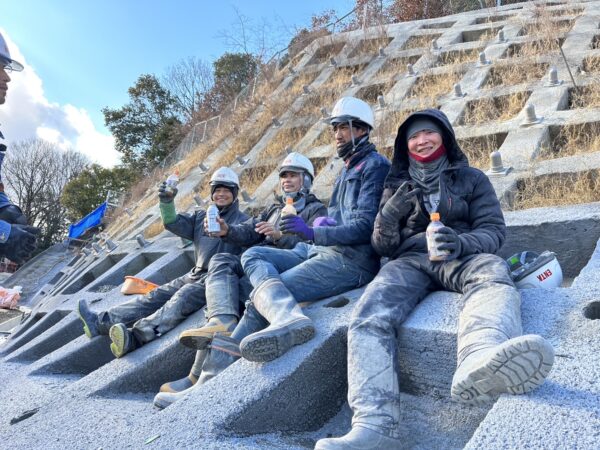
When you're working on a slope construction site, I think there are times when you notice that "even under the same conditions, the reactions of young workers and veterans are clearly different."
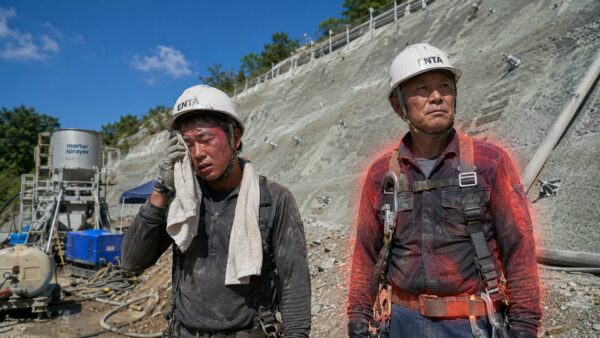
During mortar spraying in the height of summer, the younger workers would often get exhausted first, while in winter, during rope access work, the older workers’ fingers would get extremely cold.
This isn't something that can be dismissed as simply a "difference in determination"; it's actuallyPhysiological BasisIt actually happened, lol
(We were talking about how middle-aged guys aren't very adaptable, so I decided to look into it in more detail lol)
This time, I’ve gathered a few recent research papers on human adaptability as we age, so I’d like to write about them in a way that can be applied to on-site management.
I think this will be helpful for those who manage foreign staff, as well as for site supervisors in charge of training young employees.
1. How Does the Ability to Adapt to "Heat" Change with Age?
A review of the literature shows that the following changes occur in older adults (generally those aged 50 and older).
Decreased sweating,Diminished cutaneous vasodilation, blunted autonomic nervous system regulation, and reduced ability to retain water, andTemperature perception itself becomes dulled...those are the five.
What's particularly scary isDiminished Temperature SensitivityThat's what I've heard.
Even if you feel like “I’m still fine,” it’s common for your core body temperature to already be approaching a dangerous level.
You know how grandpas and grandmas at restaurants can hold things that look insanely hot without batting an eye?! lol
The numbers make this even more striking. According to overseas research, when exposed to the same heat stress, workers aged 50 and older, compared to younger workers (aged 19–30),1.3 to 1.8 times the body heatThe results show that it leads to the accumulation of [...].
Apparently, this trend held true whether the heat was dry or humid, and whether the person was exercising or at rest.
It’s important to keep in mind that, even if a veteran is stronger in terms of experience, they’re clearly at a physical disadvantage.
The bottom line is that by the time veterans realize it, it's already too late!
2. The ability to adapt to cold also declines with age
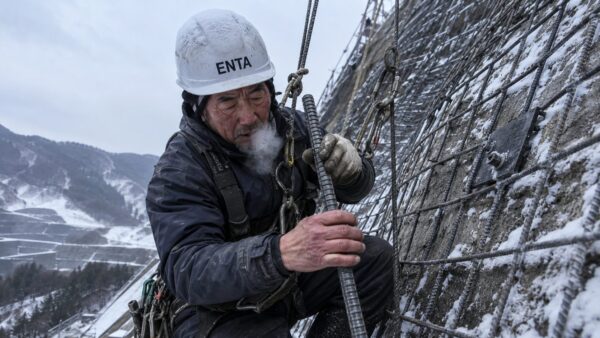
I'll also talk about winter.OverseasResearch PaperAccording to (J Appl Physiol), when older adults are exposed to cold stress, their peripheral vasoconstriction weakens (making it harder to maintain blood flow to the hands and feet),
Apparently, one of its characteristics is a decrease in cold-induced metabolic heat production (a reduced ability to generate heat by shivering).
It said that older adults have lower skin temperatures in cold weather, and that this is particularly noticeable in the limbs lol
In the context of winter work on slopes, this means it can easily lead to a loss of sensation in the fingers and reduced grip strength while working with ropes.
So there really was a good reason why experienced workers often say, “It’s a hassle when my hands stop working in the winter.”
3. Adapting to a New Environment — A Discussion of Cognitive Flexibility
From here on, let's look at this from a slightly different angle,Adapting to New Environments and New Construction MethodsAbout...
It’s often said that “older people have a hard time learning new things,” isn’t it?
The latest research actually revealed a slightly more reassuring fact, lol.
It takes older adults time to adapt their cognitive state to new goals, but
If given enough time,The conclusion is that the ability to achieve the desired state remains intact.
In other words, “be unable to do"not '" but '"It takes time"That's all."
I believe this is a very important perspective to keep in mind when training new employees on-site or introducing new construction methods.
What’s even more interesting are the findings from another study.Older adults are good at using "clues from the scene."That's right.
What I mean is, young people move while thinking to themselves, “Next, I’ll do this, and I need to be careful here.”
On the other hand, veterans pay attention to the scenery, sounds, and placement of tools on set, such asUsing the information around us as if it were an ”external brain”That's right.
When it comes to a slope construction site, it’s the ability to instantly detect “abnormalities on site”—such as the sound of drilling being slightly different than usual, the tension of the rope being off, or the sprayed material not settling properly.
In other words, while young employees are working hard to analyze and make decisions based on logic, veterans are picking up on things directly from the field.
It is true that our “mental capacity” decreases with age.
But the veteran overcomes that disadvantage by,An intuition honed through experience...so it provides thorough coverage.
Even if it takes time to learn new construction methods, when it comes to detecting problems on familiar job sites, they’re definitely better than the younger workers.
I think this is what really makes veterans so strong.
4. “Heat acclimatization” works just as well for older adults
After reading this far, you might start to feel like, “Is there really nothing we can do as we get older?” But there was also some data that offered real hope.
OverseasIn the study,6–8 Days of Heat Acclimatization TrainingHowever, it has been reported that the program was effective even among groups of people aged 50 and older, regardless of whether they had prior training experience or not.
Specifically, changes occur such as an increase in sweat rate, an increase in plasma volume, a decrease in heart rate, a delay in the rise in core body temperature, and stabilization of skin temperature.
In short, it means your body gets used to the heat.
However,U.S. National Institute for Occupational Safety and HealthAccording to the guidelines, older workers, workers with pre-existing medical conditions, and workers handling heavy equipment should,
Instead of the usual 5 to 7 days,Extended to the 10th through the 14thIt is generally considered advisable to do so.
Since slope stabilization work involves clinging to slopes while wearing heavy equipment, I think it’s exactly the kind of job that falls under this extended acclimatization period.
Considering what I wrote last time about heat reflection, it’ll take the slope workers about two weeks to adjust, huh?
5. When applied to actual work on-site,
What happens when we apply the evidence gathered so far (such as international research papers) to on-site management of slope construction projects?
I've given it some thought in my own way.
The first thing to keep in mind is,Risks at Both EndsThat's it.
Work-related heatstroke incidents have high incidence rates among both young workers (ages 18–24) who lack heat acclimatization and older workers (ages 54 and older) whose ability to regulate body temperature has declined.
The pattern is that people in their early 20s and those in their 50s and older are at the two ends of the risk spectrum, while the experienced core group in their 30s and 40s is the safest.
I think that’s consistent with what we see on the ground, don’t you think?
And one thing to keep in mind when hiring new foreign employees is,
About half of heat-related workplace fatalities occur on the “first day of work,” and 70% or more occur “within the first week.”This is the data indicating that this is the case.
Based on the available evidence, it is a high-risk practice to suddenly have technical interns from Vietnam and Nepal work full-time spraying mortar in the height of summer.
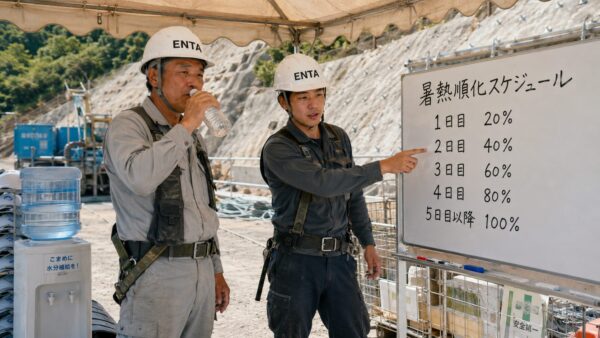
"Heat Acclimatization Training," which involves gradually increasing the workload by 20% at a timeI felt that this is something that should be strictly enforced, especially for new foreign employees.
The same applies when introducing new construction methods: don’t rush experienced workers when they’re learning new techniques.
It's not that they're less capable; it just takes them longer to adapt.
Research has shown that, given enough time, they can reach the same level as younger people.
On the other hand, veteran employees’ “ability to detect anomalies on the job” is an asset that younger employees simply can’t replicate, so we definitely want to make the most of it.
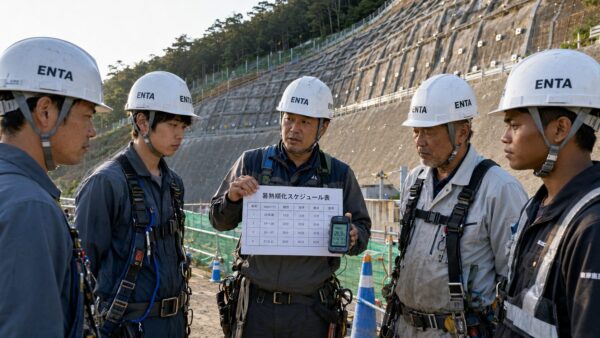
Before you dismiss it with comments like “They’re not trying hard enough” or “Kids these days…,” I think knowing these physiological facts might change the way you view things on the ground.
At slope construction sites where veteran, junior, and foreign staff work together, safety management that takes into account each group’s unique characteristics should ultimately lead to stable project progress and zero workplace accidents.
See you later.