Hello, everyone.
This is Enta.
You often see terms like “carry out” and “determination to carry out” in the news or safety documents, but aren’t they among those words that, to be honest, you can’t answer right away if someone asks you what they mean?
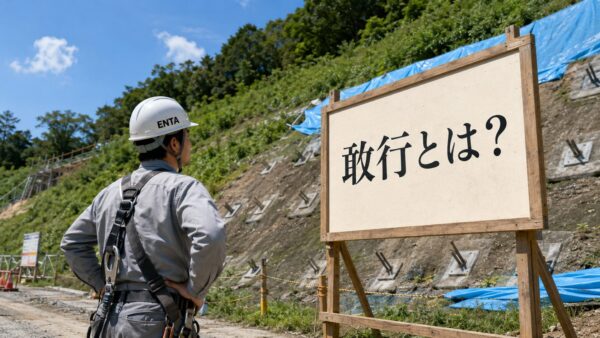
Especially at construction sites, “Willingness to Take Risks"It appears in the context of KY activities in this form."
I’ve seen that scene before where the director tells someone, “You’re too impulsive, so watch out,” and the guy freezes up, thinking, “Wait, is that a compliment? Or am I getting scolded?” lol
In this article, drawing on my experience as a civil engineer who has conducted KY activities on-site hundreds of times, I will carefully explain the following five points, based on dictionary definitions and official KY activity materials.
- The Meaning and Correct Pronunciation of “Kanko”
- How to Use "Kankō Suru" and Example Sentences
- Differences from Similar Terms (Carry Out, Enforce, Push Through, Execute)
- What Is “Willingness to Take Risks” on a Construction Site?
- Why the Accident Rate Is Determined by the Combination of Risk-Taking Behavior and Risk Sensitivity
Meaning and Pronunciation of “Kankō”
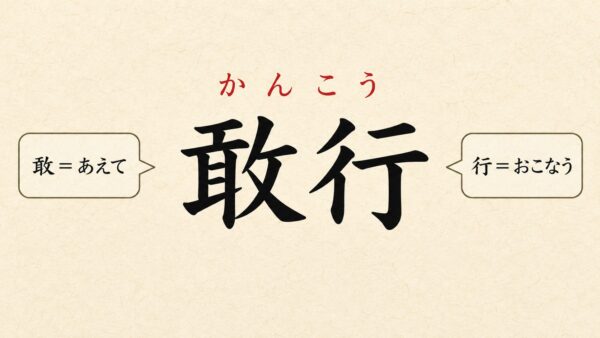
First, let's start with how to read it. "Kanko" is pronounced "TourismIt is read as "". Please note that it is not "Aekou" or "Kangyou."
Surprisingly, there are actually people who misread it, lol.
The meaning is Digital Daijisen (Shogakukan) It says the following.
To carry out a task despite adverse conditions. To take the plunge, knowing full well it’s a stretch.
"Digital Daijisen," Shogakukan (Kotobank: “Carry Out”)
The key point is “Adverse Conditions」「Knowing it's a stretch"That part." It's not just about doing something as usual, but knowing full well that there are difficulties, opposition, dangers, and obstacles—and still daring to push through them anyway.The resolve to "go out of one's way"...is the crux of the phrase.
It's easy to understand even when you break down the kanji.
- 敢: Deliberately, boldly
- 行: to carry out, to execute
In other words, “to do something deliberately” = “to carry out.” Both the pronunciation and the meaning are exactly the same as the kanji characters themselves.
How to Use "Kankō Suru" | Real-Life Examples from the Field
"Kankō suru" is used as a verb. Let's look at both its general usage and how it's used on construction sites.
- Spraying in bad weatherCarried out。
- Overriding opposing opinions, the ground anchor installation was carried out under tension,Carried out。
- Proceed with construction even though the mountain is shiftingCarried out。
- With a typhoon fast approaching, the construction site is pouring concreteCarried out。
- Nighttime Road ClosuresCarry OutAnd so, we completed the repaving.
Can you spot the common thread?
In situations where you normally wouldn't do it, would hesitate, or would be told to stop, “On purpose"It's a scenario where they say, 'Let's do it.'"
That's why you should never use it for everyday activities like "going to the convenience store to shop."
If I messed this up and wrote something like “I went ahead and transferred the salary” on the paperwork, my boss would say, “Why are you picking a fight?” lol
The weight of the words is different.
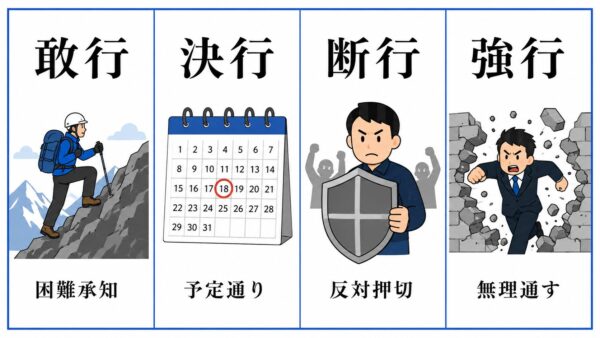
Differences Between Words Similar to "Kanko" | "Kekko," "Dan'ko," "Kyoko," and "Jikkou"
We'll organize synonyms that are easily confused, based on dictionary entries.
| Words | The Core of Meaning | Nuance |
|---|---|---|
| Carry Out | To take the plunge despite knowing the difficulties | It requires courage and determination |
| Go Ahead | Proceed as scheduled | No cancellation, neutral |
| Resolute Action | To go ahead despite opposition | The Strength to Cut Ties with Those Around You |
| Forced Through | To push through and do it anyway | A bit forceful, pushing things through |
| Execute | Do it | The most neutral and general |
goo Dictionary: Synonyms for "敢行"/Kotobank: “Carry Out”
For example, if you write “Rain or shine,” it simply means “We’ll go ahead as scheduled even if it rains.” “Rain orCarry OutWhen I write “,” it makes me even more determined—as if to say, “I’m going to push through the adverse conditions of the rain.”
However, “Forced ThroughUsing that phrase gives off a negative vibe, implying, “I did it by force even though I was told to stop.” Be careful—if you write “forced the issue on-site” in your report, it’ll cause trouble later, lol.
To use a slope construction site as an example, it would be like this.
- "Spraying in the midst of a rain forecast..."Carry Out"Did" → Acceptable as a technical decision (taking into account the possibility that the rain might stop)
- "Drilling despite the order to halt operations..."Forced Through"Did" → Totally out
A single word can change who’s held responsible. That’s why people on the front lines, in particular, should learn to distinguish between “carrying out” and “forcing through.”
"Taking Action" at Construction Sites | What Is Risk-Taking?
This is the part I most want to convey as the director.
In the construction industry and the field of occupational safety and health, “daring to act” is "Willingness to Take Risks" It appears frequently in this form.
In the context of the Hazard Prediction Training (KYT) program of the Central Association for the Prevention of Industrial Accidents (Chu-Sai-Bo), “risk-taking” is explained as follows:
A mindset that prioritizes saving time, effort, and costs associated with a task, leading to a neglect of safety checks or a tendency to think, “This much should be fine,” due to familiarity with the work or a lapse in vigilance.
Central Association for the Prevention of Industrial Accidents “Hazard Prediction Training (KYT)”
To put it simply, risk-taking is "A tendency to take risks even when you're aware of the danger" That is.
In terms of an actual slope construction site, it looks something like this.
- It's a hassle to put on a safety harness, so I climb up without one, thinking, "It's just a quick job."
- I loosened the chin strap on my helmet while working (because it was hot and it was getting in the way).
- Even though they're drilling upstairs, I'm in a hurry, so I'll take the hallway downstairs.
- They lifted the cargo while the scaffolding handrails were still removed, saying, “Just for a little bit.”
- Even though the ground had just been affected by an earthquake, they continued to tighten the anchors without conducting any inspections, citing schedule pressures.
This is something I’ve seen happen over and over again on job sites, isn’t it? Even if the person involved thinks it’s “just a little thing,” if this keeps up, an accident is almost certain to happen eventually.
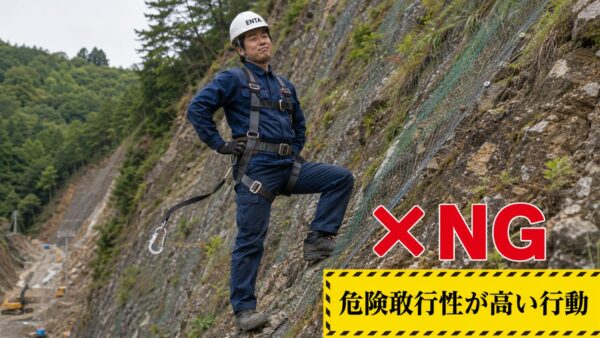
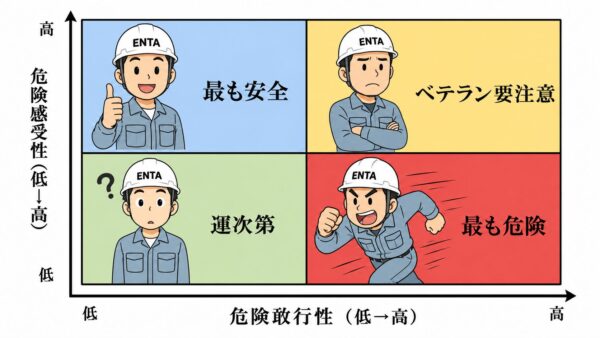
The accident rate is determined by a combination of risk-taking behavior and risk sensitivity.
What I want you to remember as a set is "Risk Sensitivity" That's the phrase.
The core of the Japan Disaster Prevention Association’s KY activities is precisely this “Enhancing Sensitivity"lies in the fact that..."
KYT aims to sharpen participants' sensitivity to recognizing hazards as such during meetings.
Here's a summary of the two terms.
- Risk Sensitivity: Detecting Danger Ability"The ability to sense when something is 'bad'"
- Willingness to Take Risks: To venture in despite knowing the danger Trends"The kind of person who just goes ahead thinking, 'Oh, it'll be fine.'"
When these two factors are combined, people's safe behavior 4 Types can be divided into...
| Sensitivity | Determination | Type | Risk of Accidents |
|---|---|---|---|
| High | Low | Awareness + Caution | Lowest (Ideal) |
| High | High | Taking the Plunge to Realize | High (common among veterans) |
| Low | Low | I don't notice it, but I don't get involved | It depends on luck |
| Low | High | To plow right in without realizing it | Highest |
The tricky part is “A veteran with both sensitivity and a spirit of initiative". Even though they know it's dangerous, they go anyway, thinking, 'I have experience, so I'll be fine.'"
In fact, their accident rate is sometimes higher than that of new employees.
He thinks he's a pro, but according to the data, he's just a total nutcase who keeps pulling off one dangerous move after another.
Like slope stabilization work A Workplace Where Safety Lines Make All the Difference So, “People who are highly sensitive but lack initiative" is overwhelmingly strong.
Caution is truly your greatest asset on the job.
The ability to use the term “daring to act” correctly reflects an engineer’s level of expertise.
The precision of one's choice of words is a direct reflection of an engineer's skill level.
People who can distinguish between “carry out,” “undertake,” and “push through” depending on the situation are those who understand how their decisions are perceived by the organization.
Conversely, people who simply use “Proceed” for everything may not fully understand the weight of their decisions and the responsibility that comes with them.
Whether it's KY activities or paperwork, "Carry OutWhen you use the phrase "," you are saying that you "I am prepared to do this even though I know it will be difficult"It's the same as declaring that."
So if you use it carelessly, when something goes wrong, they'll pull the rug out from under you and say, "You knew what you were getting into, right?" lol
Low risk-taking tendency and high risk sensitivity.
This is the golden rule for an accident-free workplace.
If you want to be an engineer who saves lives, start by understanding the weight of your words.
The next time you hear the word “go for it” in a real-world situation, be sure to pause and ask yourself, “Is this a choice made with full awareness, or is it just a case of not thinking things through?”
See you later.