Hello, everyone.
This is Enta.
Today, we’ll be installing the “Matt In"This is about a mat designed to prevent liquids from being sucked up."
Once the natural rock is cut by a machine, it can never return to its original state.
Even if the surface is covered with sprayed mortar, the interior will gradually weather away.
I think there are quite a few sites where sediment resulting from that weathering is trickling out of the drainage pipes.
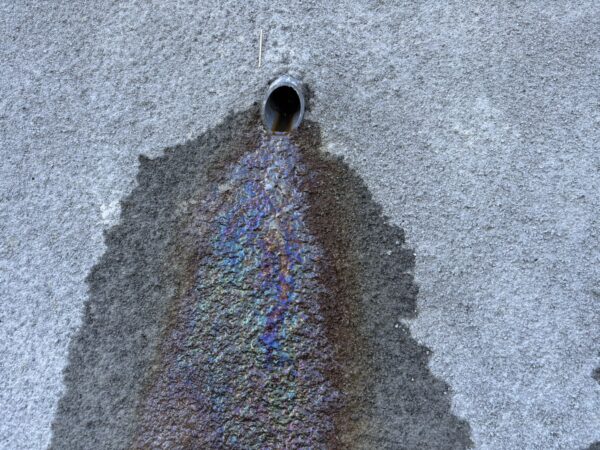
Once a mountain is cut into, the weathering never stops.
First and foremost, the weathering of bedrock is “Physical Weathering" and "Chemical Weathering"We'll proceed along these two routes."
According to materials from the Rock Mechanics Committee of the Japan Society of Civil Engineers, temperature changes, water infiltration, and freeze-thaw cycles are cited as the primary causes.
Weathering of Rock Masses / Committee on Rock Mechanics, Japan Society of Civil Engineers
When cut-and-fill work is performed, the stress in the undisturbed soil—which had previously been restrained by overburden pressure—is released, causing microcracks to propagate.
As water and air seep in, even the bedrock deep underground begins to weather.
Rainfall accelerates the process of sedimentation within the natural ground.
The number one factor that accelerates weathering isRainfallThat's it.
When rainwater seeps into cracks in the bedrock, rock-forming minerals such as feldspar undergo hydrolysis and turn into clay, eventually transforming into sandy sediment.
This corresponds to what is known as “masa-ka” in the context of granite, which is common knowledge in the field of civil engineering. (Granite is classified as masago soil.)
JOGMEC Glossary: “Weathered Layer”、Sedimentary Rocks and Strata / s-yamaga.jp
If you didn't know that, be sure to remember it!
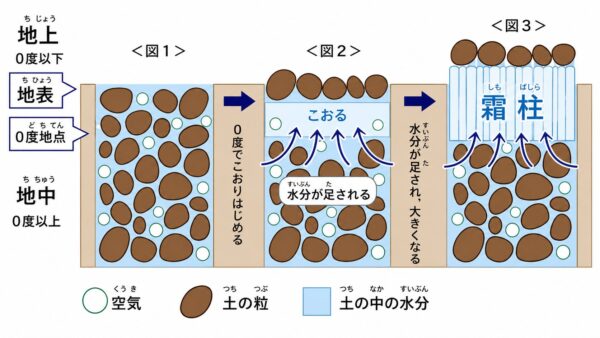
In regions subject to freeze-thaw cycles, every time water trapped in cracks freezes, its volume expands by approximately 9%, causing the rock to crack further.
Freezing and Thawing / Rock Mechanics Committee, Japan Society of Civil Engineers
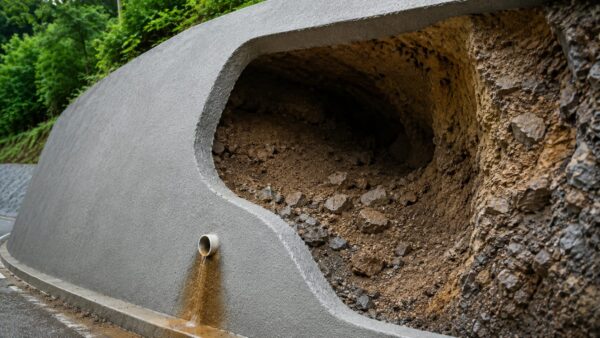
Sprayed mortar absorbs heat
Next is熱That's it.
Before the spray application, the natural ground surface is partially shaded from sunlight by vegetation and loose rocks; however, once the mortar is sprayed on, the concrete surface absorbs solar heat.
During the summer, the sprayed surface is touchable, but it’s not uncommon for it to get quite hot.
Since the thermal expansion coefficients of the minerals that make up a rock vary from mineral to mineral, repeated temperature fluctuations cause microscopic cracks to form at the mineral boundaries.
This is “Thermal weatheringThis phenomenon, known as “solar weathering,” has long been studied.
Weathering / Wikipedia
The extent to which heat from the spray directly accelerates weathering depends on site conditions, but
Surfaces coated with sprayed mortar tend to trap heat, resulting in a thermal environment that is harsher than when the natural rock was exposed.That's it.
Why Shouldn't Sediment Be Discharged?
Soil and sediment from inside the structure, caused by weathering, gradually seeps out through the drainage pipes every time it rains. If left unchecked, behind the sprayed concrete...Internal Hollowing...continues.
Sprayed mortar is a construction method that, for better or worse, covers the interior, so its condition cannot be seen from the outside.
There are plenty of cases in our track record where, by the time it was noticed, a large gap had suddenly appeared behind the sprayed coating.
The Slope Association’s guidelines also specify that drainage holes must be provided in sprayed concrete “At least one per 2–4 square meters"It has been decided to establish [...], but,"
This figure is intended solely for drainage purposes and does not account for sediment runoff.
The fact that mountains gradually erode and crumble is, in itself, a normal part of the natural cycle. However, since we’ve gone to the trouble of applying sprayed mortar, we’d naturally want to minimize internal deterioration as much as possible, wouldn’t we?
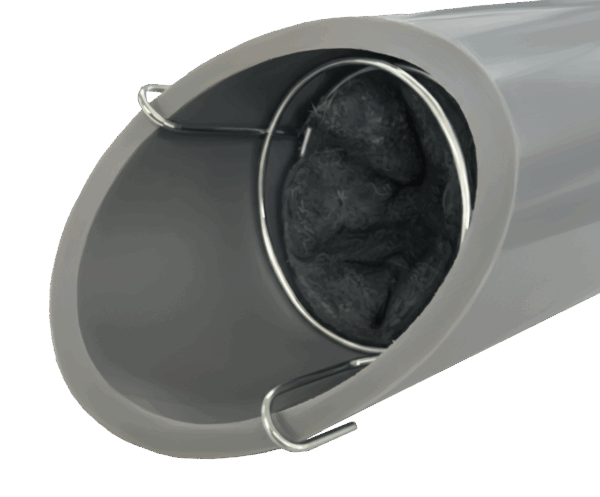
Structure and Function of Drain Pipes with Mats
So, “Matt In"."
The design features a non-woven fabric mat installed on the inside of the PVC drain pipe to prevent backflow, andIt lets water through but blocks sedimentIt functions in this way.
Matt-In is designed to be used for drainage in mortar-sprayed slopes.
The effects can be broadly categorized into three areas.
- Bedrock Section: To reduce the runoff of weathered soil and sediment and delay the formation of cavities behind the structure
- Earthworks Division: Prevent surface subsidence and sinkholes
- Fill: Prevent subsidence caused by the outflow of internal soil
- User Experience: It doesn't come off or slip easily, and it stays securely in place until the spray is applied—so it doesn't get in the way!
In particular, cut slopes and fill slopes that were originally composed of soil and sediment are prone to sediment discharge through drainage pipes.
Simply installing a mat here may help reduce the risk of long-term deformation to some extent.
At our site, it's already standard practice to...
At our site, we already use it as standard practice for jobs that look like they might be problematic.
Even when it’s not part of the design, I’ve been adding elements on my own more and more often whenever I think, “We should include this here.”
Surprisingly, it’s little things like this that lead to creativity and ingenuity.
I recommend it.
By the way, the list price is 240 yen!
See you later.
The products are sold by either Koiwa Wire Mesh or Kimoto Rubber.