Hello, everyone.
This is Enta.
Silver Week is finally over.
Now the highway is part of everyday life...
For us working people, the highway is a nightmare because of Sunday drivers.
It's about time they did something about people who just casually drive at 80 km/h in the passing lane!
But that's beside the point.
This time, I’d like to talk about workplace harassment.
The Ministry of Health, Labor, and Welfare has published a “Leaflet on Measures Against Workplace Harassment,” and when I read it, I found that the content was quite relevant to the construction industry as well.
Until now, it has been the employer’s obligation to implement measures to prevent harassment, including power harassment, sexual harassment, and harassment related to pregnancy, childbirth, childcare, and family care leave.
In addition, the amended Comprehensive Promotion of Labor Measures Act and other laws will take effect on October 1, Reiwa 8, making it mandatory for employers to implement measures to prevent customer harassment and sexual harassment against job seekers and others.
In other words, starting next month.
Since it’s the president’s job to establish company policies, this time I’ll list, point by point, the things that individual subcontractors—craftsmen and foremen—believe “should not be done.”
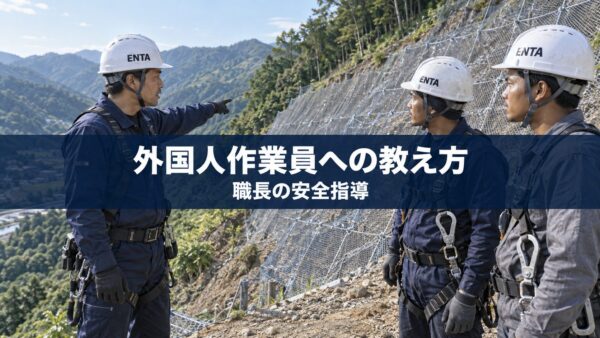
Things Foremen Should Never Do to Young Employees and Interns at the Company
First, let's talk about my family.
According to a leaflet published by the Ministry of Health, Labor and Welfare, workplace harassment is defined as conduct that meets all three of the following criteria.
- Words and actions stemming from a relationship of superiority
- Anything that exceeds the scope necessary and reasonable for business purposes
- Those that harm workers' working conditions
A foreman and a first-year employee, a veteran and a technical intern.
It’s best to assume that almost all hierarchical relationships in the workplace fall under the category of “superior-subordinate relationships.”
Here’s how the six types of power harassment listed in the brochure apply to a slope construction site.
Things You Shouldn't Do
- Hitting someone on the head, kicking them in the shin, poking them through their helmet
- Throwing tools such as utility knives, rulers, and wire
- In front of other craftsmen, he belittles them by saying things like, “Are you stupid?” or “Go back to your country.”
- Yelling at someone over a single mistake, bringing it up again and again from the morning meeting until evening
- Ignoring young employees they don't like in the office and excluding them from the lunch group
- Making me wash my own car or run personal errands because I can't say no
- A craftsman with five years of experience was forced to spend the entire day just cleaning up as a form of harassment
- Prying into my personal life on LINE on my days off, looking through the photos on my phone without my permission
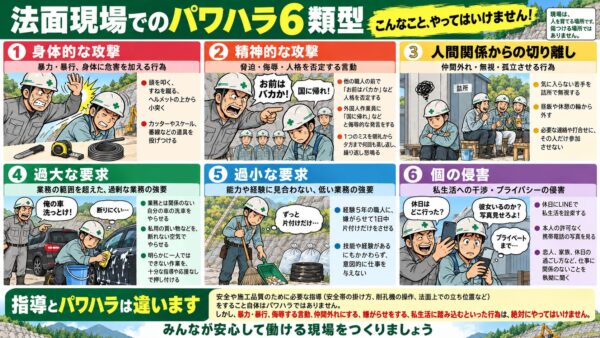
However, the leaflet also states that “from an objective standpoint, proper work instructions and guidance provided within the scope of what is necessary and reasonable for business purposes do not constitute workplace harassment.”
Stopping a young employee on the spot from stepping onto a slope without putting on a safety harness (full-body harness) is part of proper supervision.
The problem is what happens after that, isn't it?
If, after telling them to stop, you go on to lecture them for 30 minutes, saying, “That’s why you’re no good,” you’ve gone too far.
Reprimand only the behavior; keep it brief, and don't humiliate the person in front of others.
As long as you follow these guidelines, I don't think you'll go too far off track.
Since many foreigners, in particular, tend to have a lot of pride, let’s give them a gentle scolding on the down-low.
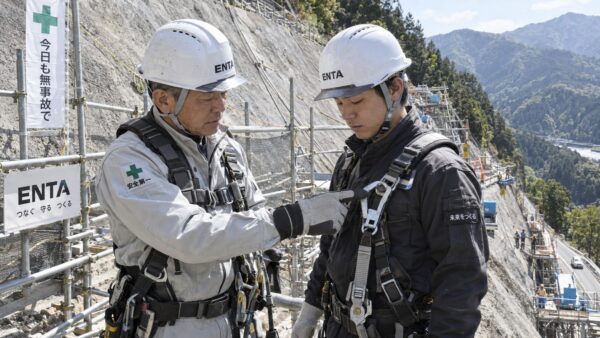
Things Subcontractors Should Never Do to Employees of the Prime Contractor (Harassment by Subcontractors)
The leaflet defines "customer harassment" as conduct committed by "customers, business partners, facility users, or other individuals associated with the business operations of the business owner."
This is the counterparty to the transaction.
From the main contractor’s perspective, a subcontractor’s confrontation with a young supervisor from the main contractor’s company could be considered harassment by a business partner.
We can no longer say, “It doesn’t matter because the general contractor is in a higher position.”
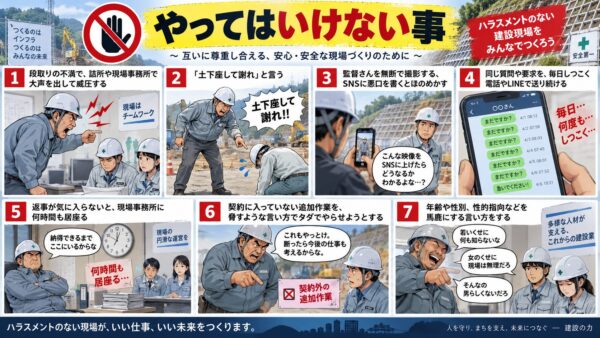
Things You Shouldn't Do
- Shouting loudly and acting intimidatingly at the foreman's office or the job site office due to dissatisfaction with the work schedule
- "Get down on your knees and apologize" (the leaflet lists forcing someone to get down on their knees as an example)
- Taking photos of the director without permission; hinting that they'll post negative comments on social media
- Persistently sending the same questions or requests every day via phone or LINE
- If he doesn't like the answer, he'll hang around the site office for hours.
- Confronting someone in a threatening manner about additional work not included in the contract
- Using language that mocks people based on their age, gender, sexual orientation, etc.
If you have something to say, it's okay to say it.
Even in the leaflet, it is stated that judgments are made based on two criteria: whether the content of the request is reasonable, and whether the means and manner of the request fall within the bounds of what is generally accepted in society.
If it requires extra effort, gather the date, location, details of the work, and photos, and submit them in writing through your company.
This approach gets the message across much better than yelling.
The days when you could win just by yelling are over, lol. (Unless it's a dangerous situation, you can safely assume that people who yell these days are just embarrassing!)
Conversely, if you are treated unfairly by an employee of the general contractor, please make a note of “when, where, who, what, why, and how (5W1H),” as indicated in the leaflet.
Take that note with you and talk to your company first.
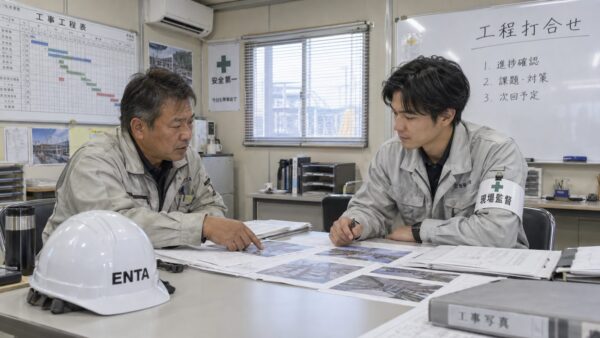
Things You Should Never Do Around Students and Job Seekers on Site Visits
This applies to the hiring process as well.
I believe there are companies that accept high school and vocational school students for field trips and internships.
In this brochure, “job seekers, etc.” refers not only to job seekers but also to participants in internships, teaching practicums, and similar programs.
This includes interactions that take place online or via social media.
Since it's usually the foreman who gives the site tour, this is something to keep in mind.
Things You Shouldn't Do
- Asking, “Do you have a boyfriend (or girlfriend)?”
- After a company tour or internship, persistently asking someone out for a meal or drinks
- Find out a person's LINE or social media account information
- Making comments about appearance, such as “You have a great style”
- In break rooms or in cars, ending up one-on-one even when it's not necessary
- "If you want to join our company..."—using the prospect of a job offer to get them to do as they're told
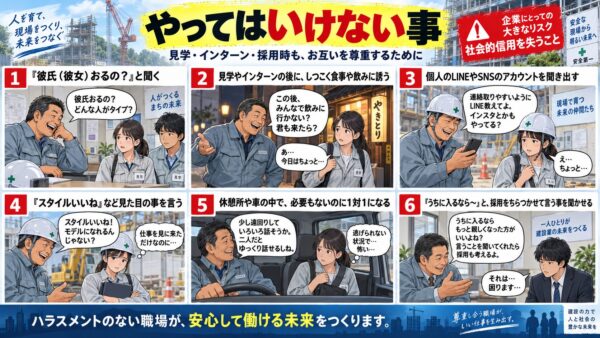
The brochure states that losing social credibility and a decline in the number of applicants are major risks for companies.
Just know that it’s only natural for people to think middle-aged guys are basically gross! lol
It’s no exaggeration to say that for a small-town slope contractor, if just one person spreads bad rumors about them, it wouldn’t be surprising if they received zero bids the following year!
In industries facing labor shortages, this is the hardest part, isn't it?
Please come in groups of two or more, and contact us using the company phone number.
That's usually all it takes to prevent most problems.
I'll also list some places you can turn to for help if you run into any problems.
First, try the company's counseling service or your supervisor.
If the issue cannot be resolved internally, you can contact the Employment Environment and Equality Division (Office) at your local Prefectural Labor Bureau or visit the Comprehensive Labor Consultation Corner located within Labor Standards Inspection Offices nationwide.
There also seems to be a pamphlet stating that dispute resolution assistance and mediation provided by the Director of the Labor Bureau are available free of charge.

To be honest, back in the day, it was common for people on construction sites to yell and hit each other.
But starting next month, the company will be required to clearly establish what “must not be done” and communicate that to the craftsmen. (Though it does make you wonder if those people are even fit to be in this line of work, lol.)
From the general contractor's perspective, subcontractors are business partners; from the perspective of students and the general public, they are the face of the company.
A single remark from a foreman can ruin the company's reputation and drive away next year's new hires.
Make sure to issue a formal notice at the company and have everyone confirm it.
See you later.