Hello, everyone
This is Enta.
This article is part of a series that started last summer, and I totally forgot about the final installment, Part 6, lol.
There are 1, 2, 3, 4, and 5, but I added a half-written "6" for something I had forgotten!
It’s lost a bit of its momentum, and I can’t help but feel a bit confused.
When you think about how "Summer" was written a year later, in winter, do ordinary readers get anxious too??
I guess that's about it~
Well, I'm pretty laid-back about that sort of thing, so please bear with me lol
But that's beside the point.
Mortar Spraying for Private Homes and Commercial Construction: Part 1 (For the General Public)
Mortar Spraying for Private Homes and Commercial Construction, Part 2 (For the General Public)
Mortar Spraying for Private Homes and Commercial Construction, Part 3 (For the General Public)
Mortar Spraying for Private Homes and Commercial Construction, Part 4 (For the General Public)
Mortar Spraying for Private Homes and Commercial Construction, Part 5 (For the General Public)
In the previous posts, I covered everything from the basics of sprayed mortar to the conditions for spraying.
Since I didn't mention the conditions for applying sprayed mortar to masonry in the previous post,
I'm going to start writing.
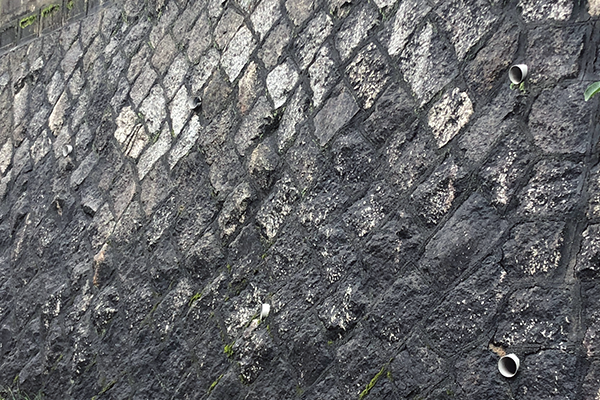
On stone walls like these,Let's apply a mortar spray to prevent it from collapsing!
It seems there are some contractors saying that lol (in the Kanto region)
There is a way!
I think what matters most is whether that approach is the right one.
The figure below shows a cross-sectional view of the stone masonry.
Since it’s mostly just stones placed on top of the ground, it’s called “empty stone masonry.”
In the case of very old stonework, there aren't even mortar joints, but
In some cases, mortar joints are applied retroactively.
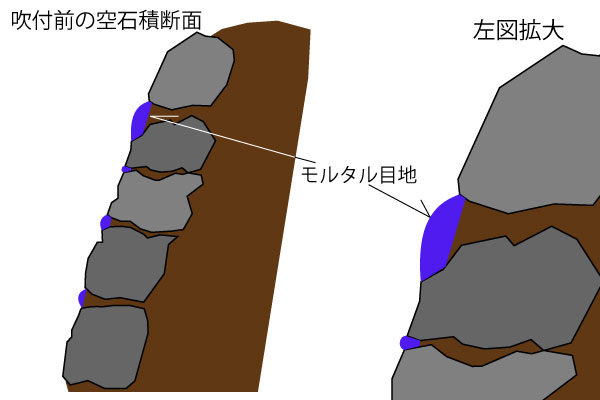
If you spray mortar onto the surface in this condition, the debris will prevent it from adhering properly.
Therefore, please be sure to strictly follow the conditions listed below.
1. Thoroughly clean the surface of the stonework with a high-pressure washer
2. Remove all grout
3. Be sure to install drainage pipes or similar in the subgrade so that they extend to the surface of the mortar. (Ensure proper drainage.)
4. When constructing the masonry surface, install not only the wire mesh but also the rebar framework whenever possible.
5. If there are gaps deep within the joints, fill them thoroughly with mortar.
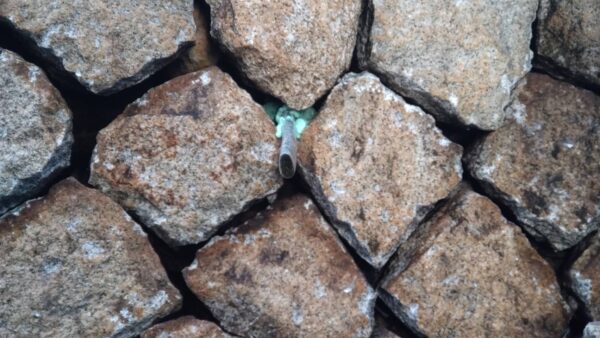
If you strictly follow the conditions listed above, the lifespan of the stonework is expected to be extended by about five years.
If possible, to prevent an increase in internal pore water pressure caused by heavy rain or similar conditions,
For added peace of mind, be sure to install a drainage borehole that is at least 4.0 meters deep.
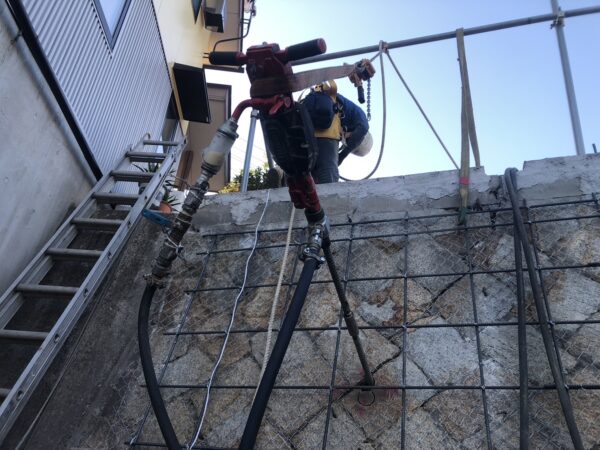
These days, there is a greater emphasis on extending the life of structures rather than rebuilding them.
Actually, it's cheaper that way, price-wise!
How can we extend the life of existing structures without altering them!?
I'm working hard on private-sector construction projects while worrying about that, lol.
Since I’m paying for repairs costing several million out of my own pocket, to ensure the work is done properly,
I think it’s a good idea for the general public to have some basic knowledge, so it certainly won’t hurt to know this.
See you later.