Hello, everyone
This is Enta.
Mortar Spraying for Private Homes and Commercial Construction: Part 1 (For the General Public)
Mortar Spraying for Private Homes and Commercial Construction, Part 2 (For the General Public)
Mortar Spraying for Private Homes and Commercial Construction, Part 3 (For the General Public)
Mortar Spraying for Private Homes and Commercial Construction, Part 4 (For the General Public)
Regarding the sprayed mortar work covered in previous posts,
In this case, given these conditions, wouldn't it be okay to apply sprayed mortar to the earthwork section?
I'm going to try writing about that.
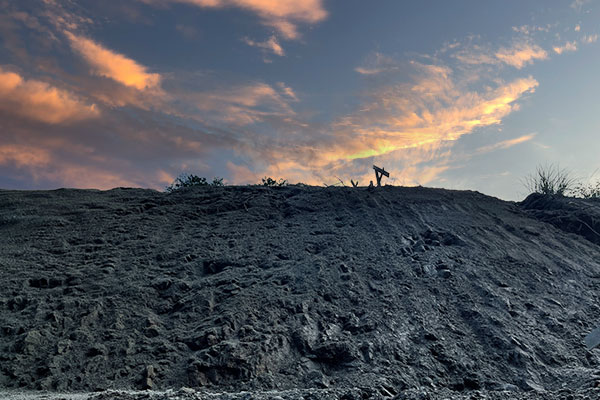
Let’s consider the on-site conditions for applying sprayed mortar in a typical residential home.
1. There are a lot of weeds, and maintenance costs money every year.
2. Every time it rains, soil and sediment wash away.
3. The foundation of the house is starting to show.
4. The stone wall is crumbling.
5. The harami is protruding. (The mountain is bulging.)
Is this what housing conditions are like for the general public?
In response to this, I will outline the specifications for the spray mortar application used to address this issue.
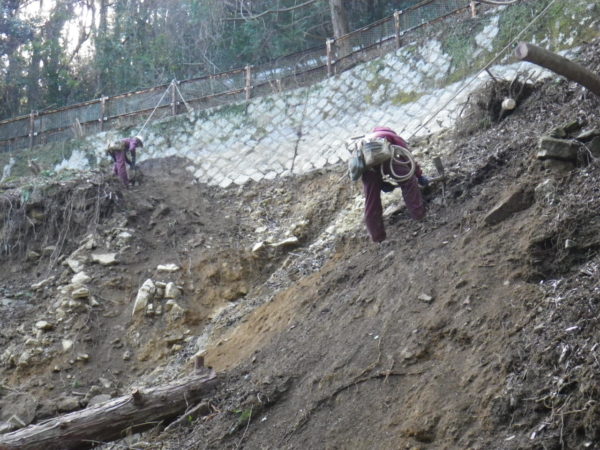
1. There are a lot of weeds, and maintenance costs money every year.
After thoroughly cleaning the slope, we recommend applying a spray coating with a thickness of at least 7 centimeters!
The same applies to gentle slopes; install sediment retention material in the drainage pipes as much as possible.
And, if possible, for administrative purposesStepped walkwayI think it would be better to make one.
Slopes are generally not places that ordinary people without special training can climb.
It is important to remove grass from areas of slope deformation and cracks.
Even if you think it won't grow, it will definitely grow, so let's have a staircase built with mortar for maintenance purposes.
2. Every time it rains, soil and sediment wash away.
3. The foundation of the house is starting to show.
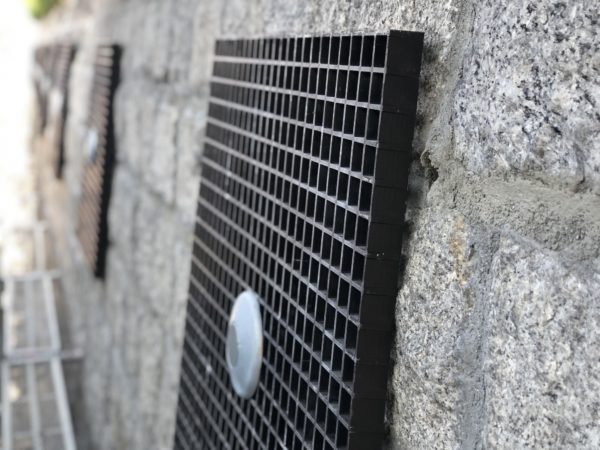
The sprayed thickness must be 10 centimeters or more, and anti-siphoning material must be installed on the drain pipes.
Since the slope may be steep, the spray thickness is 10 centimeters.
And since there is a very real possibility that such places could collapse,
We recommend using D10 to D16 rebar to create a rebar grid.
If the rebar diameter is small, use a 200-by-200 or 300-by-300 grid.
If you're going with D16, the rebar cover is just barely sufficient, so I think it's best to have at least 10 centimeters.
So, it's for dealing with landslides and sediment runoff, right?
If the base of the foundation is exposed, wrap it securely around that area to prevent rainwater from seeping in as much as possible during rainfall.
Spray in stages to reduce the flow velocity of rainwater. (This can be achieved by wrapping the coil.)
4. The stone wall is crumbling.
5. The harami is protruding. (The mountain is bulging.)
Decide whether to address the stone masonry or the root cause of the bulge.
A spray thickness of at least 10 centimeters is desirable, and since it is necessary to implement measures to prevent collapse in conjunction with this,
It may become necessary to perform rebar insertion work or dewatering drilling.
If you're going with sprayed mortar and rebar insertion, you'll need to assemble a rebar grid.
Whether or not to install a pressure-receiving plate depends on the design.
Basically,Anti-siphon material is requiredThat's right.
Install on the earthwork sectionIn that case,
I think the result would be similar if we spread the mat over the entire slope, secure it firmly, and then apply the spray.
If you ensure that the soil remains stable overall, there will be no runoff from the drainage system.
I feel like there isn't much difference between the mat and the dirt.
Since we'll be using mats in areas where spring water emerges from the bedrock, it doesn't seem like it will be much of a problem.
Instead, thickness is what matters.

As I mentioned in my previous post, the basic principle of mortar spraying is adhesion to the rock, so,
This product is not intended for use on soil surfaces.
However, it seems that the nature of this construction method has changed over time.
Given the labor shortages and lack of oversight, it’s hardly surprising that it’s used as a weed control measure.
However, if this is done using sloppy workmanship or methods, it will cause problems for us professionals down the road.
When people post videos on YouTube showing what appear to be strange construction methods—is it a misunderstanding? Or a lack of experience and knowledge?—
There are, in fact, many ordinary people who believe that.
Since we’re doing this anyway, we’d like to bring high-quality workmanship to ordinary homes as well.
See you later