Hello, everyone.
This is Enta.
When I'm working on drilling jobs, I occasionally get requests like, "Take a look inside the well."
I usually work on excavating slopes and anchor holes, but when it comes to dealing with pipes in the φ50 to φ100 range, well drilling is actually quite similar.
But that's beside the point.
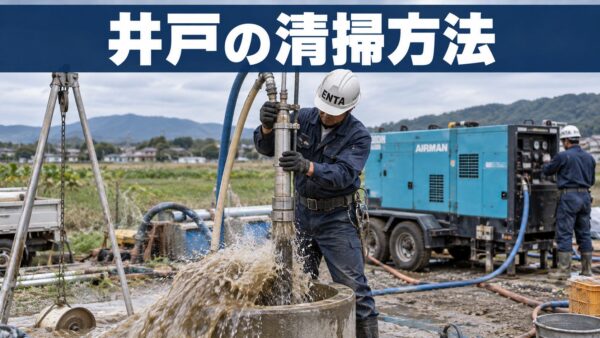
In this post, I’ll walk you through the actual steps involved in cleaning a well—something anyone who’s ever cleaned a well has probably wondered: “How do you actually clean a well?”
Why Do Wells Get Clogged in the First Place?
Wells tend to deteriorate inside over time, and there’s always a chance that bacteria could grow in them. (It depends on the well’s location, so I can’t make a blanket statement, lol.)
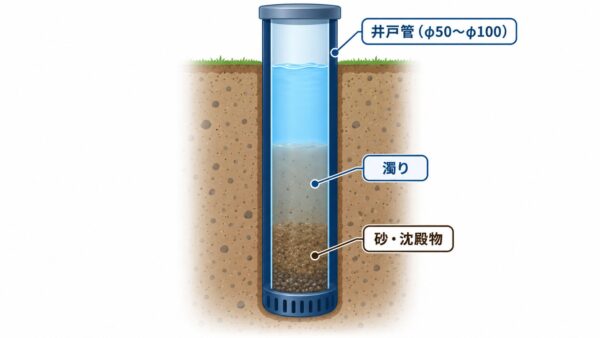
Generally speaking, the term “well cleaning” refers to the process of removing sand and sediment that has accumulated inside the well.
The conditions vary depending on the type of well, but in this case, it’s a commonPipes with diameters ranging from approximately φ50 to φ100I'll proceed on that assumption.
When sand and sediment build up inside the pipes, the water flow slows down.
As long as the groundwater continues to flow, even slowly, fine sand will gradually be carried into the pipe, and with each pumping cycle, soil particles from the surrounding area will be more easily drawn in.
The longer you leave it, the more sediment will build up, and if bacteria start to multiply inside, it will affect the water quality.
Clogs can also occur depending on the quality of the pipes you’re using, right? Things like rust, for example.
My impression is that most inquiries about well problems follow the pattern of “I noticed the flow had gradually slowed down” rather than “The water suddenly stopped flowing.”
I find that it’s harder to notice changes in a well that’s used every day, whereas, conversely, a well that’s used only occasionally is more likely to develop a clog when you need it most.
That is precisely why, rather than panicking and trying to fix the problem after a clog occurs, we need to adopt a maintenance approach that includes regular internal cleaning.
If you get into the habit of checking the depth and water level—even if it’s just once every few years—it’ll make it easier to make decisions when the time comes.
Things to Do Before Cleaning | First, Measure the Depth
Before you jump right into cleaning, there’s something you absolutely must do first.
How deep is the well?...It's important to understand this first.
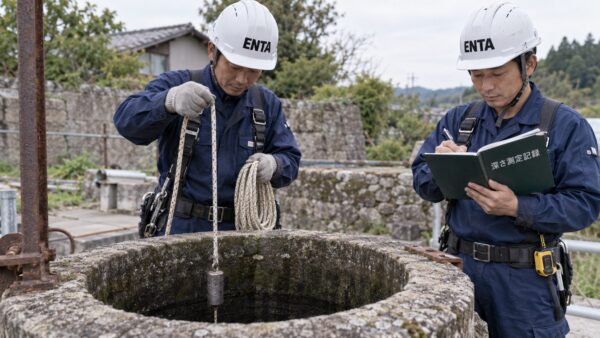
The method is simple: tie a weight to a string and lower it to the very bottom of the well.
When the string reaches the bottom, measure its length—that’s the depth of the well.
For example, if a well that was originally 15 meters deep turned out to be only 10 meters deep when measured, a simple calculation would show thatIt's packed with 5 meters' worthThat’s how it works.
If you make sure to keep track of this, you'll be able to see in numbers just how much improvement there was after cleaning, so it's definitely something you should do.
There are even measuring tapes that beep when the water level reaches a certain point, so that's what most pros use, lol. When you step into the water, it goes "beeeeeeeep."
It’s a good idea to make sure you clearly communicate this depth measurement to the client or document it with photos. For us public works contractors, photos are really important! lol
If you keep a record of how much the drain cleared up after the first cleaning and how quickly the clog progresses the next time it happens, you'll have a better idea of what to expect.
Simply keeping a record of the numbers will make it easier to estimate when the next cleaning is due and will help the conversation go more smoothly when you consult a professional.
Once you've checked the depth, the next step is to get a 3-minute polyethylene hose.
If the well is 15 meters deep, it’s best to plan for about 20 meters.
While you generally won’t need more than 15 meters, it’s definitely a good idea to have a slightly longer one on hand to allow for maneuverability and give yourself some leeway on site.
As for the hose diameter, if it’s too thin, the water and air flow won’t be enough, and if it’s too thick, it might get stuck depending on the well’s diameter, so go for something just right lol
For wells with diameters ranging from φ50 to φ100, I think a 3-mm polyethylene hose offers a good balance between ease of handling and cost.
Since hoses that are too short are a common mistake on site, it’s best to allow for a little extra length when preparing.
We’ll be lowering this hose into the well, but if we just lower it as is, it will cause problems later on, so we need to make one more adjustment before doing that.
It uses a dual-pipe system to clean thoroughly in one go using air and water.
To remove sand from inside a well, we use a strong stream of water and air.
However, if you insert a thin pipe into an empty hole with a diameter of 50 to 100 and blow air in from the bottom, the force of the air will cause the sediment inside to be expelled all at once.
This is actually quite dangerous, so to prevent it,Double PipeI'll go with that.
The design involves threading a 3-minute polyethylene hose through a pipe with a diameter of φ50 to φ100, which serves as protection.
You can use a trumpet-shaped pipe, or you can simply drill a hole in a PVC pipe to connect it—either method is fine.
If you blow air into an empty space, it comes out with more force than you’d expect, so it’s best not to skip this double-tube setup. (Protecting the surrounding area is also a lot of work.)
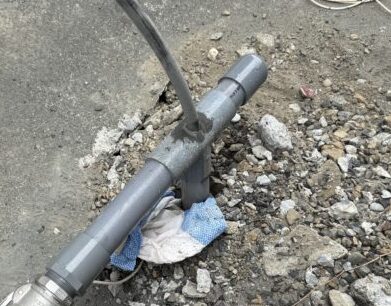
The 3-minute hose reaches all the way to the bottom, and sand is being blown up from the VP50 PVC pipe.
The sand that is blown up is forcefully expelled outside through the PV50 hose.
Lower the 3-minute hose all the way to the bottom while moving it up and down.
While it is possible to do the work using just compressed air, the deeper you go, the less effective compressed air alone becomes.
If you can set it up so that water is also pumped through the system, the cleaning power will increase significantly.
Since water pressure is stronger than air pressure, it cleans thoroughly.
For this application, we recommend using the largest compressor possible to ensure maximum air pressure.
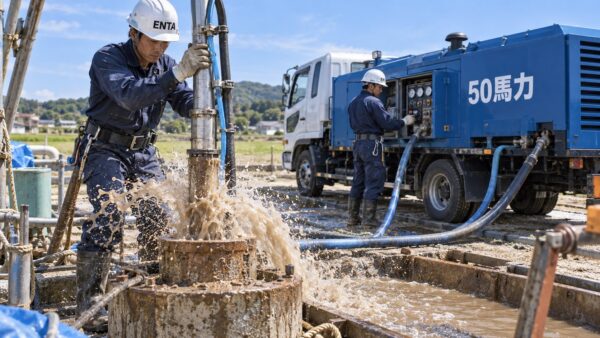
At our site, at the very least,50-horsepower compressorWe'll use this (it's the smallest class we have).
For a well with a diameter of 100 and a depth exceeding 30 meters, a minimum of about 100 horsepower (2.5 metric tons) is required.
If the air volume itself is insufficient, cleaning power will be inadequate, and as the well diameter increases, the equipment itself will need to be larger.
When actually performing the work, rather than lowering the hose all the way to the bottom at once, we adjust the depth gradually while blowing in air and water.
Rather than blowing at a constant depth, moving the nozzle up and down and washing in stages will ensure that the clogged layer is cleaned evenly.
It’s also important that the water gushing out becomes clear.
It can also serve as a rough guideline for when to wrap things up.
Here's what the machine looks like.
| Conditions | Compressor Guidelines |
|---|---|
| φ50–φ100, shallow (up to about 30 m) | 50-horsepower class (0.5 metric tons) |
| φ100 and up, over 30 m | 100 horsepower (2.5 metric tons) class and above |
*Please note that this is based solely on my on-site experience and serves as a rough guideline; the number of units required will vary depending on the well’s diameter, depth, and geological conditions.
Sterilization, Finishing, and the Limits of Liquefied Well Water
Once you've removed all the sediment from the bottom, you'll need to decide whether to sterilize it.
Generally, the process involves adding hypochlorous acid, circulating the water inside to disinfect it, and then running the pump for a while to finish the process.
If you drain the water and run it through once after disinfecting before using it, you can prevent using it while disinfectant residue is still present.
That concludes the standard procedure for cleaning a well.
If you treat the entire process—from cleaning and sterilization to running the pump for the final rinse—as a single set of steps, you’ll be less likely to miss any steps.
However, the problem is thatWhat should I do if I clean a well that stopped producing water after the earthquake?Is that so?That's the story.
To be honest, this is a very difficult call to make.
Cleaning can only address, at most,Only inside the tubeThat's it.
Since the area outside the pipe is still natural ground, we can’t reach that far.
It is not actually possible to verify the condition of the surrounding soil near the well, which was shaken by the earthquake and became liquefied.
However, I have the impression that if there are many areas where fine soil particles have accumulated after being dislodged, sand will continue to come out of the surrounding wells for a while, no matter how much you flush them.
To be honest, I can't say how long this will last.
Sometimes it gets better all of a sudden, sometimes it gets better right after washing, and sometimes it doesn't get better at all.
This is something that depends on the specific circumstances, so we can't say for certain.
We consider ourselves drilling pros, but none of us has actually seen the inside of a well clearly, lol.
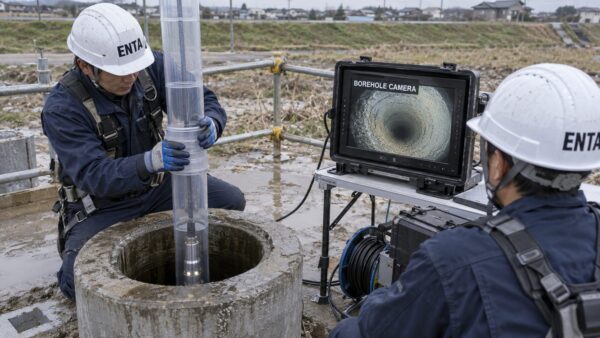
To see inside, you could connect transparent PVC pipes one after another and insert a borehole camera; that might allow you to see inside the ground to some extent.
It sounds interesting, but since renting the camera alone costs a fair bit, it’s not something you can just try out on a whim.
I believe that if we can collect data both before and after liquefaction occurs, that in itself would be valuable information.
If we can see in numerical terms just how far the cleaning process can restore the rock and at what point it can’t, the accuracy of our judgments should improve significantly. (For those who love geology... lol)
In my opinion, if the water volume and quality do not improve even after several attempts at cleaning, it’s necessary to consider that a phase is complete and move on.
In some cases, rather than endlessly repeating the same task, might it be better to consider this an opportunity to reassess the condition of the well itself?
I think it’s realistic to view the cleaning results simply as a factor in deciding whether to dig a new well or continue using the existing one—but of course, that also involves costs...
As a general rule, it is recommended to clean wells regularly before they become clogged.
As long as the material has not liquefied, there are certainly cases where it can be restored using the cleaning method described here.
To put it another way, for wells that stopped producing water immediately after an earthquake, it might actually save you money in the long run if you don’t panic right away, but instead wait and see how things develop—and consult a professional if necessary!
We can’t see everything inside the well either, and while we can operate the machinery based on intuition to some extent, there are limits to what we can do.
Still, while there are some situations where we can make judgments based on the procedures we’ve developed through experience on the job, we’ve also been told that these aren’t set in stone...
Cleaning a well may seem like a mundane task, but once you try it, you realize there’s more to it than meets the eye.
You can clean the inside of the pipe as much as you want, but there’s nothing you can do about the surrounding soil.
Even though I understand this sense of frustration, I guess I just have to do the best I can within my means.
Whether it's drilling holes or digging wells, the work ultimately involves dealing with an invisible opponent—what lies beneath the ground.
Since you can't see it, I think relying on numbers—like depth and water volume—is actually a pretty reliable way to judge things. After all, numbers don't lie, right? lol
See you later.
I'm spending half of the Obon holiday working nonstop on drilling a well for disaster preparedness.