Hello, everyone.
This is Enta.
It's been raining on and off for the past few days, hasn't it?
Plus, Silver Week starts this weekend (in 2026, it’s a five-day holiday from September 19 to 23). I bet there are quite a few people thinking, “It’s been a while since I’ve had a long weekend—maybe I’ll head to the mountains.”
Oh, slope maintenance is just a regular job! ...
But that's beside the point.
This time, I’d like to share a story that I feel compelled to write about precisely because of the timing.
To get straight to the point,Even after the heavy rain stops and the weather clears up, the mountains don't dry out easily.
In particular, for about one to two weeks after heavy rain, the mountains may remain saturated with water, and from a technical standpoint, this is a period that requires caution.
Even after the heavy rain stops, the mountains still hold onto the water.
As I mentioned in a previous post on this blog, as a river swelled by rain begins to recede, some of the water flows over the ground and recedes immediately, while other water seeps into the ground and gradually emerges.
Although the water level above ground stabilizes relatively quickly, the water underground doesn't drain away that easily.
This isn't just true of rivers; the same applies to the mountain slopes themselves.
The Nagano Prefecture Soil and Water Conservation Division’s website states, “During heavy rains, rainwater accumulates in the soil, but it takes time for it to drain away, so there is a risk of landslides even after the rain has stopped.”
During the 2018 torrential rains in western Japan, the Landslide Prevention Public Relations Center issued a warning in response to an interview with the Kobe Shimbun, stating, “Since landslides are caused by rainwater seeping into the ground, there is a risk of them occurring even after the rain has stopped, so caution against landslides is necessary for several days.”
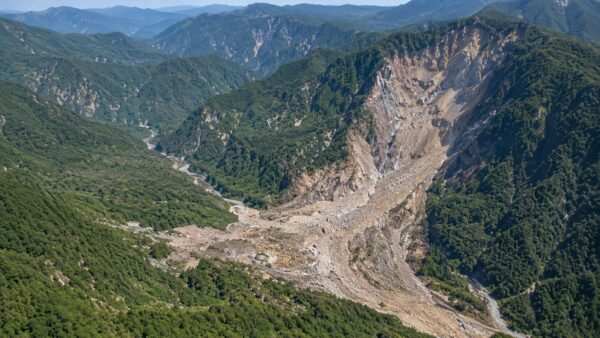
If it turns into a larger-scale “deep collapse,” the situation will drag on even longer.
According to a report from the Ministry of Land, Infrastructure, Transport and Tourism, deep-seated landslides not only “occur in conjunction with heavy rainfall” but “may also occur after the peak of rainfall has passed and the rain has stopped,” and,
During Typhoon No. 12 in 2011, total rainfall exceeded 1,000 mm across a wide area of the Kii Peninsula, resulting in 72 cases of deep-seated landslides and 17 instances of river channel blockages (natural dams).
(From a news article)
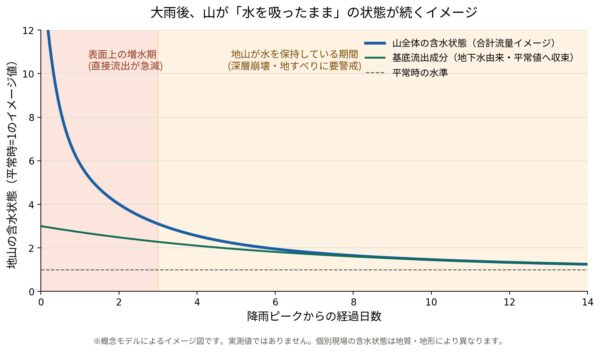
*Please note that the timeframe of “1 to 2 weeks after heavy rain” is a rough estimate I have derived by comparing my on-site experience with various reference materials; it is not a specific number of days set by any particular government agency. Please consider it merely as a general trend based on industry data.
The graph below conceptually illustrates the number of days elapsed since the peak of heavy rainfall and the state of the natural ground as it retains water.
The key point I want to convey is that even if the visible rise in water level subsides quickly, it takes much longer for the entire ground to return to its normal moisture content.
I compiled various data points into a graph, and it's not too far off.
Why Are Slopes Along Rivers Dangerous?
"Mountains near rivers are prone to landslides"—that’s something you really come to understand firsthand when you’re working in the field.
There are several overlapping reasons.
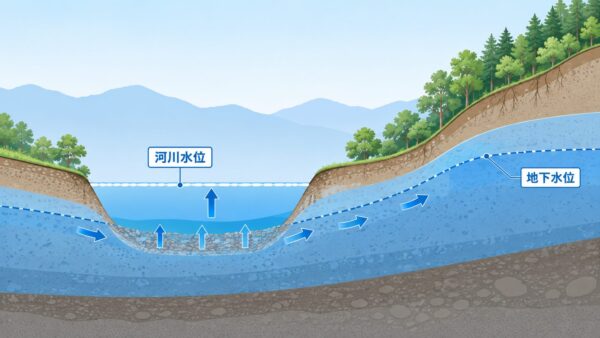
First, when the river’s water level rises, the groundwater level on the slopes adjacent to the river is pushed up as well (this is the phenomenon known as “bank storage,” where river water seeps into the land on the inland and uphill sides of the levee).
Furthermore, when the current of a river—whose water level is rising—erodes the base of the slope (the toe), a phenomenon known as scouring occurs, causing the soil that supported the slope from below to be lost, thereby destabilizing it.
As a slope engineer, you’ve probably seen cases at riverside job sites where “the slope itself seems fine, but only the toe is eroded,” right?
It's hard to see from above, but if you look closely at the riverbank slope, you'll see it clearly.
*Although it is said that capillary action (the upward movement of water through pores) in soil containing fine particles also influences the relationship between slope moisture content and river water levels, there are significant individual variations depending on soil type and topography, so this cannot be generalized or stated with certainty. This explanation is intended to describe a general trend only.
When a slight tremor occurs in saturated soil,
Another thing to be mindful of is the combination with earthquakes.
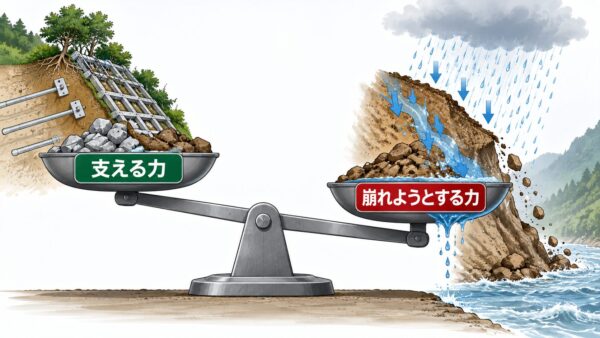
The strength of soil (shear strength) tends to decrease as it absorbs more water.
When a slope is barely holding together (technically speaking, when the safety factor is close to 1), even a slight tremor can trigger a collapse.
In an emergency public notice titled “Be Aware of Landslides After an Earthquake,” the Ministry of Land, Infrastructure, Transport and Tourism’s Landslide Control Division cites the case of the Tateno district (Minami-Aso Village, Kumamoto Prefecture) as an example following the Kumamoto Earthquake, where landslides worsened due to rainfall falling on ground that had been loosened by the earthquake.
In this case, the sequence is “earthquake → rainfall,” but to put it another way, this means that “when another stimulus is applied to ground that has already lost some of its strength, it can trigger a collapse.”
In a situation like this one, where “the ground has already become saturated due to heavy rain,” even a small tremor of around Seismic Intensity 1 could trigger a landslide—the possibility isn’t zero.
Whether a slope will actually collapse from a magnitude 1 tremor depends entirely on the slope’s geology, gradient, and moisture content. The point I’m trying to make here is not a definitive statement that “it will definitely collapse,” but rather a general principle of mechanics: “When the safety factor is at its absolute limit, even a disturbance that would normally be insignificant can serve as a trigger.”
To be honest, if I were to flat-out say, “It’ll collapse even with a seismic intensity of 1,” I’d probably get criticized for being too alarmist, but from our perspective as people working on-site, slopes with a safety margin that’s already stretched to the limit really are a matter of a hair’s breadth.
Even a tremor that would normally be nothing to worry about becomes a different story when the ground has completely absorbed all the water.
I hope that anyone heading into the mountains during Silver Week will take a moment to think not just, “It’s sunny, so it’ll be fine,” but also, “How many days have passed since that heavy rain? Isn’t the ground still saturated with water?”
See you later.
The mountains are already saturated. A slope collapse could occur at any moment | Heavy Rain Warning