Hello, everyone
This is Enta.
Mortar Spraying for Private Homes and Commercial Construction: Part 1 (For the General Public)
Mortar Spraying for Private Homes and Commercial Construction, Part 2 (For the General Public)
I think you’ve understood everything from the slope cleaning work up to the lath installation work that took place a few days ago.
This time, the main...Spray ApplicatorThat's it!
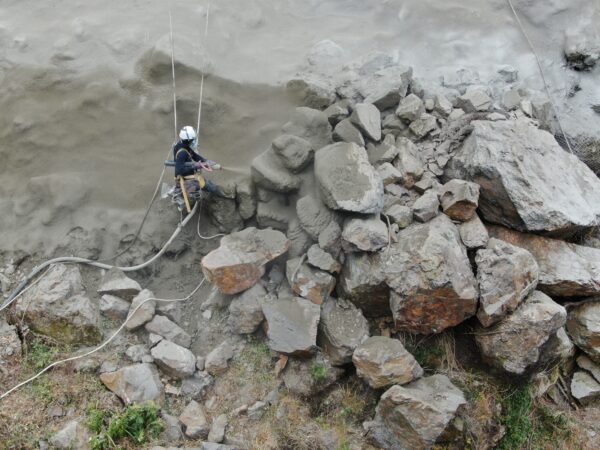
There are actually different types of spray-applied coatings.
1. Mortar Spraying Worker
In standard mortar spraying work, a 1:4 mortar mix is used.
A 1:4 mortar mix means that for every 1 part cement, there are 4 parts sand.
In terms of the recommended formulation,
Cement: 420 kg Sand: 1,680 kg
Furthermore, the water-to-cement ratio is between 45% and 55%.
This is a sprayed mortar worker.
Any other mix proportions—even for sprayed mortar—are generally not permitted in public works projects.
However, public works projects involve specialized construction methods using special mixtures, and these are exceptions.
As for the sprayed thickness, in prefectural construction projects, a thickness of 7 centimeters or more is considered permanent, while any thickness less than that is considered temporary.
Please assume that the sprayed mortar on prefectural roads and similar surfaces is at least 7 centimeters thick.
I think most of them are about 10 centimeters, though.
For national highways, 15 centimeters is considered the standard thickness, and for standard national highways, shotcrete is the primary method used.
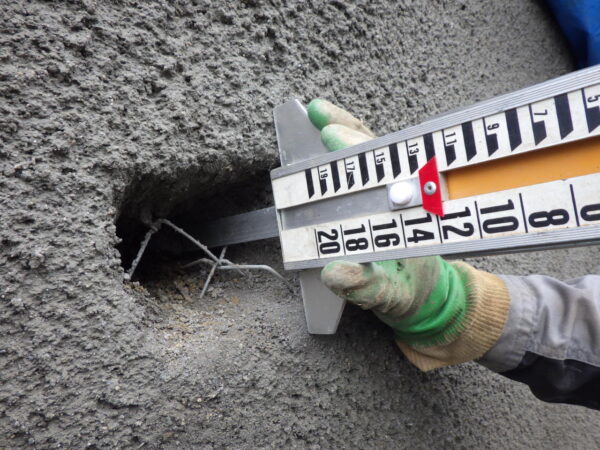
The thickness also varies in cold regions and other such areas.
2. Shotcrete Worker
Crushed stone will be added to the sprayed mortar mix.
The ratio is 1:4:1, and
1 part cement : 4 parts sand : 1 part crushed stone
Water-to-cement ratio of 45% to 55%
The main differences from mortar are that it is stronger and more resistant to friction.
And the price goes down as more crushed stone is added.
If the mixture is sprayed according to the design specifications, the total amount of cement used will decrease and the amount of crushed stone will increase, thereby increasing the sprayed area.
From a long-term perspective, the reason the Ministry of Land, Infrastructure, Transport and Tourism specifies concrete for this sprayed concrete application is to strike a balance between strength and cost.
That said, it’s also true that there isn’t a clear-cut difference—at least not one that’s immediately obvious—and,
I think flexible sprayed mortar is a convenient option for spray applications.
And there’s a major drawback to applying concrete by spraying.
It's because the crushed stone bounces back and flies away when it's sprayed, lol.
So even if you add crushed stone according to the mix design, half of it will roll down below the slope.
Ideally, it would be sprayed while still well-enclosed in mortar, but the crushed stone is discharged on its own.
Well, if you think about it logically, their volumes and densities are different, so I guess it can’t be helped, lol.
So, in reality, there’s actually very little crushed stone in sprayed concrete. (Huh? Was it okay for me to write that?? lol)
3. Fiber-Reinforced Mortar Spraying and Concrete Spraying
This is the spray-applied method I wrote about the other day, where fiber is added without applying a final coat.
One of its features is that the addition of fiber makes it less prone to cracking, and
It is said to have some resistance to freezing and other conditions.
Because the fibers run in various directions—unlike in wire mesh—the mortar bonds more firmly.
Other than this, the rest involves specialized spray-application techniques, and since the major companies hold patents on them, they aren't commonly used, so I'll skip those lol.
So, that's it for this time lol
We'll carry this over to the next meeting.
See you later