Hello, everyone.
This is Enta.
Young engineers often ask me, “Is set loss really necessary?”
I see. Even though the term “set loss” is thrown around all the time on set, there are actually a lot of people who’ve never had it properly explained to them, huh?
I’m one of those people who, way back when, read the Ground Anchor Design and Construction Guidelines, tried them out, asked around, and finally got it to click, lol.
But that's beside the point.
In this post, I’ll provide a comprehensive explanation of “set loss”—from how it works to practical solutions on the job site, and even my own personal theory.
It’s no exaggeration to say that the quality of ground anchors depends on proper tensioning, so young construction managers should definitely keep this in mind.
What Is Set Loss? | The Mechanism Behind the Drop in Load at the Moment of Setting
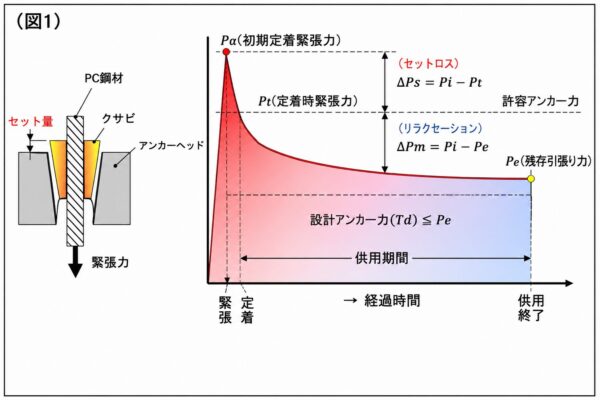
In a nutshell, set loss is...A phenomenon in which the load during the service life falls below the planned level due to stress stabilizationThat's what it's about.
There is a diagram illustrating this load reduction on around page 79 of the Design and Construction Standards for Ground Anchors.
I'll explain what's happening step by step.
Tighten the jack ↓ Insert a wedge into the anchor head ↓ Release the jack ↓ The wedge gets wedged in (this is set loss) ↓ The load drops below the specified load by the amount it has sunk ↓
Furthermore, the PC strands loosen due to relaxation ↓ The load drops even lower than the specified value ↓ It can’t be held at 100% of the intended force (I’m exaggerating a bit, lol)
Basically, even if you apply a load with the jack that’s “perfect—100 points!”, the moment you drive the wedge in and remove the jack, your score drops by the amount the material has been indented.
On top of that, there’s also the relaxation caused by the steel wire itself gradually loosening.
Incidentally, the test method for relaxation is specified by JIS (Test Method for Tensile Relaxation of Metallic Materials), but,
That’s something you do in a lab using short test specimens, so it’s a whole different world from actual anchors on-site, lol.
*I'll write more about relaxation in my next post.
Basics of Test Preparation | Anticipating Mistakes and Staying Focused: 4 Ways to Master the Material
The basic approach to addressing set loss is,I tense up from the start, taking into account the relaxation of the steel wire and set loss.That's the thing.
It's the idea of adding the amount of the drop in advance, isn't it?
Let’s consider a specific method for securing a tension connection—for example, in the case of a wedge-type connection (wedge and ring) with a design load of 100 kN.
Step 1: Apply a load of 100 kN and secure it in place. (This is the most common method.)
Step 2: Calculate the value taking set loss into account, add a margin such as 110 kN, and tension the anchor to set it in place.
Point 3: The anchor will be fully tensioned at approximately 80% of the design load. (Since this will amount to about 80% of the design load even under 100% loading—and given that relaxation also occurs—I think it’s okay to disregard this.)
Step 4: Apply a load of 100 kN, then unload the jack once; reapply a load of 100 kN, and then secure it in place.
I think what’s happening on-site is generally either option 1 or option 2.
However, what I think is the best isPart 4That's it.
A method for securing the wedge by first driving it firmly into place to minimize any loss as much as possible.
The idea is to let it sink in first. (Note: This applies only to models equipped with a wedge and ring.)
On the other hand, that third figure alone isn't very good. Since it will gradually increase after the service begins, there's a possibility it could fall even below 80%.
But since the anchor is in a completely passive state, there's plenty of leeway even if the slope starts to slide.
However, since the tension is weaker, the degree of relaxation is reduced accordingly, so in reality, there may not be much of a difference.
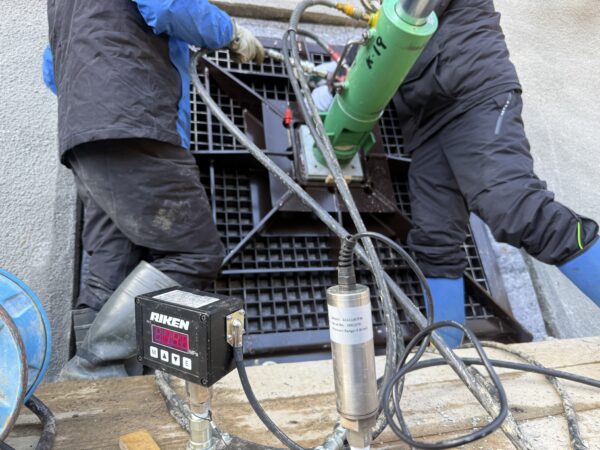
The template for managing set loss is available in the "Downloads" section of our (Shioda Development Co., Ltd.) website, so please feel free to use it if you need it.
Pitfalls on Site | Without Sufficient Bearing Capacity, the Load-Bearing Slab Will Settle, Leading to Increased Losses
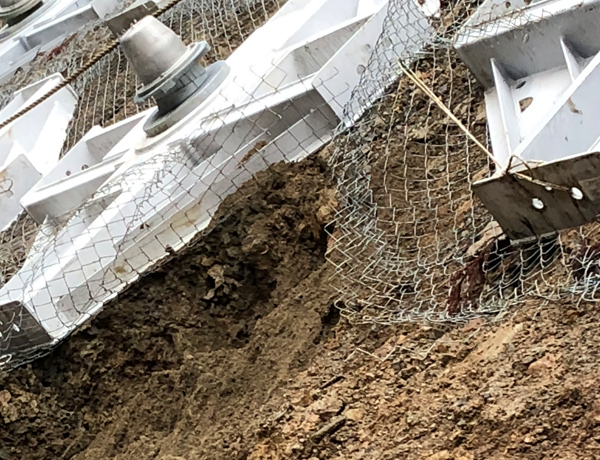
Even if you understand how it works and what measures to take, there’s another pitfall to watch out for on the ground.Bearing CapacityThat's it.
If there is no bearing capacity under tension, the structure under compression will settle.
Since the design concept is for the structural frame to bear the load as a whole, a slight settlement isn't a problem, and the gravity retaining wall basically won't shift at all (it would be a huge problem if it moved here, lol).
The biggest problem isPressure-receiving plateThat's it.
There are various types of bearing plates, but all of them will inevitably sink if there is no bearing capacity in the ground.
At a job site with poor surface conditions that I worked on, the ground subsided by more than 10 cm.
At this point, it was clearly a case of insufficient bearing area, but once we’re in the construction phase, it’s practically impossible to make changes to the load-bearing structure. That’s just how design works, and the materials have already arrived, lol.
If the pressure plate continues to sink, there is a possibility that the design anchor force will decrease significantly.
In other words,In addition to settlement loss and relaxation, the load is also dissipated due to settlement of the ground.That’s what makes it a triple whammy.
To address this type of soil, we use a method in which we fill sandbags with improved soil (soil mixed with a cement-based stabilizer) and stack them around and beneath the load-bearing plate.
When placed in sandbags, the soil forms a solid mass that is less likely to crumble. If a load-bearing plate is installed on top and tension is applied before the stabilized soil hardens, the sandbags will settle into the natural ground.
And above all, on ground like this,Take as much time as possible to let it sink in... While waiting for the sinking to subside.
*The sandbags are UV-resistant, filled with cement-amended material, and should be positioned slightly wider than the load-bearing plate.
When it comes to tensioning methods in ground anchor construction, there are many different approaches and ways of thinking among engineers.
There are so many things you can only understand through experience.
I’ve been writing about how set loss works and how to deal with it, but finally, here’s my honest opinion lol
To be honest, there’s a part of me that’s always wondered, “Do we really need to worry about set loss?” lol
That's because, rather than being extremely tense at 100%, it's better to settle at around 80%, which is the design load, andStandby TypeThat's because I think it's better to leave it that way—that's how it's supposed to be.
If the mountain is temporarily displaced by an earthquake or similar event while it is locked in the 100% state, it may become slightly overstretched, similar to the 110% state.
Excessive tension can lead to uneven load distribution or breakage.
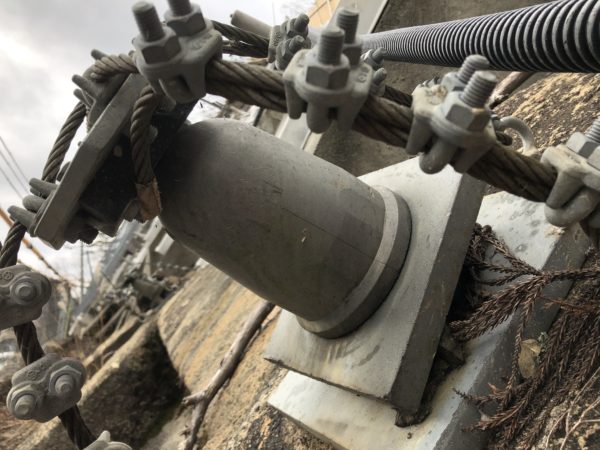
*The head of an anchor that has become overly tight*
In fact, I’ve seen sites where excessive tension in a landslide-prone area caused deformation in the adjacent anchors, and I’ve also had to relieve the load on an over-tensioned anchor and retension it. (Disconnection followed by reconnection)
Keep it around 80% to be prepared for emergencies. In the event of an emergency, the mountain will be securely anchored, and even then, it will remain within about 100%.
So, in my personal opinion,Using the method described in Part 4 (unloading and reloading) to minimize losses, while taking set loss into account, a range of approximately 80% to 90% of the design load is appropriate.That's the idea.
However, this depends on the installer’s judgment, and there’s no single “right answer” in this field.
There are also matters to discuss with government agencies and design considerations to balance (and government agencies are highly unlikely to approve anything that falls below the safety factor).
Consultants don't know about that kind of thing, so they're not too keen on it lol
The more I learn, the less I understand. Civil engineering is really interesting, isn't it!? lol
See you later.
If the ground doesn't have sufficient bearing capacity, the load will be transferred elsewhere.