



Hello, everyone. This is Enta.
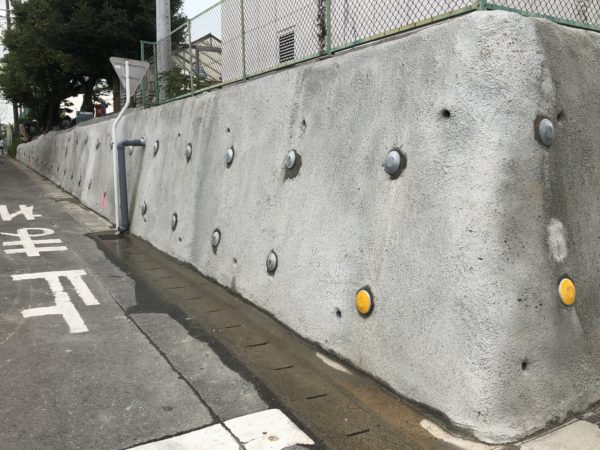
The other day, at a slope construction site contracted by a company other than NEXCO, regarding the end treatment of rebar inserts,A worksite without a capI saw it.
"Oh, so I've finally gotten this far," I thought, so I'm going to write another post about why I'm disliked by materials manufacturers lol
To cut to the chase, it's about time..."No head cap" is the national standardThat's what I want to happen.
I’ve covered this topic before in a blog poll, but I’d like to take this opportunity to organize the evidence and write about it again.
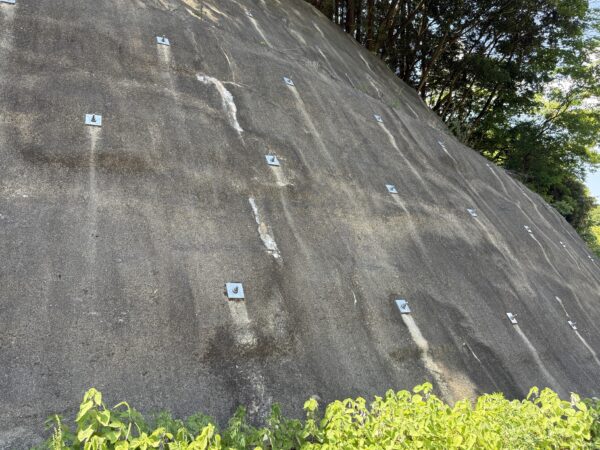
What is the purpose of a head cap, anyway?
The head cap for rebar insertion tools was originallyTo prevent “the rebar in the head from becoming exposed and rusting”This is a component that was created.
This design involves filling aluminum caps with rust-preventive oil to seal nuts, washers, and the heads of rebar.
But today’s topic is: When you really think about it, is this specification really necessary in this day and age?
Let's look at each reason why a cap isn't needed, one by one.
1. Caps were first developed because, in the past, uncoated (unplated) materials were prone to rusting.
Around the 1980s and 1990s, when rebar insertion techniques began to gain popularity, prestressed concrete steel bars and deformed steel bars wereBasically, unplated raw material...was the norm.
Exposed rebar ends corrode when exposed to rainwater and oxygen. That’s why, back then, the standard practice was to build formwork and pour concrete into it.
Alternatively, the prevailing practice was to bury the design within the legal framework.
However, since I can't manage this (even though I'm not actually managing it, lol), I filled the aluminum caps with rust-preventive oil and
That’s how the idea of “sealing it and preserving it in oil” came about.
Given the technical standards at the time, this was a reasonable decision.
The problem is that what was considered “reasonable at the time” has remained unchanged as the standard specification to this day.
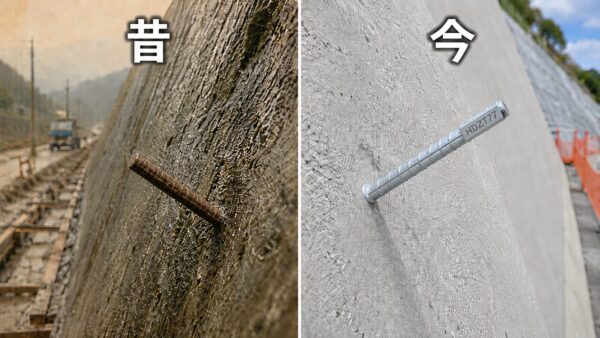
2. Since everything is now hot-dip galvanized, it won't rust.
Currently, the reinforcement materials used in rebar insertion work areAlmost all are hot-dip galvanizedThat's it.
In the past, plating was only done in coastal areas because the materials were too expensive to make it feasible elsewhere.
But before I knew it, both the nut and the washer had been replaced with plated ones as well.
In other words, the very nature of the materials has changed over the past 30 years.
Put a rust-proof cap on a rust-resistant material. When you think about it objectively, this...Status of Dual CountermeasuresThat's it.
The typical coating thickness is HDZ55 (550 g/m²) or greater, and the level of corrosion resistance is fundamentally different from that of the era of bare steel.
3. The plating will last for more than 50 years.
According to corrosion data from the Japan Hot-Dip Galvanizing Association,Approximately 60 years or more in rural areas, and about 30 to 50 years in industrial areasIts service life has been proven.
A figure that fully covers the design service life (typically 50 years) of slope structures.
The feeling that “I’m uneasy unless I wear a cap” is just a holdover from my days as a raw material worker.
4. Nuts (made of iron) are less likely to be stolen than those made of aluminum.
This is a point that doesn't get talked about much, but from a thief's perspective, it's actually pretty important lol
During periods in the past when scrap metal prices soared,Cases Where Aluminum Caps Were Targeted for TheftThere was one.
On the other hand, if the steel nuts are exposed, their scrap value is low, so the risk of theft actually decreases.
This actually goes against the intuition that “leaving things exposed is dangerous.”
What's more, there's a high chance that the price will be reduced for galvanized steel!
5. Just apply some anti-loosening adhesive, and you'll be fine.
To prevent nuts from coming loose, use a product like LoctiteAnaerobic AdhesiveIf you use this, vibration and loosening due to aging will practically never occur.
And even if it does come loose, as long as the head is exposed, you'll notice it right away and can tighten it immediately.
In fact, sealing it with a cap has the drawback that you can't see what's happening inside.
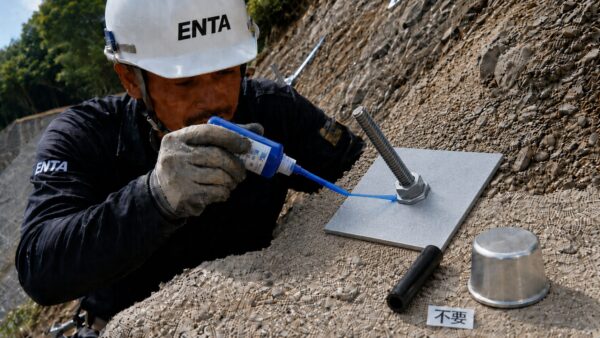
6. At NEXCO, head treatment is already done almost entirely without caps.
This might be the strongest piece of evidence.
As you all know, NEXCO isA contracting agency that takes maintenance seriouslyIt's one of them, isn't it?
Well, if a structure were to fail on a highway that’s open to traffic, that would definitely lead to a major accident.
The fact that NEXCO has determined that "caps are unnecessary" and has standardized this practice. (There is a precedent where caps were eliminated based on past data.)
Why do they continue to demand specifications that are stricter than NEXCO’s for prefectural, municipal, and forest roads with similar or even less demanding usage conditions?
Don't you think that's inconsistent? (Or am I just not thinking things through??)
7. The service life of rust-preventive oil is approximately 5 to 10 years.
This is another little-known fact, but even if you seal it with a cap,The rust-preventive oil inside has evaporated and deterioratedI'll keep doing that.
It is generally said that the protective effect of rust-preventive oil lasts for about 5 to 10 years. (As I mentioned in a previous blog post.)
What's the point of applying rust-preventive oil that wears off in 10 years to a plating that lasts 50 years? lol
In fact, when we open them up during maintenance, we often find that the rust-preventive oil has dried up and become crusty.
The punchline is, “When I opened the lid, nothing was protected.”

8. At the end of the day, it's a waste of taxpayer money
In terms of public works cost estimates, each aluminum cap—including the anti-rust oil—costs around 2,500 yen.
If it's 100 bottles per site, that comes to roughly 250,000 yen.
On an annual basis, the total value of construction projects nationwide ranges from several hundred million to several billion yen.That brings us to the topic of...
If that money can be used to add even one more reinforcement bar, it will definitely improve disaster prevention effectiveness.
Since public works projects are funded by tax dollars, it’s not really acceptable to keep spending money on unnecessary specifications, is it?
What exactly are these economic comparisons we're doing in design...
It turns out the same applies to conduit and terminal caps as well.
We've been talking about head caps up to this point, but actually...The same principle applies to the sheath tube and the tip cap.。
Now that galvanized rebar has become the standard, its significance for corrosion protection has diminished considerably.
The same applies to the tip cap; assuming it will be completely filled with the injection material, there is virtually no reason to protect the tip.
In other words, this isn't just about the head treatment; there are several components throughout the entire rebar insertion process that "simply follow past specifications."
If you take another look at this,The number of reinforcement bars can be increased by several to over a dozen per site.That's the calculation.
Furthermore, the presence of the tip cap and sheath means that grout has not adhered to those parts. (No adhesion)
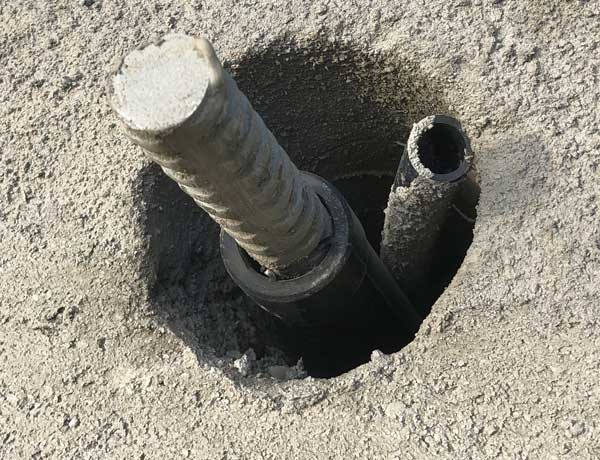
It's just that the design practices haven't been updated
Please don't get me wrong—I'm not trying to speak ill of consultants.
In design, there is a "play it safe" logic that involves following precedents, and I can understand that in itself.
Still, even though both the materials and technology have changed, it does feel a bit off that the drawings and specifications are still stuck in the past, just as they were 30 years ago, doesn't it?
Given that the NEXCO specification has already proven itself with the “capless” design, I think there’s plenty of reason for other contracting agencies to follow suit.
To summarize the reasons for not using a head cap:
- The material does not rust (all parts are plated)
- The plating will last for over 50 years.
- The rust-preventive oil will reach the end of its service life first.
- NEXCO is already toll-free
- In fact, the risk of theft is lower with steel nuts.
- Glue is sufficient to prevent loosening.
- Waste of Taxpayer Money
I think you'll find that convincing lol
Simply by removing the conduit and cap, you can use the money saved to install even one more reinforcement bar.
This serves as disaster prevention infrastructureA purely positive storyRight?
I think things would change significantly if the client, consultant, and contractor—the three parties involved—simply discussed the question, “Do we really need this?” just once for each job site.
It would be fastest if major general contractors and major consulting firms took the lead, but,
Things won't change unless we on the front lines speak up, right?
However, there are exceptions.
We recommend flat caps in areas where contact with a car could be dangerous or where there is a risk of contact with people.
NEXCO also uses flat caps on the lower sections near the vehicle.
See you later.



It’s a completely different industry (control panel manufacturing), but there are pointless specifications based on past practices in every field, aren’t there…
I guess that happens in every world, huh? lol
But these days, it’s time to start cutting back on the things we don’t really need, isn’t it...
It’s pretty common to design products without a sheath or tip cap, but it’s actually pretty rare to design one without a cap at all, isn’t it...
Thank you
Even if you write that it's not necessary, there are some things you just can't do anything about because government offices are clueless and just stick to past practices, right?
That's very unfortunate.