Did You Know? Heatstroke Alerts and Their Background
In recent years, due to the effects of extreme heat and tropical nights, the number of people transported to hospitals due to heatstroke has exceeded tens of thousands annually. There is a risk of heatstroke even indoors, and the situation is serious, with the number of people transported reaching a record high last year.
To protect people from this life-threatening heat, the Ministry of the Environment has been issuing “Heatstroke Watch Alerts”; however, starting in 2024, a new “Heatstroke Special Watch Alert” has been introduced to address even more severe situations.
Please note that, starting this year, the assessment criteria have been partially revised; by excluding cooler locations such as mountainous areas, alerts that more accurately reflect actual conditions will be issued starting Wednesday, April 22.
This announcement covers extremely important information that directly impacts the operation of construction sites. For those of you who are unsure about the differences between the various alerts, I’d love for us to work together to gain a better understanding of them!
What's the difference between a "Heat Stroke Watch" and a "Heat Stroke Special Watch"?
[Heatstroke Alert]
To put it simply, a heatstroke warning is a regional alert that essentially says, “It’s going to be really hot today, so please be extra careful about heatstroke!!”
The goal is to encourage people to pay attention to their own well-being and that of those around them—by thinking, “I wonder if it was this hot last year, too…” or “Everyone’s working hard…”—rather than pushing themselves too hard, and instead reminding themselves, “It’s especially hot today. Let’s stay hydrated and take plenty of breaks.”
It will be announced at "5:00 p.m. the previous day" or "5:00 a.m. on the day of the event."
[Heatstroke Special Alert]
On the other hand, the “Special Heatstroke Alert,” which is one level higher, is a very high-priority alert issued when life-threatening heat is forecast at “all” observation points within the prefecture. It anticipates a serious danger of such a magnitude that “usual precautions may not be sufficient to prevent it.”
It will be announced as early as “2:00 p.m. the day before.”
[The Biggest Difference]
The main differences between these two are the timing of their issuance and the fact that the Special Heat Alert is issued only when dangerous heat is forecast for “all locations within the prefecture.” Once this alert is issued, it is necessary to exercise greater caution than usual and strengthen preventive measures.
What are the disclosure standards, and what are the details?
[1. Presentation Unit]
Heat Stroke Alert: Forecasts are issued based on 58 prefectural forecast zones and other units covering the entire country (with Hokkaido, Kagoshima Prefecture, and Okinawa Prefecture further subdivided).
Heat Stroke Special Alert: By prefecture
[2. Disclosure Criteria and Timing]
Heat Stroke Alert:
Disclosure Standards: Issued when the daily maximum Heat Index (WBGT (*1)) is forecast to reach 33 or higher at any of the observation points providing Heat Index information within a prefectural forecast area or similar region, either for the following day or for the current day.
Presentation Time: 5:00 p.m. the previous day and 5:00 a.m. on the day in question
Heat Stroke Special Alert:
Disclosure Standards: Issued when it is forecasted that the daily maximum heat index for the following day will reach 35 or higher at all heat index monitoring stations within each prefecture (excluding those listed in the “Monitoring Stations” column of the Appendix to the Enforcement Regulations of the Climate Change Adaptation Act).
Presentation Time: 2:00 p.m. the previous day
(*1) Heat Index (WBGT (Wet Bulb Globe Temperature): Wet Bulb Globe Temperature) is an index that focuses not only on air temperature but also on the heat exchange (heat balance) between the human body and the outside air. It incorporates three factors: ① humidity, ② the surrounding thermal environment (including solar radiation and other forms of radiation), and ③ air temperature. Compared to a dry-bulb thermometer, it more accurately reflects temperature increases caused by radiant heat from sunlight and road surfaces, as well as the cooling effect of humidity. (Excerpted from the Ministry of the Environment website)
This information is not only available in weather forecasts but is also posted on the Ministry of the Environment’s heatstroke prevention website and its official LINE account. Since this is important information, be sure to check it every day!
Let's cherish that "Is this a little weird?" feeling!

Heatstroke doesn’t cause you to collapse suddenly; it starts with a slight sense of unease—a feeling that “something just doesn’t feel right.”
If you notice a drastic decrease in how often you use the restroom, or if you feel like, “My face feels unusually hot today” or “My head might be a little light,” those are signs that your body is telling you, “Watch out!” Don’t push yourself just because you still feel able to move—get into the habit of taking a break in a cool place right away and having some water or salted candy.
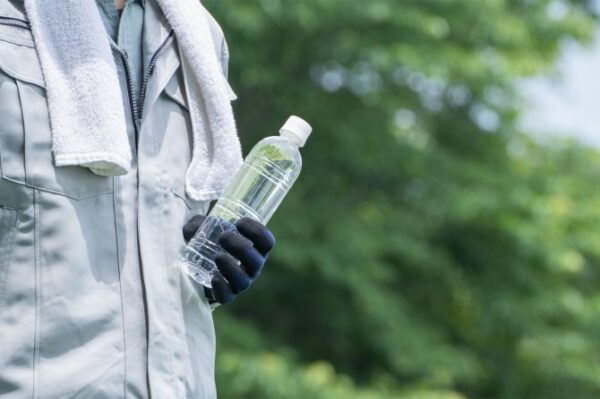
Also, as your stamina starts to wane, tasks you normally take for granted may become difficult. For example, opening the lid of a water bottle or plastic bottle might feel like a struggle. If you find yourself unable to do things on your own more often, don’t hesitate to ask those around you for a little help.
It's very important to address any concerns as soon as possible.
Let’s all look out for each other and protect lives from heatstroke!!
These days, there’s a wide variety of workwear with built-in fans to let air circulate through your body, as well as products that make it easy to cool down. Instead of telling yourself, “I’m still fine,” try actively using these convenient items.
Whether it’s thinking, “I want to finish this much of the work,” or “The deadline is approaching,” there are likely many situations where you push yourself too hard precisely because you feel a sense of responsibility. However, your body is a precious asset that can’t be replaced by anything else. Using your tools wisely—and sometimes making the decision to “take a break without hesitation”—is also an important part of doing your job well.
If you notice any changes in your physical condition and are unsure how to proceed, don’t try to handle the situation on your own—seek professional help. Consulting a nearby hospital or calling 119 without hesitation are the most appropriate actions you can take to protect a precious life. It’s also essential to look out not only for yourself but also for your family and coworkers.
If you notice a small change—such as thinking, “That person seems to be moving more slowly than usual today”—you can gently check in with them. Working together to create that kind of caring environment is the best way to prevent heatstroke.