

Hello, everyone.
This is Enta.
Now that Obon is over, it seems like the heat on the job site has finally started to ease up a bit, but this is still a time when heatstroke remains a real danger if you let your guard down.
Let's make sure to stay hydrated and get enough salt, lol.
But that's beside the point.
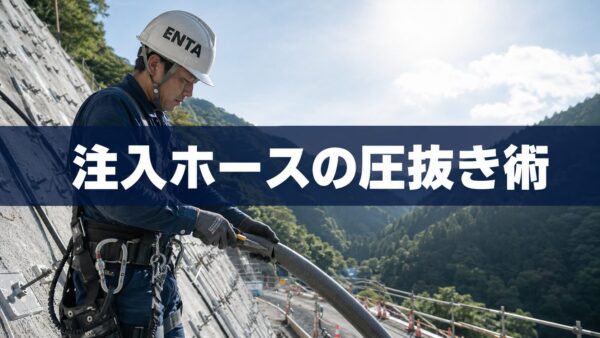
In this article, we’ll discuss a common problem that occurs when injecting grout (cement slurry) during rebar insertion or ground anchor installation—specifically, when pressure remains trapped inside the injection hose, causing it to burst—and how to address it.
I touched on this briefly in a previous blog post, but this time I’m going to dive a little deeper and cover everything from the causes to the actual “techniques” I use, lol.
Why Do Injection Hoses Clog and Burst?
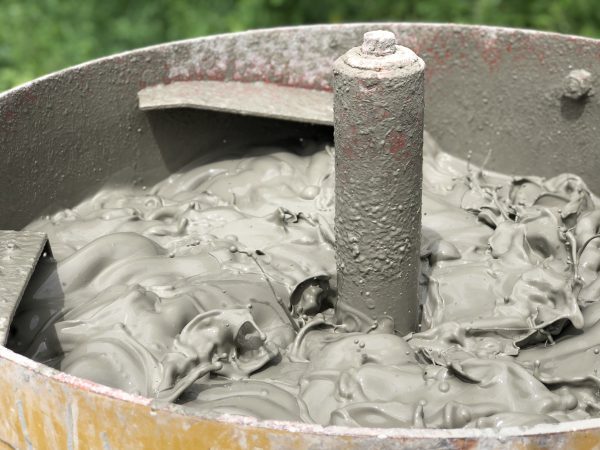
I imagine quite a few of you have had the experience of a hose bursting suddenly due to a sudden surge in pressure while performing grout injection.
On construction sites, the causes of clogs in injection hoses—such as those used by rebar installers—can generally be attributed to the following two factors.
- Soil and sand enter the hose from inside the drilled hole (due to high internal pressure)
- The hose itself bends inside the hole (the tip gets caught)
In either case, the cement slurry that can no longer pass through the hose has nowhere to go, causing the pressure on the pump side to rise steadily.
As a result, the pressure is suddenly released from the weakest part of the hose, causing it to burst.
By the way,The maximum pressure for the polyethylene hose is 0.5 MPa.That's it.
If I wear this, something's definitely going to burst!
The moment it bursts, cement slurry sprays everywhere, and depending on the force, it could even cause injuries, so honestly, it’s not a very pleasant experience.
That is precisely why, rather than aiming to completely eliminate clogs altogether, it is a more practical approach to set up a system in advance that safely releases pressure when a clog does occur.
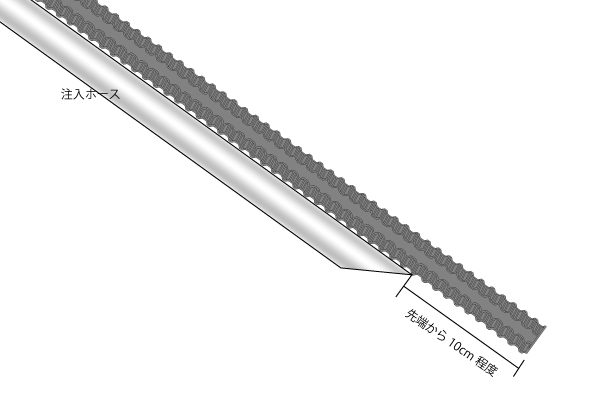
As a basic precaution to prevent this, we recommend positioning the injection hose slightly above the tip of the hole.
Rather than positioning it right at the tip, placing it slightly higher makes it less likely for the tip to become blocked; additionally, cutting the tip at an angle reduces resistance during insertion.
However, since this doesn't guarantee 100 percent protection against clogs, it's important to think about how to relieve the pressure when a clog does occur.
The Concept of Releasing Pressure | V-Cuts and Their Weaknesses
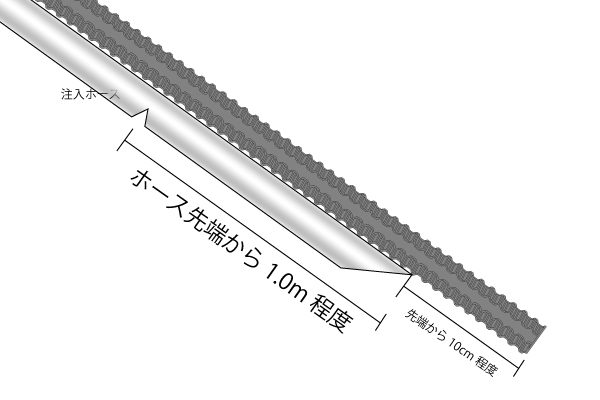
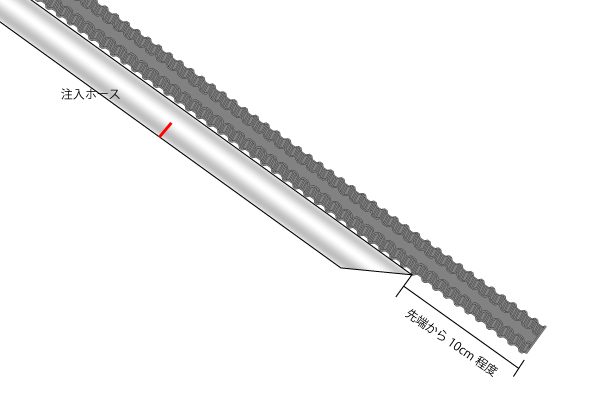
A method that has long been used on-site to relieve pressure when a clog occurs is to make a V-shaped cut about 1 meter from the tip of the hose.
As shown in the photo above, the idea is that by cutting a V-shaped notch in the side of the hose, pressure can escape through that opening when the hose becomes clogged and the pressure builds up.
It's not wrong in theory, but honestly, this V-cut is quite a hassle.
The process of cutting a V-shape with a blade is both time-consuming and dangerous; moreover, depending on the position of the V-cut, the cement slurry may leak out before reaching the intended tip.
"While you can release the pressure, it's hard to tell if the solution is being injected exactly where you want it"—that's the honest truth about the V-cut's weakness.
A Solution That Involves Simply Making Vertical and Horizontal Cuts with a Cutter
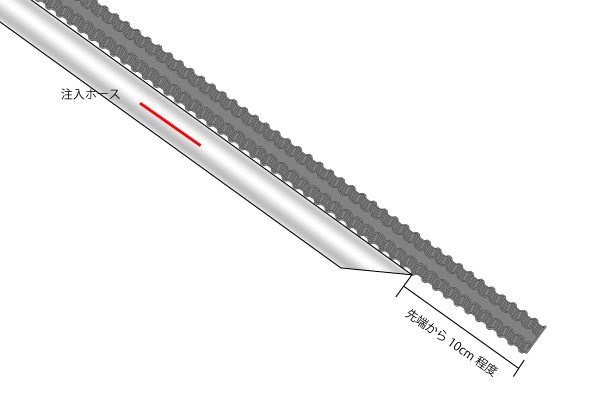
So, here’s a method that’s easier than the V-cut—one I’ve been using on the job for many years.
As shown in the photo above, it's a simple method that involves just making a vertical cut in the hose with a utility knife.
Make cuts at regular intervals—1 meter, 2 meters, 3 meters, and so on. It’s fine to make just one cut, but
At work sites where you know pressure tends to build up, it’s safer to add a little extra and adjust as needed.
As usual, while cement slurry is flowing from the tip at the very bottom, nothing comes out of the cutter's cutting edge.
The mechanism is designed so that, in the unlikely event of a blockage causing pressure to build up, the pressure is released with a "psst" sound through the slotted section, preventing the hose from bursting.
I feel that making horizontal cuts, as shown in the photo above, allows the steam to escape more easily at a lower pressure than vertical cuts.
While a V-cut involves the hassle and danger of using a knife, this method allows you to make the cut simply by pressing the utility knife firmly into the material, making it a relatively easy and safe option.
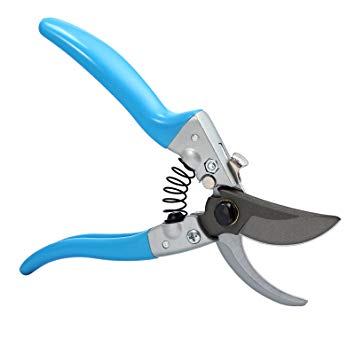
If you're making a horizontal cut, you can simply use pruning shears to snip through the hose cleanly, as shown in the photo above, which is much easier.
However, if you cut too much off the sides, the hose itself will become unusable, so I recommend practicing a little at first before you tackle the real thing lol.
Clumsy people end up cutting themselves anyway, right? lol
How to use them in different situations on-site...
There are certainly a number of people on set who are particular about V-cuts, and I have no intention of dismissing that.
This is because their functions—both the V-cut and the cutter's notch—are the same.
However, personally, rather than getting hung up on strange quirks, I’d prefer to choose a method that reduces the effort and risk, even if only a little.
Although drilling and grouting may seem like mundane tasks, they are jobs where it’s impossible to see exactly what’s going on inside the ground.
That’s exactly why I want to make sure that the mechanism for releasing pressure is simple and reliable.
You don't need any special tools. All you need is a utility knife or a pair of pruning shears, and you can try it right there on the spot, so,
I think the best thing about this method is that it requires almost no cost or effort.
After all, nobody benefits from a hose bursting and cement slurry splattering everywhere, lol.
If anyone out there is struggling with a similar problem on the job, I’d encourage them to try using just a utility knife—without insisting on a V-cut.
However, I’ve heard that some general contractors have recently banned utility knives....
Major general contractors are really doing some pretty stupid things these days, aren't they?
I wonder what you think about the idea that the solution is just to ban everything...
See you later.
I want you to realize that safety involves some acceptable level of risk!