

Hello, everyone. This is Enta.
Today, I’ll summarize the key points for installing self-drilling rock bolts in a Q&A format.
I feel that self-drilling rock bolts are a construction method where “the more experience a contractor has with them, the more cautious they become.”
Although it may seem simple at first glance, each of the drilling, grouting, and measurement steps involves many decision points, and
This is a construction method that often causes confusion on-site.
In this article, we’ll take a step-by-step look at the process—from drilling to final inspection—focusing on the questions we’re most frequently asked.
What Is a Self-Drilling Rock Bolt?
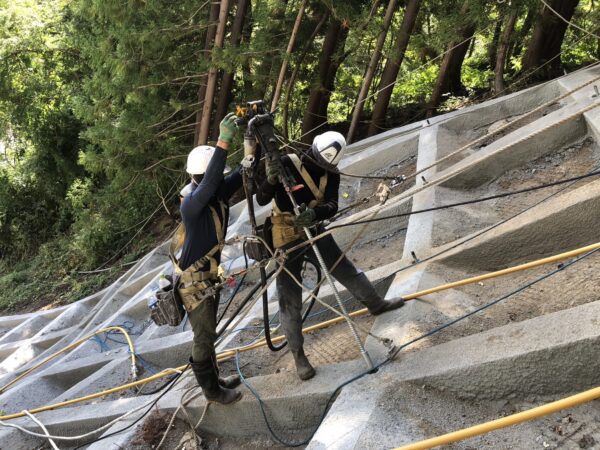
Self-drilling rock bolts are,Drill Bits, Drill Rods, and Connecting CouplersThis is a rock bolt method in which the rod body is left in place within the hole, and grout is injected through the center hole of the bolt.
Unlike conventional perforated types, it is characterized by the fact that drilling and insertion of the main body are completed simultaneously, andNatural rock where the borehole wall is not self-supportingIt is frequently used in this context.
Cement slurry conforming to JIS A 6204 is generally used as the grout material.
The Background Behind the Shift from Permanent to Temporary Use
There was a time in the past when we used self-drilling rock bolts as our standard installation method.
However,Challenges Regarding the Reliability of Injection...and is currently used primarily for temporary purposes.
It has been pointed out that it is difficult to verify whether the grout has been uniformly distributed all the way to the back of the borehole, and that this creates uncertainty in ensuring the design strength.
On the other hand, in recent years,Hot-dip galvanizing specifications (equivalent to JIS H 8641 HDZ55)As improvements in injection verification methods continue, there are now cases where these methods are being adopted for full-scale implementation, depending on the conditions.
However, please note that this is a decision to be made in consultation with the designer; on-site personnel cannot switch between permanent and temporary installations on their own authority.
Construction sites where small drilling machines cannot be brought in are also likely to be discussed.
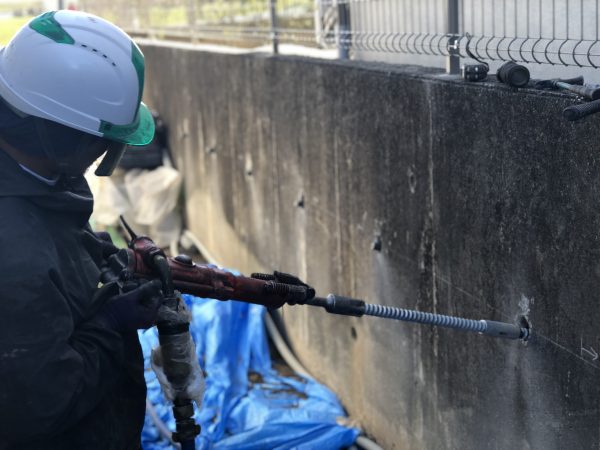
Key Considerations When Drilling Holes
Determining when to drill is simple, and"Are there any Kriko (Drilling Slimes) around?"That's it.
As long as cuttings are being discharged, we can conclude that the borehole wall is holding up reasonably well on its own and that drilling is proceeding.
Conversely, if the flow of the fluid decreases drastically or stops, it could indicate a collapse of the borehole wall or a blockage at the bit tip.
The basic procedure is to pull the rod back about 20–50 cm, check that the air has been expelled, and then feed it out again.
If you continue pushing forward even though no slime is coming out, you increase the risk of the rod breaking or the grout not spreading evenly throughout the area during injection.
Since it’s often too late to notice any issues during subsequent dimensional inspections, it’s important to inspect the holes during the drilling stage.
When it comes to self-drilling, the "go-getter" type just won't cut it!
Basic Rules You Must Not Break When Injecting
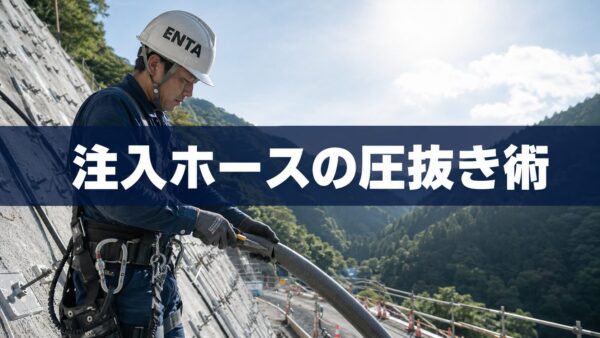
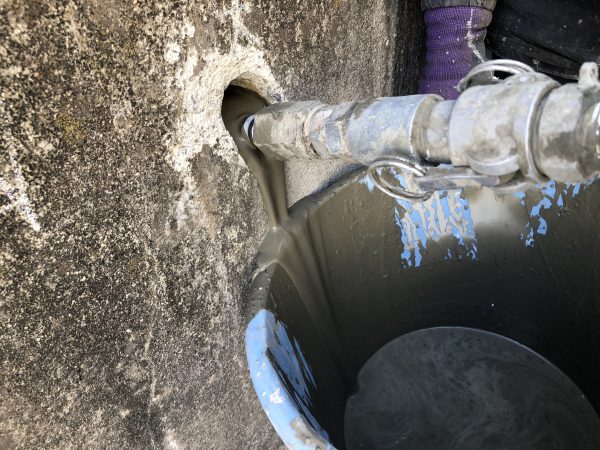
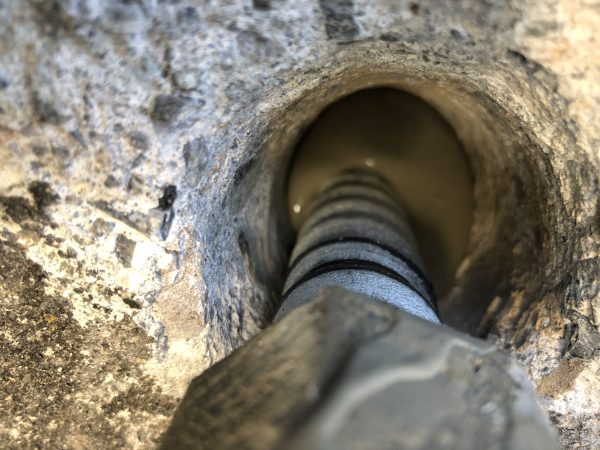
The grouting of self-drilling rock bolts is,The hole in the center of the rod (inner diameter approximately 13 mm)We'll start from there.
Since this method does not involve routing the injection hose separately, injection from the tip is not possible if the inside of the rod is clogged with drill cuttings.
Once drilling is complete, it is essential to check for air flow by passing a rod through the hole.
The fundamental principle of injection is"Inject from the deepest part and confirm that the solution returns to the mouth area."That.
If this is not done, the rock bolt will be only partially filled, and in extreme cases, it could end up being nothing more than a rebar simply stuck in the rock.
So, after drilling the hole, is there any slime coming out? If not, try putting your mouth on the rod and blowing into it.
If it still won't blow, remove the rod once to clear the clog, then re-drill the hole and reinsert it.
After confirming that the grout has returned from the nozzle, it is important to always jiggle the rod (vibrate it) to promote adhesion to the grout.
Without a dedicated injection adapter, the injection process itself cannot take place.Therefore, preparing your equipment in advance is also important.
Frequently Asked Questions (FAQ) from the Field
From here on, we’ll be answering some of the questions we frequently receive on-site and through inquiries.
Q1. While drilling, the clinker suddenly stopped coming out. Should I continue?
A. Please stop advancing the rod for a moment. The hole wall may be collapsing, or the bit at the tip may be clogged.
Pull the rod back about 20–50 cm, confirm that the air has been expelled, and then feed it through again.This is the basic action.
If the problem still persists, pull out the rod to clear the blockage and drill the hole again.
Q2. Can drilling be performed even in cliff faces or highly weathered rock with an N-value of 10 or less?
A. It depends on the conditions, but the difficulty level increases significantly. In rock formations where the borehole walls are not expected to remain stable on their own, drilling itself becomes difficult, and it also becomes harder to confirm the return of grout.
When drilling into a cliff face, there is a high probability that the grout itself will be diverted elsewhere, making self-drilling extremely challenging.
If you attach a swivel to a drilling rig (rock drill) and drill through clay and other materials using a water-cooled method, drilling becomes much easier.
Situations where changes to the construction method should be discussed with the clientThat's right. Rather than forcing the issue and having construction defects discovered later, holding preliminary discussions is actually the quickest way to resolve the matter.
In the worst-case scenario like this, there’s a high chance we’ll have to drill a double-pipe well. (If possible, that is.)
Q3. How do you distinguish between steel bits and chisel bits?
A. The choice depends on the hardness of the ground. Steel bits are suitable for relatively soft ground, but they won’t advance when they hit bedrock.
Bits with carbide tips can handle rock formations up to a certain hardness, but if excessive stress is placed on the rod at points where the rock formation changes abruptly, the risk of the rod breaking increases.
A good sense of how much force to use, andIt's important to watch for a pullback from the peak and decide when to pull back.
Q4. What is the maximum length for a hand-dug borehole?
A. From a cost estimation perspective,About 2.5 meters is a general guideline. For lengths exceeding this, it is practical to consider switching to machine drilling.
If you continue to extend it any further by hand, the clip will not return properly.
However, while we do have experience with depths of up to 5 meters, it depends on the soil conditions, and we used a swivel and a water trench for that project.
Also, since the return of the Kriko (drilling slime) is extremely important, I have to be careful.
Q5. How do you measure the pipe after grouting?
A. Since this method does not require removing the rod,Insert the wire into the center hole (injection hole) to measure the length.I will.
This method involves cutting a piece of wire about 2 to 3 mm long to the specified length and checking the penetration depth.
Since the wire does not reach all the way to the bit, we subtract that distance (generally around 30 mm) when evaluating the length.
Please measure the actual deduction length using the bits in question.
It’s best to check the measuring wire before drilling to ensure accuracy.
Q6. If there is no return signal from the mouth, where should I look for the problem?
A. There are three main causes: (1) clogging of the rod center hole, (2) grout leakage due to borehole wall collapse, and (3) clogging caused by borehole wall collapse.
Checking for Air Leaks Inside the RodSo, the key question is: Will the rod move after placement?
Also, if air is passing through, increasing the pump pressure when injecting the fluid will likely cause it to rise.
Q7. How much should I plan for the excess excavation?
A. To the Chief DesignerA slightly larger-than-usual YohoriUsing this reduces the risk of clogging at the tip.
However, when excavating soft layers such as peat, there is a risk of backflow, so it is not simply a matter of increasing the depth across the board; adjustments must be made based on the conditions of the natural ground.
Signs That Indicate a Veteran Contractor
Finally, here are some tips on how to identify contractors who understand self-drilling rock bolts.
Since this is about what happened after the order was placed, please take it just as a reference.
- I've made sure to bring plenty of spare shank rods with me.: This shows that you understand the risk of loss.
- I own a swivel for rock bolts: It can handle water well drilling, and drilling tends to be stable. Surprisingly few operators own swivels.
- We carry injection adapters in a variety of sizes.: We have the on-site flexibility to respond immediately to changes in rod diameter.
- You can tell a lot about the underlying rock just by the color and amount of the clinker: Experience points are factored into the decision to drill.
On the other hand, I personally don’t really recommend companies that immediately reply, “Self-piercing is easy.”
It is possible that they have not fully experienced the difficulties involved in actual drilling and grouting.
Self-drilling rock bolts are an interactive construction method that works in harmony with the rock mass.
The amount of grout, the vibration of the rod, and the rate at which the grout returns—all of these are based on a wealth of information that can only be gathered on-site.
You won’t be able to grasp the key points of this construction method just by reading the installation manual.
How can we pass on the expertise of experienced craftsmen and construction managers to the younger generation entering the field?
I believe self-drilling rock bolts are a prime example of this type of construction method.
See you later.