

Hello, everyone.
This is Enta.
I'm sharing that this August has been just as sweltering as ever, and I realized that the key to getting work done on-site is to take advantage of the cool morning hours.
Ice slush is absolutely the best!!!!
I think this is a must-have for summer slopes lol (at least for now).
But that's beside the point.
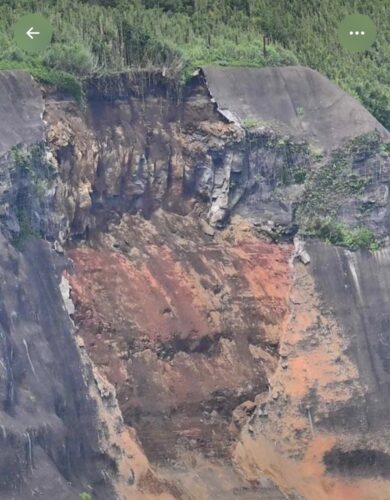
I’m sure you’ve all seen the news coverage of the recent Reiwa 8 Kumamoto Earthquake.
The Ministry of Land, Infrastructure, Transport and Tourism is releasing updates on the damage caused by the earthquake that struck the Kumamoto region on the evening of July 28, 2026, with a maximum seismic intensity of 7.
As was the case during the Heisei 28 Kumamoto Earthquake 10 years ago, when an earthquake of that magnitude strikes, slopes collapse significantly.
After watching those videos and reading the local reports, I’d like to write about something I’ve been thinking about for the past few years.
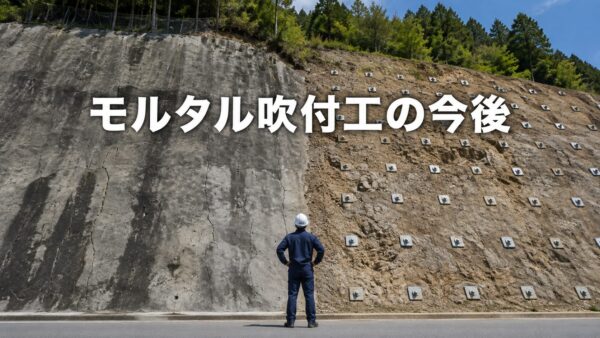
The theme is “The Future of Sprayed Mortar.”
What is the purpose of the sprayed mortar method in the first place?
To begin with, sprayed mortar is applied to prevent weathering.
The “Guidelines for Cut Work and Slope Stabilization in Road Earthworks (Heisei 21 Edition)” (Japan Road Association) also states that the functions of sprayed mortar and concrete include “preventing the weathering of bedrock,” “preventing or mitigating erosion and collapse caused by the infiltration of rainwater and other fluids into the ground,” and “preventing small-scale rockfalls.”
This applies to bedrock that is prone to weathering; bedrock that may weather and flake off or collapse; and soil that, although firm immediately after excavation, is prone to becoming unstable due to seepage water.
The standard spray thickness is generally 8 to 10 cm for mortar spraying and 10 to 20 cm for concrete spraying.
This standard refers to full-scale construction along roads such as national highways.
In short, it is a “protective coating designed to prevent damage to the rock’s surface,” not a construction method that reinforces the rock itself.
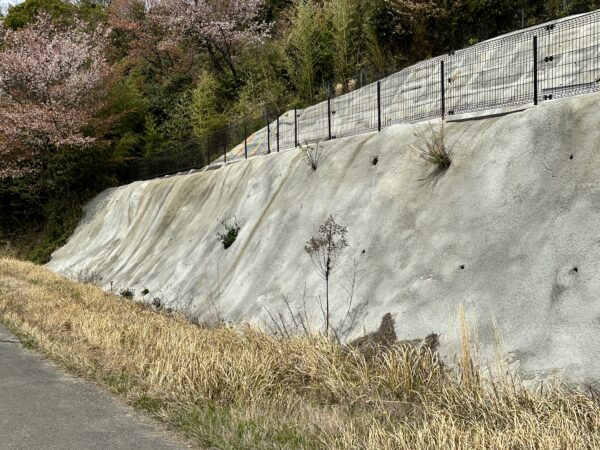
However, when it comes to the actual situation on-site, there has recently been an increase in cases where sprayed mortar is being used as a weed control measure on small slopes less than 2 meters high.
I can totally understand how you feel when you think about the hassle of mowing the lawn, lol.
So, considering that the number of companies offering weed control services is decreasing, this is definitely a viable option, right?
Furthermore, even on mountains where layers of soil and rock alternate, the relatively simple process of sprayed mortar is commonly used.
I believe that, in reality, the scope of actual implementation has expanded considerably beyond the “protection of weather-prone bedrock” envisaged in the guidelines.
The moment you cover it, the danger disappears from view
But is this really okay?
That's what I've been thinking for the past few years.
The reason is that I can't see the danger.
Since it's covered in mortar, I don't know what's inside.
That's exactly why it's dangerous—because you can't see it.
If we could see it, we could take measures, but since we can't see it, we can't take any measures.
And then, it suddenly collapses due to external forces such as earthquakes or heavy rain.
If the natural ground is visible, it’s obvious that “that area is dangerous,” so it’s possible to make decisions regarding evacuation or road closures.
I think that, at first glance, sprayed mortar and concrete work looks like a safe job.
Especially for the general public.
Looking at a slope neatly covered in gray, hardly anyone would think, “That’s a dangerous slope.”
But even we professionals can only determine whether a structure is sound or not by making full use of methods such as tap testing, ultrasonic testing, and infrared thermography.
In fact, when the temperature distribution of a sprayed slope is imaged using infrared thermography, temperature differences appear between the affected areas—such as voids, water accumulation, and delamination on the back surface—and the sound sections; this allows the condition of deterioration to be assessed remotely.
To put it another way, it means you won't understand unless you go that far, lol.
Furthermore, it has been pointed out that, unlike bridges and tunnels, regular inspections of sprayed-concrete slopes are not mandatory, so inspections tend not to be conducted at all.
Who the hell is going to climb up that ridiculously steep slope to do an inspection!? A drone?? lol
To be honest, I’m starting to think that most of the sprayed mortar and concrete contractors out there are pretty shady.
There are a vast number of sprayed-concrete slopes across the country that are 40 or 50 years old, and since no one can actually see what the backside of them looks like now,
Since sprayed mortar and concrete construction is considered to have become widespread around 1955, the earliest examples are now 70 years old.
As for what happens behind the sprayed concrete, the weathering of the underlying rock quietly progresses behind it, and as the weathered soil and rock settle or wash away, voids form between the sprayed concrete and the underlying rock.
If a cavity forms, the sprayed coating becomes “nothing more than a thin sheet” that isn’t supported by the underlying rock, and if water pressure or seismic motion acts on it, the entire sheet will simply snap off.
It’s pretty scary to imagine a mortar slab 8 to 10 cm thick falling from a 10-meter-high slope, isn’t it?
That’s why, during inspections, we use tapping tests to check for pipe sounds (sounds indicating cavities behind the surface) and infrared imaging to detect temperature differences, but honestly, manually tapping the entire slope surface is a grueling task.
Working at heights requires rope access, which involves both time and expense.
As a result, I believe the reality is that many sprayed slopes are left unattended until defects become visible on the surface.
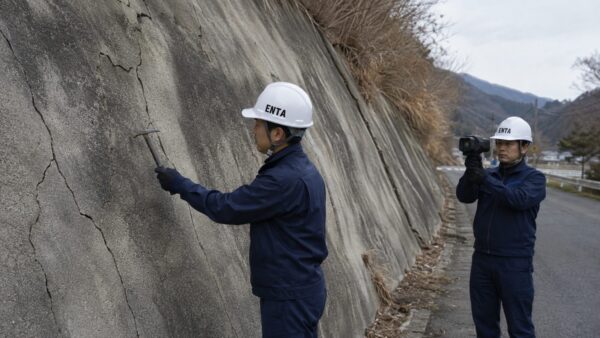
The problem where, once you've blown it, the only option left is to remove it (chipping)
Here's another major problem.
Once you’ve applied sprayed mortar or concrete, your only option afterward is to remove it.
After all, there was a time when people used to say, “As a general rule, deteriorated spray-applied coatings should be removed.”
However, it is said that removal would require large-scale temporary protective fencing, the excavated material would generate a large volume of industrial waste, and construction itself would be difficult on slopes located near roads and residential areas.
That’s why, in recent years, a non-removal method—in which the existing sprayed coating is repaired and reinforced by applying an additional layer of sprayed coating over it without removing the original—has been developed as a major construction technique. It has been registered with NETIS and is widely used, isn’t it?
But here's the thing.
To start with, if we consider existing mortar and concrete to be natural rock (with strength comparable to that of natural rock),
It’s really just a matter of spraying it on from above—but turning that into a “construction method” was a pretty clever idea, lol.
Of course, I understand that this is different from simply increasing the thickness, since it combines various core technologies such as fiber-reinforced mortar, back-fill grouting, and reinforcing bars.
Knowing that, I have to admit it’s a pretty smart business move, lol.
But I’d like you to think about this calmly.
Even if you add material on top, the underlying rock on the back side will still not be visible.
Simply stacking one sealed system on top of another doesn't solve the fundamental problem of "invisible hazards" at all.
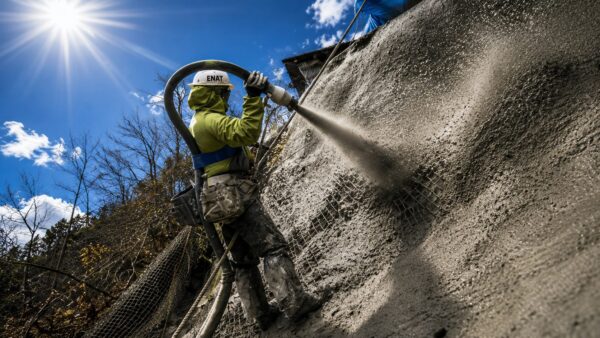
The Concept of Open-Type Countermeasures
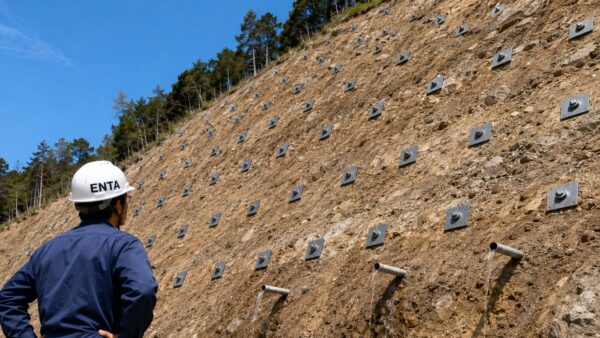
So, as for what to do, I’d like to recommend what’s commonly referred to as “open-style countermeasures.”
The “Guidelines for Earthwork and Slope Stabilization in Road Construction (Heisei 21 Edition)” also state that since it is difficult to manage spring water after construction, open-type construction methods should be used as much as possible when spring water is a concern, and
There is a clear statement to the effect that it is preferable to avoid enclosed construction methods, such as sprayed mortar.
Even at the standards level, they don't unconditionally recommend sealed types, do they?
Personally, I believe that using rebar insertion (rock bolt) and dewatering drilling methods—without resorting to special construction techniques—is sufficient.
Reinforce the natural ground with rebar to prevent surface slippage, and use drainage boreholes to remove water from the rear. (This creates a situation where no water pressure is applied.)
Since the bedrock remains exposed, both the progress of weathering and changes in the spring water can be observed visually.
If any abnormalities arise, we can take additional measures, and if the situation is dangerous, we can decide to close the road or order an evacuation.
When it comes to slope failures, don’t they almost always boil down to just two factors: “water” and “seismic energy”?
The rebar insertion worker is responsible for handling the external energy from slippage, while the dewatering drilling worker is responsible for handling the water.
Their roles are clearly defined, and neither hides what’s on the back.
With dewatering drilling, you can determine the movement of water behind the borehole by observing the flow of water coming out of the borehole opening, and any abnormalities around the head plate of the rebar inserter will reveal what’s going on.
The reinforcement work itself acts as a "sensor for the natural ground."
I believe this is the biggest advantage of open-back headphones that closed-back models don't have.
To put it bluntly, I can’t help but wonder if just the rebar insertion work and the dewatering drilling work wouldn’t be enough.
Well, even if on-site spray-applied formwork is an option, lol
With an open-frame system, you can see the natural ground through the gaps between the frames, so it’s much easier to assess the conditions than with a closed-frame system.
A construction method that makes hazards visible while ensuring the structure remains intact!
I believe this is the mindset Japan’s infrastructure needs going forward.
In that case, personally, I’d like to recommend the “drainage rock bolt method,” but it looks like I’ll finally get a chance to try it out for real soon! (Just a little longer, lol)
I’d like to write about this in more detail in a separate article.
Why Sprayed Mortar Continues to Be the Choice
It might sound a bit odd after writing all that, but I don’t think sprayed mortar workers will disappear anytime soon.
It's inexpensive, fast, has a proven track record, and is easy to design.
From the client’s perspective, there’s no doubt that this construction method makes it easy to choose.
Plus, with all the various trends in society, political considerations, and "adult" factors to deal with, choosing a construction method is actually pretty tough in reality, lol.
In some cases, the choice is made from among the construction methods listed in standard comparison tables provided by design consultants, and in reality, sprayed concrete is often chosen because of its lower unit cost.
We also do a lot of sprayed mortar work as part of our job—like, a looooot! lol
However, considering that an earthquake like the Reiwa 8 Kumamoto Earthquake struck again just 10 years later, even at this very moment, behind aging sprayed-concrete retaining walls across the country,
I think we can't rule out the possibility that erosion and hollowing out are progressing without anyone noticing.
For new construction, use it only on “bedrock that would normally require shotcrete,” in accordance with the guidelines; in areas where water is present or on interlayered slopes, select the open-type system.
For existing facilities, we’ll conduct thorough inspections and gradually rebuild the problematic areas using an open-type design. (Not saying we’ll actually be able to do it, lol.)
When it comes to Japan’s future infrastructure, I’m thinking it might be better to build it in a way that’s visible.
When I think about it that way, I get the feeling that the number of sprayed mortar and concrete workers will gradually decline going forward. In the long run, perhaps!?
So, it’s safer when you can see the danger, right?
See you later.