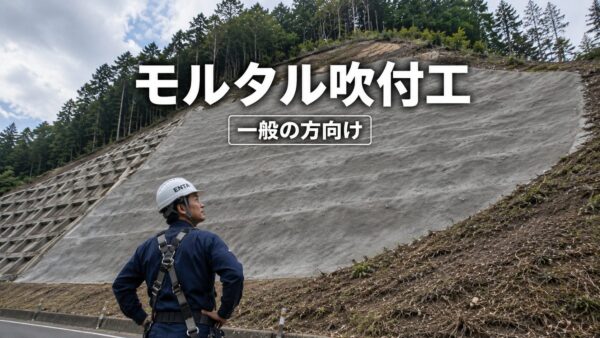
Hello, everyone.
This is Enta.
Now that it's July, summer is in full swing on the job site.
The glare off the sprayed surface is really intense, so let's make sure to take proper precautions against heatstroke ^^
In particular, the WBGT index table for slopes is different from that for flat surfaces!! (Just a guess, lol)
But that's beside the point.
"How do you manage the thickness of sprayed mortar and concrete?"
People ask me this every now and then.
This is a basic point, but managing the spray thickness and addressing situations where the thickness is insufficient aren't things you can do right away!
I know some of you might be thinking, “Huh?”, but this is serious, and—The thickness of the spray coating depends on the craftsman.That's it.
In this post, I’ll discuss the reasons behind this and the only practical solution available on-site.
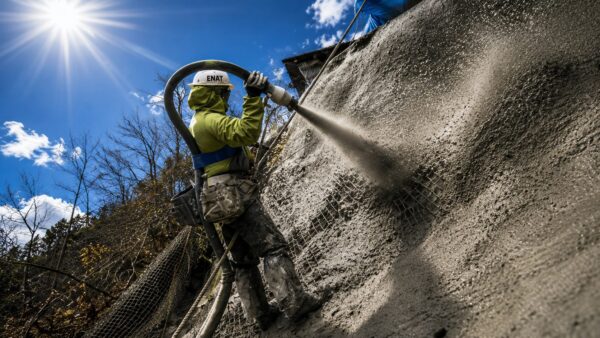
The Reality That Controlling Spray Thickness Depends on the Craftsman
In formwork construction, there are formwork panels, right?
Having a mold means that the dimensions are guaranteed by the mold itself.
So, unless something really out of the ordinary happens, it’s unlikely that the finished product will fall short of specifications.
However, the quality of sprayed mortar and sprayed concrete work depends entirely on the skill of the craftsman.
Since Nozzleman sprays based on his own judgment—thinking, “This should be about right”—if the craftsman isn’t very skilled, the spray quality may be poor (with excess material hardening),
There may be cases where the thickness is insufficient.
This is something we administrators are all aware of, isn't it?
So, how can we get around this?
To put it bluntly, the only option is a spacer.
Honestly, this is the only option!
I’ll explain why I can say that with such certainty, step by step.
What do the quality control standards say?
What happens if a defect is pointed out during an inspection?
You’ll check the specification values listed in the as-built inspection standards, right?
According to the Ministry of Land, Infrastructure, Transport and Tourism’s Standards for Construction Management of Civil Engineering Works (Standards for As-Built Inspection),
For sprayed mortar and concrete, the standard tolerance is -10 mm if the design thickness is less than 5 cm, and -20 mm if it is 5 cm or more.
Furthermore, if the sprayed surface is uneven, it is considered acceptable to ensure that the minimum spray thickness is at least 50% of the design thickness and that the average thickness is equal to or greater than the design thickness.
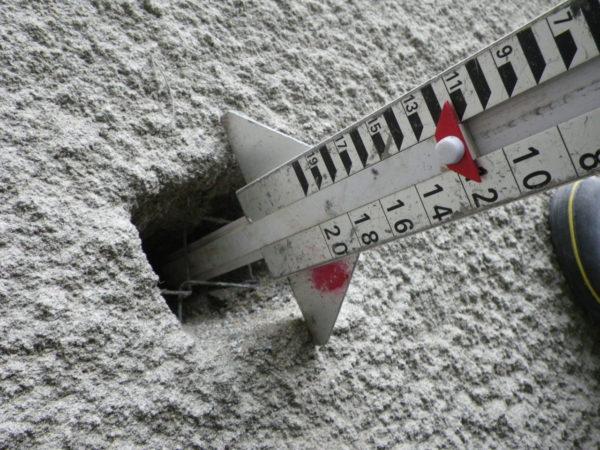
Measurements shall be taken at one location per 200 m² of construction area; for areas of 200 m² or less, two locations shall be measured per construction site by drilling holes.
In other words, while a thickness of 50% or more may be sufficient in some areas, it’s not acceptable if the average thickness falls below the design specification.
This phrase, “the average thickness is equal to or greater than the design thickness,” is a bit of a tricky one.
Let's look at a specific example.
Suppose 10 inspection holes were measured at a site with a design thickness of 8 cm.
If 9 of the holes are exactly 8 cm and only one hole is 4 cm.
Since the minimum spray thickness is 4 cm, 50% of the design thickness (4 cm) is ensured.
However, the average thickness is 7.6 cm, which is less than the design thickness of 8 cm, so it doesn't meet the requirements.
If there's even just one thin spot, you're pretty much screwed on average unless the other areas are coated really thickly lol (though that's highly unlikely, of course).
That's why it's dangerous to think, "As long as I have at least 50%, I'm safe, so it's okay."
Since this is more common than average, the top priority is to prevent thin spots from forming in the first place.
This is what makes controlling the thickness of spray-applied coatings so tricky.
"No, no, it'll be fine!!?" That's what I think, too, but when you consider that the Japanese population is going to decline in the future, we can't afford to let our guard down!
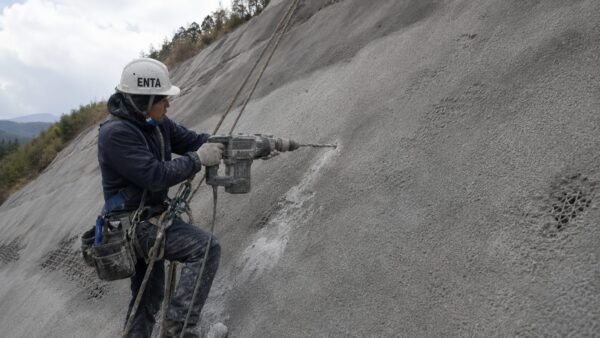
Memories of drilling with a hammer drill on the day of the inspection
In my experience, there was a job site a long time ago where a senior colleague was told that the spray-applied coating wasn't thick enough.
Back then, it was common practice to drill into the sprayed coating on the day of the inspection, so we would use a hammer drill to drill into the spot指定 by the inspector on the day of the inspection and then wait.
The process was to first complete the document review, followed by an on-site inspection to verify the thickness.
These days, it’s generally standard practice for the person in charge to check it before the inspection and fill it in by the time of the inspection… though there may be differences depending on the region.
In the end, the surface didn't have enough thickness—it was a spray-applied coating covering about 1,000 square meters—but following the inspector's instructions, we drilled a ton of inspection holes!
Well, since it somehow managed to exceed the design specifications on average... I somehow passed (maybe thanks to the alumni network!? lol)
It sounds like a joke, but it's actually true lol
Even if I realize after I've already blown it that it's not thick enough, I can't fix it right away.
I couldn't possibly do something like that.
Do I have to start all over from scratch? That'll take time and money.
That's exactly why I have no choice but to clap my hands before I start playing and while I'm playing.
Why Is It Difficult for Supervisors to Control Spray Thickness?
Why is this happening?
This is because the process relies heavily on skilled craftsmen, making it difficult for managers to control the thickness.
If an supervisor were to perfectly control the spray thickness, they would have to hang right next to the spray operator and use a pin pole to check it.
This is so annoying lol
I feel like Nozzle Man is gonna give me that look lol
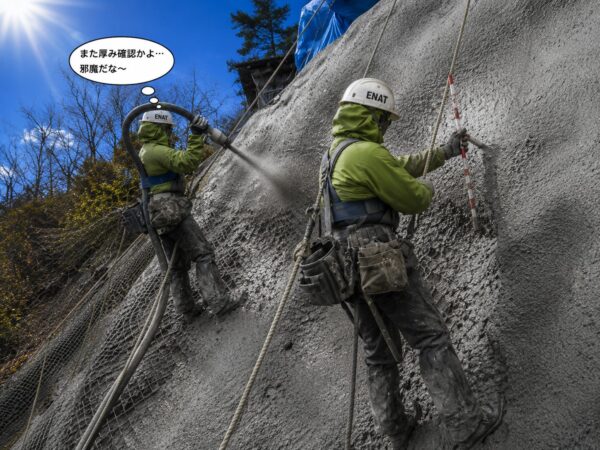
Actually, that's pretty much the only way to check it all the time!
Besides, it's physically impossible to watch the entire spraying process.
So, what should we do?
First, let Nozzleman know in advance which areas are likely to thin out!
And since Nozzleman is human, too, he’ll give further instructions once you get to the area he indicated.
It's just the same thing over and over again.
Once you become a somewhat experienced nozzle operator, I think you'll start to get the hang of it.
The areas where the surface is uneven tend to become thinner.
Conversely, the lower areas tend to be thicker.
Since the protruding areas extend beyond the reference plane, it’s difficult to achieve the designed thickness unless you’re careful when applying the material.
Ideally, the design thickness should be uniform throughout, but it’s not always that simple, is it?
Therefore, Nozzle Man is required to blow accurately, using the protruding part as a reference.
In the past, they would mark the thickness on the pin pole, and the nozzle operator would spray the mortar while pushing the pole into it.
They're still around, though.
This is fine just the way it is.
It shows that you're committed to applying the spray thoroughly and carefully.
And if that allows you to avoid substandard work, then it’s an excellent management method.
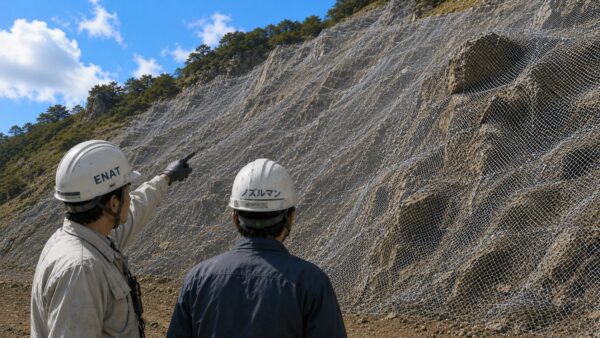
In the end, all I have is a spacer.
And the only thing that can easily solve this reliance on skilled craftsmen is a spacer.
It's simple.
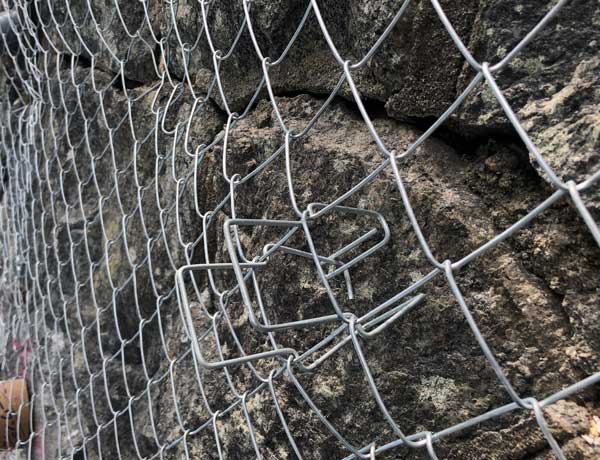
Be sure to insert spacers in areas where the material is likely to become thinner.
If you're worried, just add a little extra!
Then, spray the paint so that it covers the spacers.
This alone ensures the required spray thickness.
From Nozzleman's perspective, this provides a clear goal—"spray until the spacer disappears"—which significantly reduces the need to rely on intuition.
The less experienced the craftsman is, the more they have no choice but to use spacers.
If removing the spacer is all it takes to ensure the required thickness, you should definitely do it.
To be honest, it doesn't really matter whether the bottom wire mesh is right in the middle of the sprayed coating or not, lol.
However, the higher the lintel is positioned (above the natural ground level), the less likely the mortar is to drip, which means it bonds better with the natural ground.
Therefore, inserting spacers also serves the purpose of improving the bond between the subgrade and the mortar.
Ensuring sufficient thickness and proper integration with the natural ground.
Since one spacer works for both, there's no reason not to use it, right?
Besides, the hassle of using spacers is nothing compared to the losses you’d face if you had to do extra spraying or touch-ups because the finish wasn’t up to par, lol.
While it is physically impossible to control every single thickness, the use of spacers helps reduce reliance on the craftsman’s skill, even if only slightly.
Being a "Nozleman" is a job that relies heavily on individual skills.
But I think it’s also important to make sure that trainees from Vietnam, Nepal, and other countries can do that as well.
If all you say is “Hone your skills,” the project will be over before people have a chance to grow, lol.
The discussion was that spacers are the key component in the sprayed mortar process used for that purpose.
If you're having trouble controlling the thickness, start by adding extra spacers to the raised areas that are likely to become too thin.
Just this alone will really help ease that stomach pain before the exam, lol.
If you're confident in your management skills or can say, "I use skilled craftsmen!", then that's perfectly fine!
We recommend using spacers simply because we want to minimize risk as much as possible.
However, plastic spacers are a no-go!
The Ministry of Land, Infrastructure, Transport and Tourism recommends using steel spacers.
See you later.
Creating the Best Products as Fast as Possible Within the Minimum Rules | The Slope-Worker’s Way