Hello, everyone.
This is Enta.
Sometimes, young workers on the job site ask me, “So, how many spacers should we actually put in?”
The more experienced you are, the more you rely on instinct, so when you actually try to explain it in words, you get stuck lol
I think I'll set the record straight on this one.
This is about the "number of spacers for slopes."
To cut to the chase, there are absolutely no rules regarding the number! LOL (You don't really need to read any further, but I'd still like you to read on anyway.)
There are no "rules" regarding the number of spacers.
When asked, “How many should I put in?” this is the first thing I want to say.
There are no specifications regarding the number of items in any of the documents or specifications.
So, what criteria do most contractors use? Well, it seems that many of them operate on the general rule of about one unit per 3 square meters.
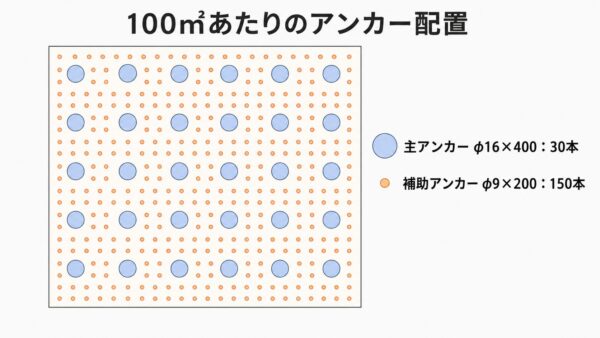
The key factor here is the number of anchors used for the last layer.
For the final layer, there are 30 main anchors (φ16 × 400) per 100 square meters and 150 auxiliary anchors (φ9 × 200) per 100 square meters.
These are the official standard values for roof decking work.
That makes 180 in total, right?
I used this as a reference for the number of spacers back in the day!
However, this is based on the idea that “since the anchors are driven into the ground to lift the reinforcing mesh, you need to add spacers accordingly,”
It stems from old-fashioned, unfounded ways of thinking.
When I was first told that, I thought, “Really?” (I was skeptical) lol
But in reality, we’ve been installing them in these quantities.
The real reason for inserting spacers is to “ensure the spray thickness.”
I've been using PC spacers lately, and I usually put in more than 10 of them.
The reason for including it is clear: to ensure the required spray thickness.
A skilled Nozzle Man might say, “I don’t need something like that,” but personally, I can’t believe such an implausible story lol.
We always use spacers to ensure the correct spray thickness and finished dimensions.
Whether you're skilled or not, use this to ensure a solid installation!
To be honest, it doesn't matter where the reinforcement mesh is located—whether it's in the middle, at the top, or at the bottom of the sprayed concrete.
The strength of the lath mesh in sprayed mortar and concrete hasn't been calculated, and there aren't any references that specify that the lath mesh should be positioned exactly in the center.
Occasionally, there are inspectors who are concerned about the concrete cover of rebar, but that’s only an issue for rebar whose position is clearly determined based on strength calculations.
Reinforcement cover requirements do not apply to lath wire mesh that does not affect structural strength.
So, what is the purpose of the mesh? As stated in the construction plan, it’s used to improve the bond between the mortar and the subgrade.
Secure the wire mesh to the natural ground using anchor pins.
In that case, the net won't move, right?
By spraying mortar onto that surface, the natural ground, the wire mesh, and the mortar become integrated.
I think it would be easier to understand if you think of the spacer as the component responsible for controlling the thickness in that situation.
Furthermore, the inclusion of spacers increases the amount of contact between the mortar and the wire mesh.
So, when it comes to improving the fit, it really does make sense to use a mesh lining.
The mortar will also stay in place and won't drip or fall off.
So, as for the all-important question of “how many should I put in?”
If they're placed at a density similar to that of auxiliary anchors, I think we'll be able to maintain the proper thickness even during spraying.
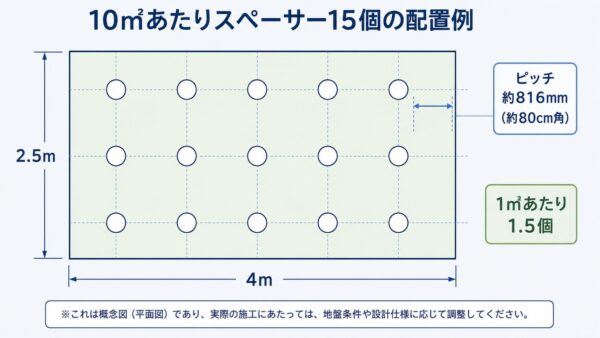
Based on my experience and my own theory, I’d say—maybe 15 or more per 10 square meters!? That’s the general idea, lol.
What do you think? lol
To calculate this specifically, 15 units per 10 square meters means that each unit covers an area of approximately 0.67 square meters.
For a square layout (arranged with rows and columns aligned), the pitch is approximately 816 mm.
In short,Roughly one piece measuring 80 cm squareIt’s kind of a matter of filling it in as you go. You could just remember that it takes about 1.5 pieces per 1-meter square.
If you apply it at intervals like this, you should be able to achieve the correct spray thickness and finish.
To be honest, there isn't really a set standard that someone has laid down regarding the number of spacers.
It's a world based on intuition—one where professionals have built up a sense of "if I put in about this much, it'll be fine" based on their individual experience.
But I think at the root of that atmosphere lies a solid sense of reliability—as people working on-site—that comes from “ensuring the spray thickness is accurate” and “delivering precise results.”
It's not so much about the actual number of items, but whether you understand why you're putting them in there.
I think this is the biggest one. I’d like to make sure even the younger kids know that, lol.
See you later.
Reinforcement Installer: How many anchors need to be installed!?