

Hello, everyone.
This is Enta.
The slope in August is scorching hot first thing in the morning, so our work uniforms with built-in fans are working overtime.
It's that time of year when the battery runs out before my body does, lol.
I'm seriously gonna die lol
But that's beside the point.
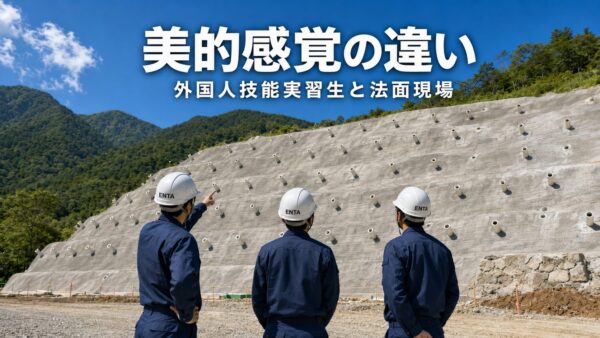
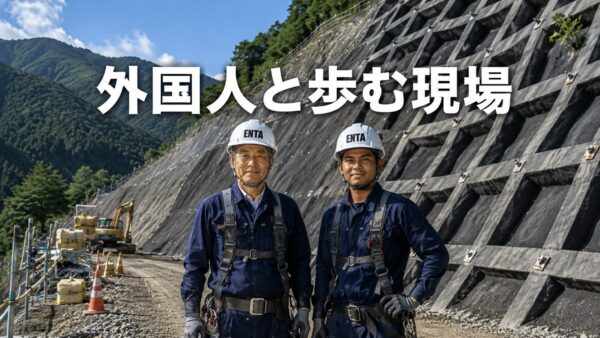
This time, I’m not going to talk about technical matters, but rather about the “differences in aesthetic sensibilities” that I encounter every time I work on slope stabilization projects with foreign technical trainees.
I think anyone in the construction industry who works with trainees from Nepal or Vietnam will probably nod in deep agreement with this ^^
The drainage pipe is not "clear"
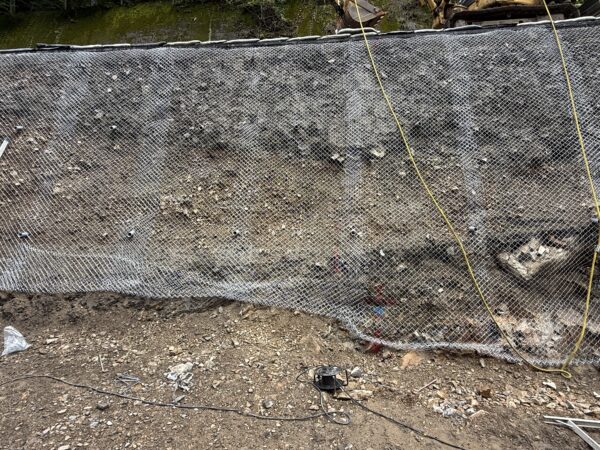
This happened the other day while I was working on a slope construction project with some interns.
We had the drain pipes installed based on instructions such as “one per 3 square meters.”
And yet, it is actually stuck in there.
The numbers are correct, too.
But when you glance at it, the PVC pipes aren't lined up in a straight line.
We Japanese can’t help but say, “Why is it like this?” the moment we see that, can we?
But from the trainee’s perspective, it’s like, “No, no—it’s going in exactly as you said it would.”
The same applies, for example, if you give the instruction, “Install them every meter.”
It is 1 meter long.
But the heights are all over the place, so it's just bumpy.
And the person themselves can't even see those bumps and dents, can they?
This is about the "path" along the slope.
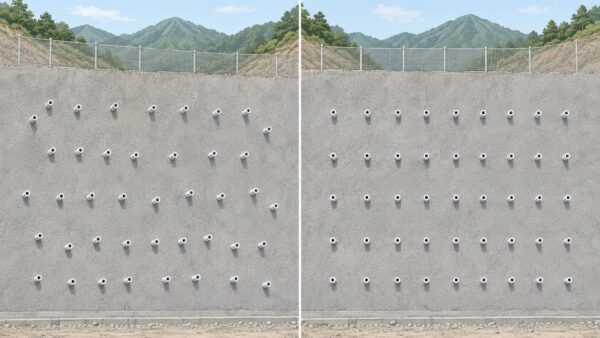
The difference in perception between “books are placed there” and “books are scattered about”
To explain this difference in sensation in simple terms, let's use the example of a book on a desk.
If there were a pile of books scattered haphazardly, I think any Japanese person would notice and think, “That’s a mess.”
To the interns, that seems perfectly normal.
When I say “ordinary,” what I mean is the feeling that “there’s a book there.”
While Japanese people notice that the books are "scattered about," they see only the fact that "there are books there."
That’s why, even in civil engineering construction, it’s easy to fall into the mindset of “as long as it’s there, that’s good enough” or “it’s fine as long as it exists.”
If you look at it purely in terms of functionality, the water drains out, and you can read books.
In a way, it’s actually very logical.
However, in the Japanese workplace, appearance is considered just as important as quality.
After all, if the work looks sloppy, that alone will lead people to judge it as a “site that isn’t being properly managed.”
This part is really hard to explain.

I decided to investigate why our perceptions differ so much.
I did some research to find out why there is such a big difference between Japanese people and trainees.
As I’ve been doing some research on various topics, I’ve frequently come across the concepts of “high-context cultures” and “low-context cultures,” as proposed by cultural anthropologist Edward T. Hall.
Japan is considered one of the world’s most representative high-context cultures—that is, a cultural sphere based on the expectation that people will “read the situation and act accordingly without being told.”
Phrases like “align the edges,” “match the surfaces,” and “insert it straight”—aren’t those unspoken understandings that Japanese people get without even having to say them?
However, it seems that this expectation of “reading between the lines” doesn’t work at all with people who don’t share the same cultural assumptions.
In fact, according to materials from various companies and supervising organizations regarding the acceptance of technical interns, misunderstandings caused by language barriers and cultural differences are cited as major challenges in the workplace.
In other words, the fact that “no matter how many times we say it, they just don’t get it” seems to stem largely from our own tendency to rely too heavily on unspoken assumptions, rather than from any lack of ability on the part of the trainees.
That really hits close to home, lol.
I can't even count how many times I've said, "You can just tell by looking, can't you?"...
It's hard because you can't tell just by looking, isn't it?
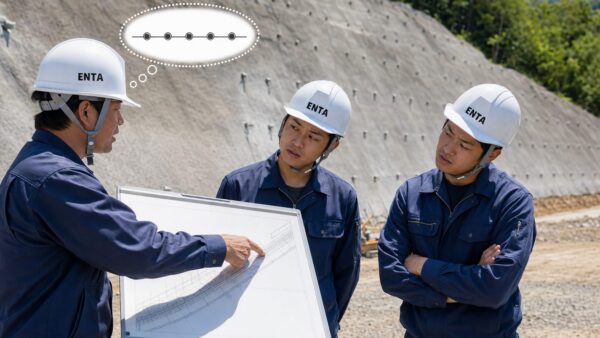
Even so, there are still kids who move in a way that seems "typically Japanese."
That said, it’s not all doom and gloom.
Every now and then, a girl with great taste pops up.
To be honest, I don't know if this is just my natural inclination or if it's something I've picked up through habit.
However, every now and then, a child appears who exhibits “typically Japanese behavior”—that is, being mindful of the street or the neighborhood on their own initiative.
In that case, that student teaches the other interns in their native language, which is a huge help.
From our perspective, the key will be how we raise this child.
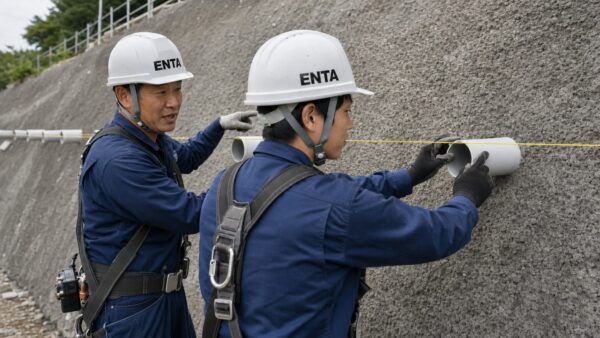
Speaking from my own experience on the job, I’d say we should ditch abstract terms like “neatly” and “properly,” and instead,
I feel that the best way to convey visual standards—such as “align it along the string” or “trim it to a height of 30 centimeters above the ground”—is to use numbers and tools.
This is just my personal impression from the field, but I think it’s about translating that intuition into a form that can be measured, rather than simply teaching it.
All things considered, if we look solely at functionality, their approach might actually be the more rational one.
However, in the Japanese construction industry, appearance is considered part of quality.
I’m sure there are many people on the front lines who are at their wits’ end because no matter how many times they say it, nothing changes—no matter how many times they say it, the same thing happens over and over again.
Even here, the bosses are always scratching their heads over this, lol.
That said, trying to get someone who doesn’t “pick up on cues” to understand what you mean is also a problem with how you’re communicating.
Translating tacit understandings into numbers and tools.
It may seem unassuming, but I’ve learned once again that this is how we’ll manage to survive alongside foreigners lol
Let's create something tangible that's easy to understand, even without putting it into words!
See you later.
Let's Shake Up Our Complacency | A Warning Against Arrogance