Hello, everyone.
This is Enta.
Do you hold technical training sessions on anchors?
I generally make it a point to attend study sessions (almost always, lol).
The reason is simple: working underground, where you can’t see what’s going on, remains full of mysteries no matter how many years you do it—and that’s what makes it so interesting.
And that's because new technologies are gradually emerging!
But that's beside the point.
In this article, we’ll cover the basics—specifically, “What exactly is ground anchor construction?”—by comparing on-site experience with established standards,
I'll break it down and explain it in simple terms.
I'll write this in a way that even newbies can understand, so veterans, feel free to use this as a refresher lol.
What Is Ground Anchor Construction? It’s a soil reinforcement method based on the concept of “pulling to support.”
First, let's start with the big picture.
When it comes to ground reinforcement, people often have a strong image of “pressing down” (compression)—such as retaining walls or backfill—but,
Ground anchors, on the other hand, are a construction method based on the concept of “pulling to support.”
To make it easier to visualize, think of a rubber band.
Dig a hole in the ground and secure the tip of the rubber at the bottom of the hole.
While pulling that rubber band really tight, secure the other end to the ground.
As a result, the soil sandwiched between the rubber bands is compressed and becomes immobilized.
This is the basic principle behind anchors, and it’s explained using this “rubber analogy” in a certain technical document.
This is an extremely important ground reinforcement technique used for preventing the collapse of cut slopes and natural slopes, preventing the overturning or sliding of retaining walls, and mitigating landslides.
The foundation for design and construction is,The Japanese Geotechnical Societyの"Design and Construction Standards for Ground Anchors, and Explanatory Notes (JGS4101-2012)"is used as the standard.
If you're ever stuck, this is the first thing to use as a guide.
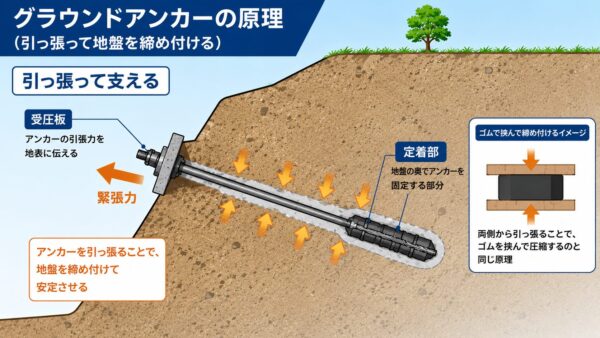
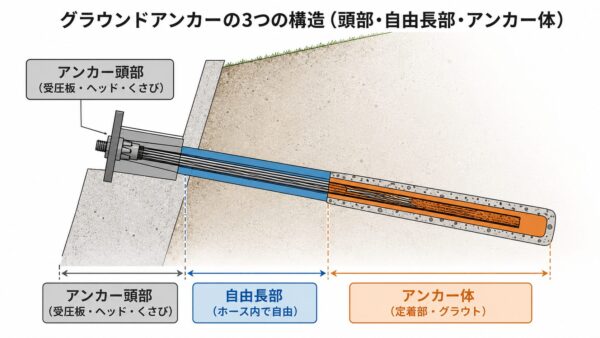
There are three basic components: the anchor head, the free length, and the anchor body (anchorage section)
Ground anchors consist of three main parts.
1. “Anchor head.”
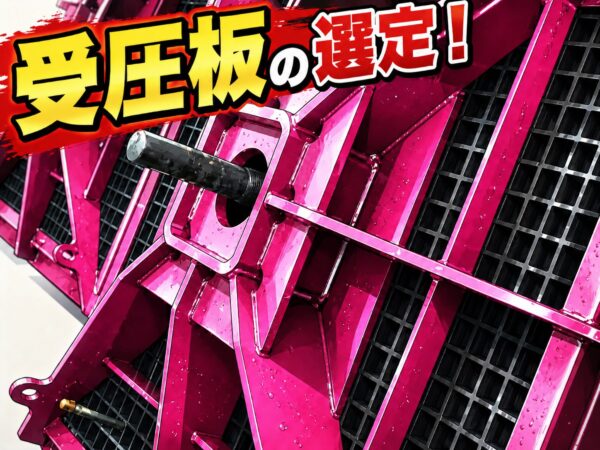
This is the part that absorbs forces at the ground surface and consists of a load-bearing plate (load-bearing structure), an anchor head, and wedges or nuts.
Here, the tensile force is transferred to load-bearing structures such as the formwork, and the ground is held in place by the entire surface.
2. “The Longer Discourse on Freedom.”
This is a section where the PC steel strand (tendon) is isolated from the ground inside the hose so that it can move freely.
It is precisely because of this structure that the force applied to pull the tendon is directly converted into downward pressure on the head.
3. “Anchor body (anchoring section).”
This is the section where cement-based grout was injected deep into the ground to integrate the tension members with the soil.
According to the book, the tensile force is transmitted to the ground through the frictional resistance at this point (rock mass + cement slurry + anchorage) and provides support.
PC steel strands and PC steel bars that comply with JIS standards are used as tension members.
There are different types based on how the load is transmitted, such as “tension-type” and “compression-type,” and each company has its own unique features, but,
To be honest, from our perspective as the contractors, there isn't really much difference between the basic pouring methods, lol.
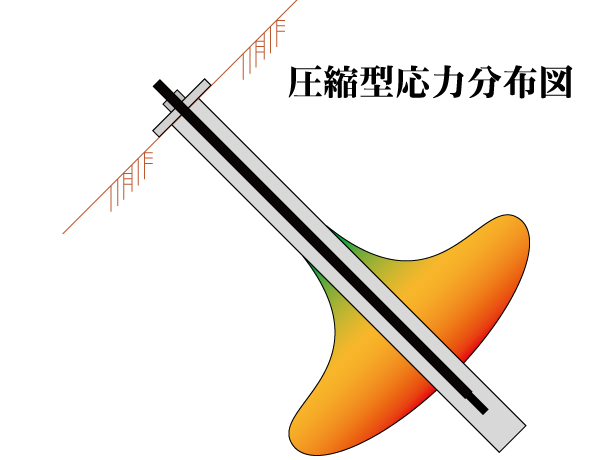
Here's what I have in mind.
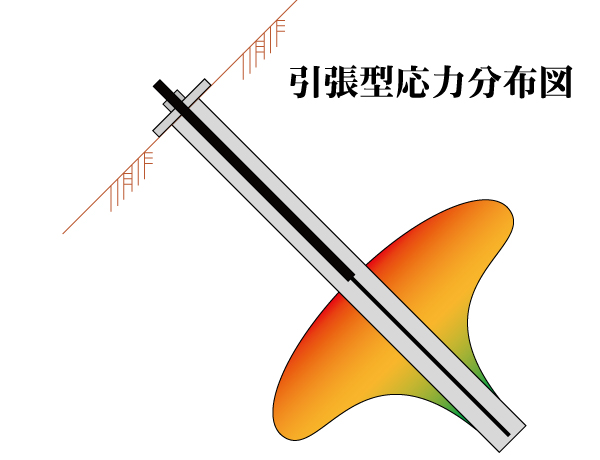
Incidentally, the standard anchor embedment length is between 3 m and 10 m, and the standard anchor free length is generally 4 m or more; the length determined during the design phase is in 50-cm increments,
There is a rule stating that the minimum spacing between anchors must be at least 1.5 meters (group effect).
It’s good to keep these things in mind when reading a design.
You Can Only Perform When You’re Under Pressure | The Basics of Stress Management and Exams
Ground anchors do not function simply by driving PC steel strands into the mountain.
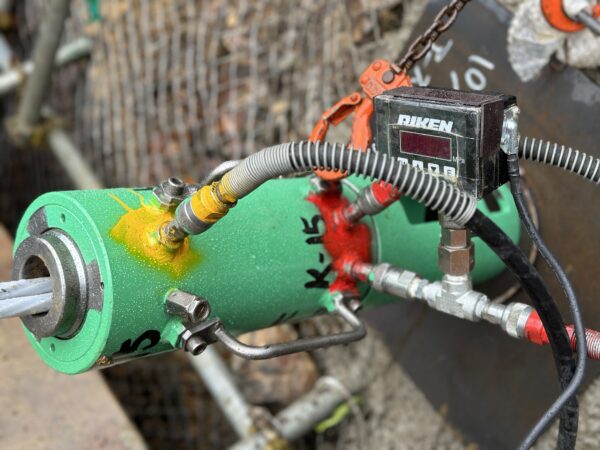
Only after the tensioning cables are tightened using a dedicated hydraulic jack to apply the “design anchor force” specified in the design does the system generate the force needed to stabilize the ground.
That’s the key difference from rebar installation (rock bolts).
While the other method applies tension passively without exerting force, the anchor pulls actively.
So, when it comes to managing nerves, the most important thing—obviously—is “not to lose it,” lol.
To be honest, that's really all there is to it lol (as I've said many times before)
The most important thing is to confirm that the anchor is safe in terms of its design anchor force—in other words, that it won’t pull out.
We will conduct a test to verify this.
There are typically two types: the “aptitude test” and the “confirmation test.”
For example, if there are 100 anchors, the general rule is to conduct qualification tests on the greater of 5% of them or at least 3 anchors, and to conduct confirmation tests on all of the remaining anchors.
If there are 100, then 5.
If there are 10, that means 3.
In qualification tests, loads of up to about 1.2 times the design anchor force are sometimes applied; the reasoning is that if the system can withstand that, then the design anchor force should be sufficient to ensure safety.
From the perspective of someone with on-site experience, even if the test results vary slightly, the anchor itself is sound as long as it hasn't come loose.
When the result falls outside the upper and lower limits, it's usually a problem with how the test was conducted.
Precisely because this work takes place underground and out of sight, I believe that interpreting the conditions here is where I can really show what I’m made of.
Also, try not to charge too much of a premium.
After all, it wouldn't mean anything if it were missing.
The Key Is “Corrosion Protection and Maintenance” | It Doesn’t End with Concrete Placement
Finally—and this is really important—ground anchors aren’t something you just “install and tension, and then you’re done.”
In fact, the real challenge is ensuring it lasts for decades after it’s poured.
Since the tension members are made of steel, if they rust, it's all over.
Therefore, under current standards, “multi-layered corrosion protection”—which involves applying three layers of corrosion protection—is a fundamental requirement, and there are different grades for these protective structures.
In particular, apply rust-preventive oil to the cap on the head and apply a water-stopping compound to the underside of the head.
If rust-preventive oil isn't thoroughly applied to the head, wedges, and PC steel strands, they will rust within a few years.
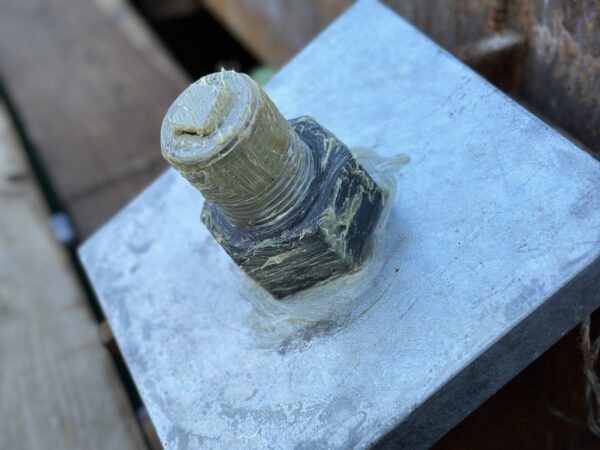
It turns out that just a little thoughtfulness is the key to making things work in the long run.
What’s concerning, though, are the anchors installed in the past that offer poor corrosion protection.
In fact, there have been reports of cases during the Noto Peninsula Earthquake where the prestressed concrete steel strands in anchors on affected slopes broke or were pulled out, and I was shown photographs of this by a representative from the Public Works Research Institute.
Some of the structures under pressure had shifted and were completely broken.
The point is that since anchors are hidden underground, inspecting their integrity is extremely important.
The tension during concrete placement is also important.
However, corrosion protection and maintenance after installation are just as important.
I really hope that young people who are just starting out as anchors will keep that in mind.
Precisely because this work isn’t visible, the effort you put into doing it carefully will pay off decades down the line.
The other key is to hire skilled craftsmen who pay close attention to detail.
See you later.