Hello, everyone.
This is Enta.
Lately, I’ve been seeing a lot of videos about sprayed mortar on YouTube.
While it's good that information is becoming more widely available, this can also lead to the spread of misinformation.
A while back, a general private construction company asked me, “Sprayed mortar doesn’t crumble, does it?”
Also, I hear that kind of thing quite often from the general public.
In this post, I’d like to take a closer look at the idea that something is “half right and half wrong.”
But that's beside the point.
This time, for those considering sprayed mortar work for private homes or commercial construction projects,
From the construction process to the mix design, recommended spray thickness, and handling masonry, I’ll cover everything from start to finish as someone working on-site.
Although this includes some technical content, I’ll do my best to write in a way that’s understandable even to those who aren’t usually involved in construction work.
What Is Sprayed Mortar? Basic Construction Procedures
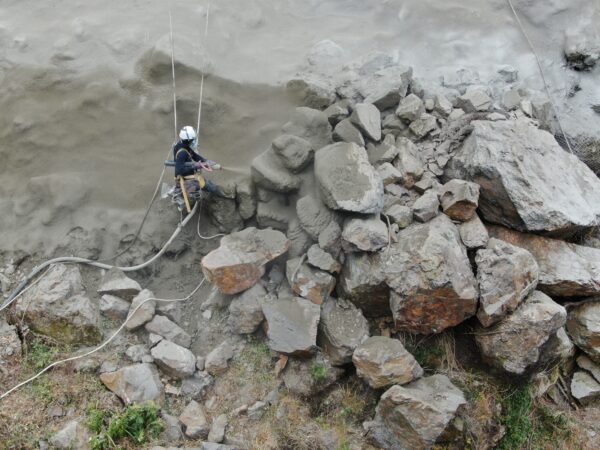
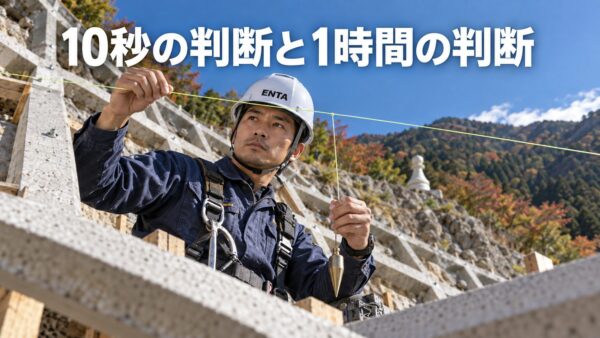
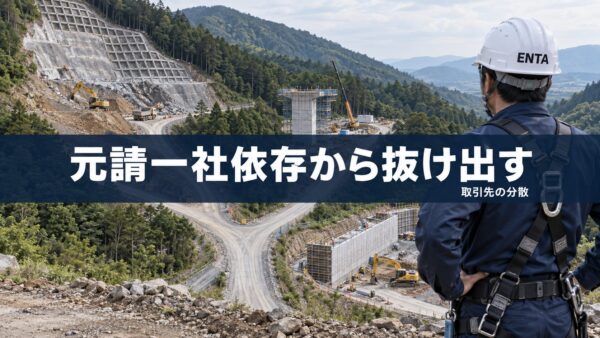
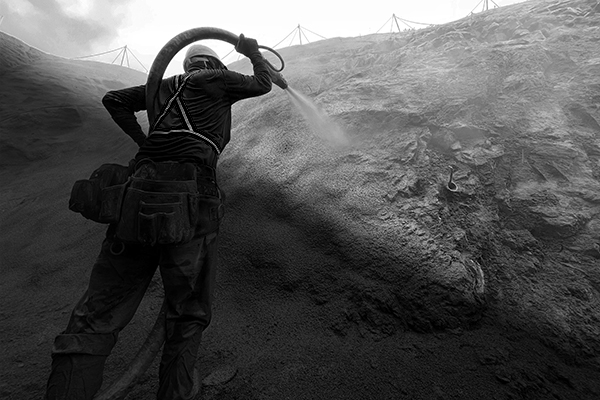
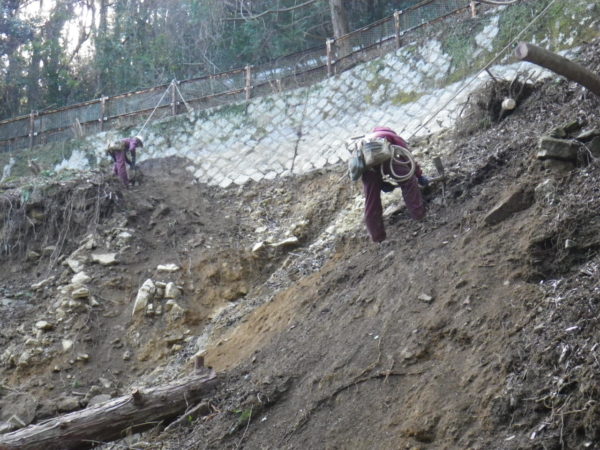
Mortar spraying is a construction method in which mortar is sprayed onto steep slopes (such as boulders or bedrock) like the one shown in the photo above to protect the surface.
The primary purpose of this surface protection work is to prevent the bedrock on the slope from weathering and collapsing.
The installation procedure is as follows.
The process proceeds in the following order: slope clearing (including tree removal), lath installation, and mortar spraying.
Slope cleaning work involves removing loose rocks, vegetation, and other organic matter from the slope.
For rocks perched on a slope, we will implement measures to prevent them from falling before beginning construction.
If the loose stones are large, either break them into smaller pieces and remove them, or secure them firmly so they won’t move before applying the spray.
In public works projects, there is a process called “temporary mortar spraying” performed prior to the main construction work to eliminate hazards; this is distinct from the main sprayed concrete work.
In temporary spray-applied systems, lath is sometimes not installed; instead, special fibers are mixed into the material during application.
This fiber serves to maintain continuity in place of lath.
The reason for removing organic matter is that if it is left mixed into the mortar, it will eventually rot and create voids.
We occasionally receive requests to “uproot trees,” but we don’t really recommend it.
This is because cutting down a tree leaves a large hole, which causes the ground to become unstable to that extent.
In most cases, it’s best not to forcefully pull out tree roots that are too large.
In public works projects, the base is usually cut to fit the shape of the mountain, and mortar is simply poured over it.
Ensure thickness and continuity using lath and spacers
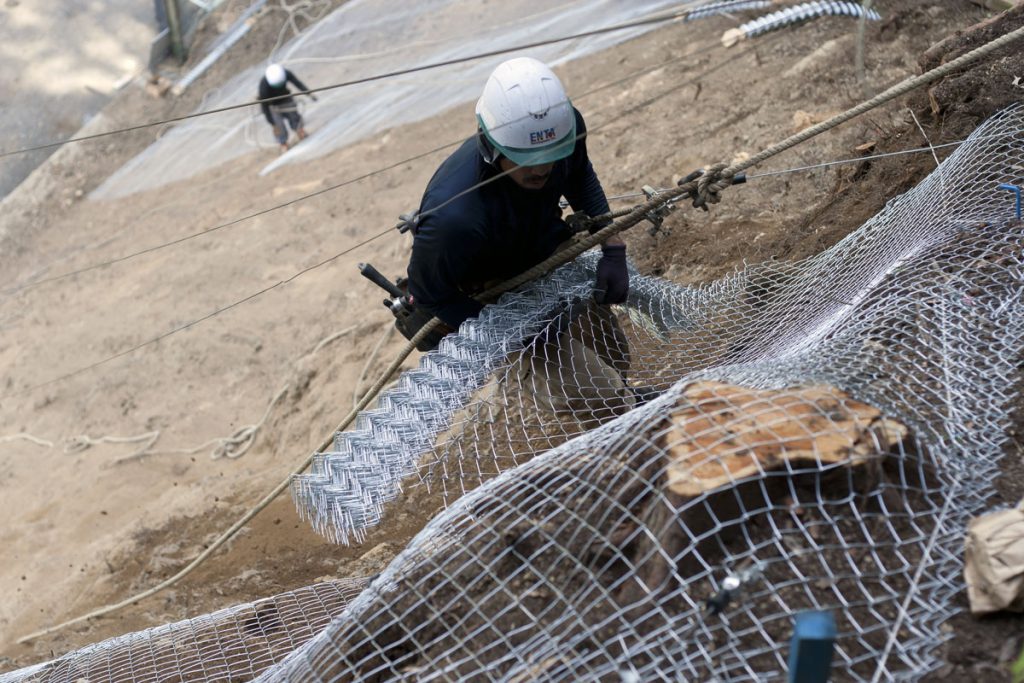
I’ve seen explanations on YouTube and other sites stating that “the final layer of sheathing is installed to increase strength,” but this is not accurate.
The wire mesh is intended solely to ensure the continuity of the mortar.
It basically serves no structural purpose.
It prevents sagging and partial peeling during mortar spraying and helps the mortar bond better with the subgrade.
If you want to increase the strength of the sprayed concrete, installing rebar will increase its strength to some extent, but it is not possible to calculate exactly how much stronger it will become.
If the rebar is arranged with a certain spacing and size, it can be treated as a concept similar to a simple formwork system.
Based on my experience, I recommend a 20 cm pitch.
In cases where a house is built on old fill and there are concerns about the stability of the stone masonry, the design may treat the stone masonry as an integrated load-bearing structure and use rebar insertion to prevent the entire structure from collapsing.
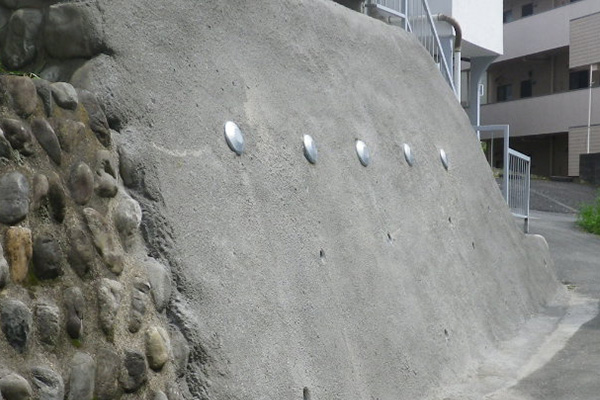
Just because it's a private construction project doesn't mean we're skipping the design phase.
I feel that one of the advantages of private-sector construction projects is that they allow for flexible designs that aren’t possible in public works projects.
While lath installation is generally a necessary step, fiber reinforcement may be used in cases where the terrain is very rugged or where the sprayed surface is nearly vertical.
Adding fibers can sometimes achieve results equivalent to or better than those of lath mesh, but,
Since the fiber is relatively expensive, even if the lath-setting process is eliminated, the cost tends to remain fairly high.
When installing the last layer, we recommend using spacers whenever possible.
Using a "PC spacer"—a spacer designed specifically for sprayed mortar—has the important benefit of ensuring the correct spray thickness.
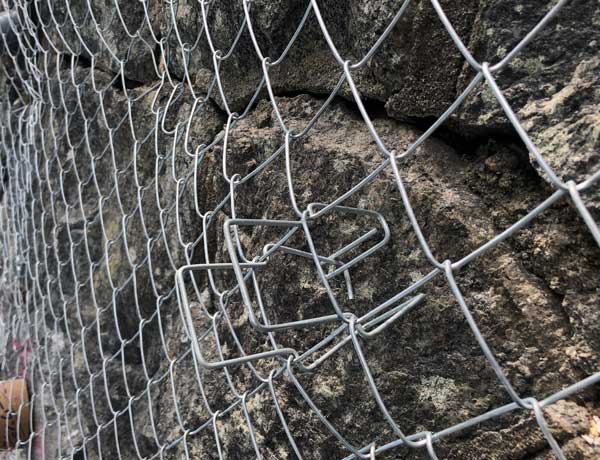
Apply the spray coating after installing the spacers; once the spacers are no longer visible under the coating, this serves as an indication that the specified thickness has been reached.
Some products are stronger than galvanized wire mesh and are more resistant to cracking.
It is on public works sites that quality and workmanship are ensured through the accumulation of these small, thoughtful details.
I haven't heard of many contractors that specialize exclusively in private-sector projects, but even for private-sector projects, I recommend hiring a contractor with a track record in public works projects, if possible.
It’s even more reassuring if the company can handle both management and design.
Differences and Mix Proportions Between Sprayed Mortar, Sprayed Concrete, and Sprayed Fiber
There are several types of spray application methods.
The first method is standard mortar spraying, which uses a 1:4 mortar mix.
This means a ratio of 4 parts sand to 1 part cement; according to the standard mix design, the recommended amounts are 420 kg of cement and 1,680 kg of sand.
The water-to-cement ratio ranges from 45% to 55%.
Any other mix proportions are generally not permitted in public works projects, even for sprayed mortar applications.
In some cases, exceptional mix ratios are permitted for specialized applications. (Mix ratios as high as approximately 1:3 are allowed for spray application.)
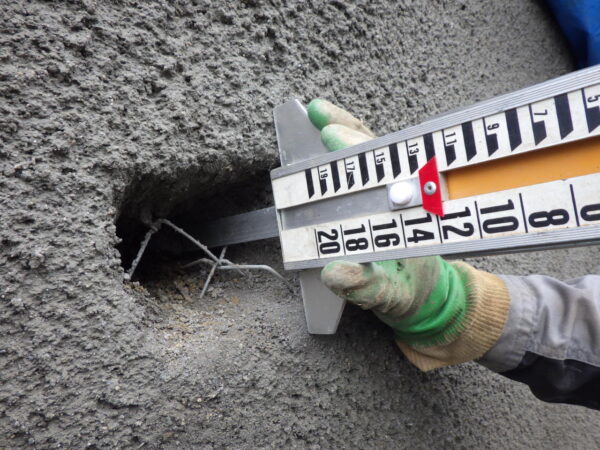
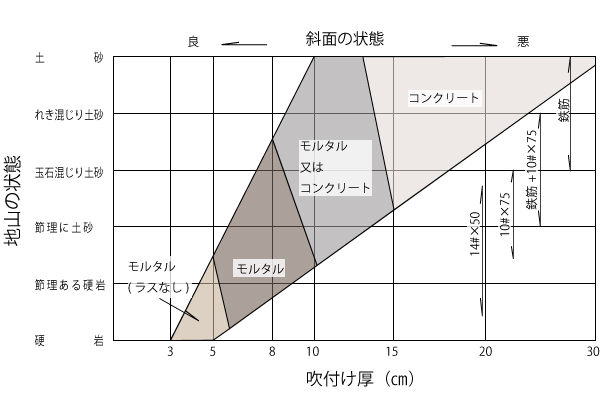
With regard to spray thickness, on prefectural roads, a thickness of 7 cm or more is considered permanent, while thicknesses below that are regarded as temporary.
In reality, my impression is that at most sites, the depth is around 10 cm.
For national highways, 15 cm is considered the standard thickness, and sprayed concrete is often the primary method used on these roads.
In cold regions and similar areas, the concept of thickness takes on a different meaning.
The second is sprayed concrete, in which crushed stone is added to the mortar mix.
The mix ratio is 1 part cement, 4 parts sand, and 1 part crushed stone, and the water-cement ratio is also between 45% and 55%.
The difference from mortar is that it offers superior strength and resistance to friction compared to mortar.
There is also a tendency for the unit price to decrease in proportion to the amount of crushed stone used.
The idea is that if the mixture is sprayed according to the design specifications, the amount of cement used will be reduced, making it easier to increase the sprayed area by the amount of crushed stone.
It is believed that the Ministry of Land, Infrastructure, Transport and Tourism’s decision to use concrete for the permanent sprayed concrete layer was based on a balance between strength and cost.
However, in actual construction sites, the difference isn’t really noticeable enough to be clearly discernible, so there’s a tendency to switch from concrete to mortar since concrete isn’t really necessary.
One drawback of shotcrete is that crushed stone tends to bounce back and fly off during the spraying process.
Even when crushed stone is added according to the mix design, it is not uncommon for more than half of it to have rolled down below the slope.
Ideally, it would be sprayed while well-enveloped in mortar, but crushed stone tends to be discharged on its own.
Given that their volumes and specific gravities are different, I suppose it’s somewhat unavoidable, but concrete really doesn’t work well with spray application.
The third method, as mentioned above, involves spraying fiber-reinforced mortar or fiber-reinforced concrete—a process in which fibers are mixed into the material without first installing lath.
It is said that adding fiber makes the material less prone to cracking and provides some resistance to freezing. (Although this has not been confirmed.)
Because the fibers are oriented in a wider variety of directions than in standard wire mesh, the mortar tends to bond more strongly.
Spray-applied coatings other than this one are not commonly used, as they involve specialized methods patented by individual manufacturers.
Why "Spraying onto Earthwork" Is Dangerous in Residential and Private Construction Projects
On YouTube, it is sometimes explained that “spraying mortar onto soil stops soil erosion and eliminates the need to remove weeds.”
First, as a general rule, it is not standard practice in public works projects to apply sprayed mortar directly onto soil.
Recently, to reduce the effort required for weed control, we sometimes apply spray to specific areas of the soil, but this is only a partial solution.
The primary purpose of sprayed mortar and sprayed concrete is to provide surface protection to prevent the weathering of bedrock.
That said, I do feel that using sprayed mortar as a weed-control measure is quite effective in and of itself.
The issue is the thickness.
Let’s consider a scenario where mortar is sprayed onto a soil slope overgrown with grass and featuring trees about the height of shrubs, following slope cleaning.
Even for privately owned earthwork sections, we recommend a sprayed thickness of at least 7 cm.
Ideally, I'd like to leave about 10 cm of space.
Even if it’s 10 cm thick, it can end up looking like this after a few years.
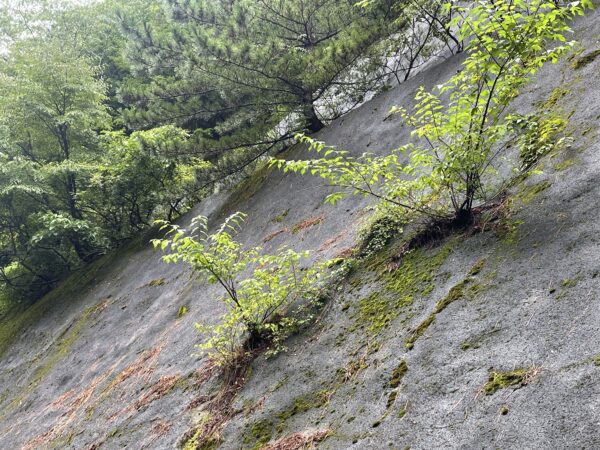
Slopes that were originally bedrock may turn into soil and sand due to deterioration over time, and vegetation may begin to grow there.
It is also possible that cracks may form due to aging, allowing nearby seeds to enter and take root.
This means that when sprayed concrete is applied to earth and sand, it can deteriorate to this condition over time.
I feel that this tendency is particularly noticeable on gently sloping hillsides.
The vitality of plants is stronger than you might imagine.
Another point I often see mentioned is that it helps prevent soil erosion.
While that is true in itself, the key point is whether the drain pipe installed during spraying is equipped with a backflow preventer.
If one is not installed, soil and debris inside may wash out after rainfall, causing the interior of the sprayed mortar to become hollow.
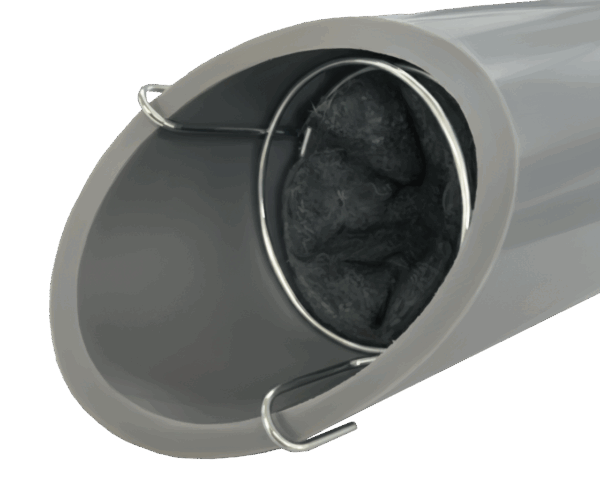
Since it is difficult to detect just by looking at it, this kind of hollowing out can actually be considered a dangerous condition.
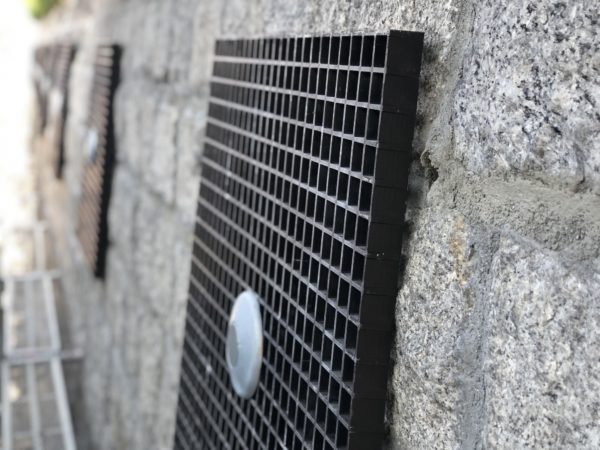
When working on earthwork sections of public works projects, be sure to install anti-suck-out material.
This is a design feature intended to allow water to drain away while preventing the soil inside from being washed away during rainfall.
If there is sprayed mortar on the earthwork areas of your home, I recommend checking to see if it contains this anti-seepage material.
Try tapping the mortar surface lightly with a hammer; if you hear a hollow sound, the mortar may be coming loose.

The fact that it floats is thought to be a sign that it has become hollow inside.
By Site Conditions | Guidelines for Spray Foam Insulation in Single-Family Homes
The site conditions for considering sprayed mortar in residential homes generally fall into the following categories:
The first scenario is one where there are a lot of weeds, resulting in high annual maintenance costs.
In this case, we recommend thoroughly cleaning the slope and applying a spray-on coating with a thickness of at least 7 cm.
Even when the slope is gentle, the basic principle remains the same: install anti-siphon devices on the drain pipes wherever possible.
For ease of management, we also recommend creating areas where people can walk in a stepped pattern.
Slopes are generally not places where inexperienced people should feel comfortable climbing.
Since removing grass from slope deformations and cracks is an important maintenance task, the idea is to have steps built using mortar.
The second scenario involves cases where soil and debris wash away every time it rains, or where the foundation of the house is becoming visible.
In this case, aim for a spray-applied thickness of at least 10 cm, and install anti-siphon devices on the drain pipes.
Since the slope may be steep in some cases, we use 10 cm as the standard thickness.
In areas where there is a risk of collapse, we recommend using D10 to D16 rebar to form a reinforcement grid.
When the rebar diameter is small, the mesh is often made with 200 mm or 300 mm squares.
When using D16, the concrete cover for the rebar tends to be very tight, so it is important to ensure that the sprayed concrete thickness is at least 10 cm.
If the bottom of the foundation is exposed, wrap the area securely to prevent rainwater from seeping in as much as possible.
To reduce the flow velocity of rainwater, measures such as applying the coating in stages or installing a mesh may be taken.
The third case is when the stone wall is crumbling or the mountain is bulging outward (harami-dashi).
First, we need to determine whether to address the stone masonry itself or the root cause of the stone shifting.
The sprayed thickness is generally 10 cm or more, and this method is often combined with rebar insertion and drainage drilling as measures to prevent collapse.
When combining sprayed mortar with rebar insertion work, a rebar grid is installed.
Whether or not to install a pressure-receiving plate depends on the design.
In either case, please consider the anti-siphon material to be essential.
When applying the material to a soil slope, another method involves laying the mat over the entire slope and securing it firmly before spraying the material.
If we can prevent the soil from shifting overall, we can also reduce runoff from the drainage system.
Since mats are sometimes used even in areas where spring water emerges from bedrock, this approach isn't all that unusual.
Instead, it’s important to ensure sufficient thickness.
The fundamental principle of sprayed mortar work is that it should adhere to the rock surface.
It can be said that applying this to earthwork is an unconventional use that deviates from its intended purpose.
That said, given the labor shortage and the administrative burden, it is also true that there are an increasing number of situations where we have no choice but to use it as a weed control measure.
If work is done carelessly or using the wrong methods, it’s not only the client who ends up facing problems later on, but also contractors like us.
Since we’re going to be doing the work anyway, we want to bring the same high-quality workmanship to ordinary homes as well.
Conditions to Be Observed When Spraying Mortar onto Stone Masonry (Dry Stone Masonry)
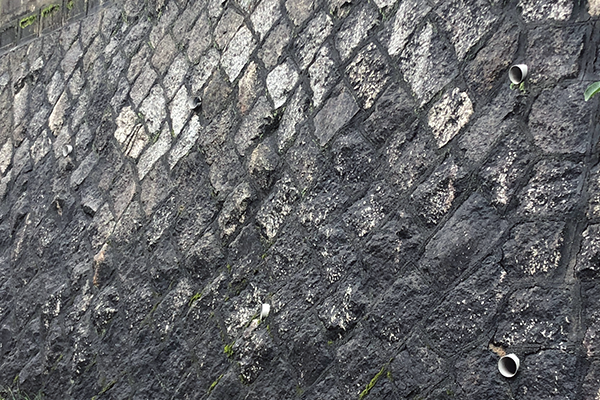
It seems there are some contractors who recommend, “Let’s apply mortar all over to keep the stonework from crumbling!”
While there is a method, the key question is whether that method is correct.
Most stone walls are constructed using a technique called "dry stone masonry," in which stones are simply placed on top of the soil.
In older stone masonry, there may be no mortar joints.
In some cases, mortar joints are applied later.
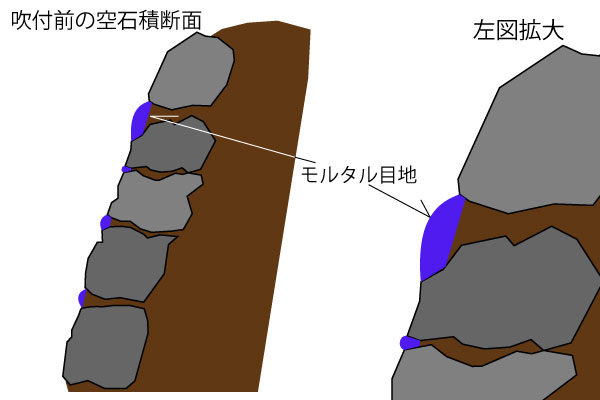
If mortar is sprayed onto the surface while it is in this condition, a large amount of debris will remain, which will hinder the mortar’s adhesion to the rock.
Therefore, it is essential to strictly adhere to the following conditions.
Thoroughly clean the surface of the stone masonry with a high-pressure washer.
Remove all existing grout.
Be sure to install drainage pipes or similar in the subgrade to allow water to drain up to the surface of the mortar.
When constructing a stone wall, install the rebar framework along with the wire mesh as much as possible.
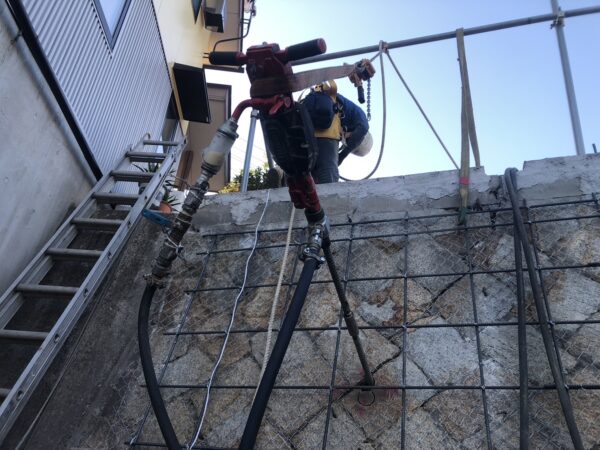
If there are gaps deep within the joints, be sure to fill them thoroughly with mortar.
I believe that if these conditions are met, the service life of the stone masonry could be extended by several decades or more.
If possible, for added peace of mind, it is recommended to drill drainage boreholes to a depth of at least 4.0 meters to help prevent an increase in pore water pressure caused by heavy rain or similar conditions.
Recently, there has been a growing demand to extend the service life of existing structures rather than rebuild them.
In fact, that option is often more cost-effective.
We’re tackling private-sector construction projects while grappling with the challenge of how to extend the lifespan of existing structures as they are.
Precisely because homeowners are undertaking repairs costing several million yen on their own, I believe it’s easier for them to choose a high-quality contractor if they have a certain level of knowledge themselves.
In sprayed mortar work, if even one step—such as slope cleaning, lathing, mixing, or spray thickness—is neglected, it can result in hidden weaknesses that are difficult to detect by visual inspection.
There are sound reasons behind each of the detailed standards that have been established over time in public works projects.
I don't think the fact that these are private residences or commercial construction projects is a valid reason to disregard those standards.
I hope this article will be of some help to you in deciding how to choose a high-quality contractor.
See you later.