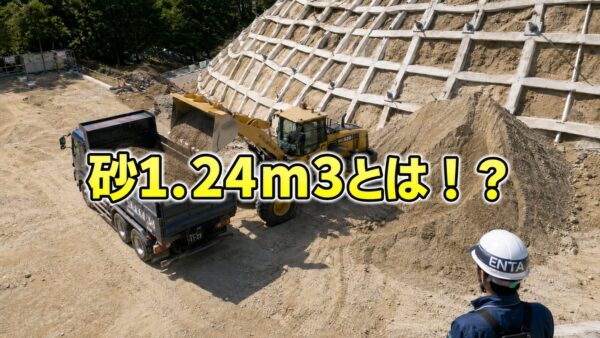
Hello, everyone.
This is Enta.
In slope design, how do you go about construction? How do you get the machinery up there?
That's really important, isn't it?
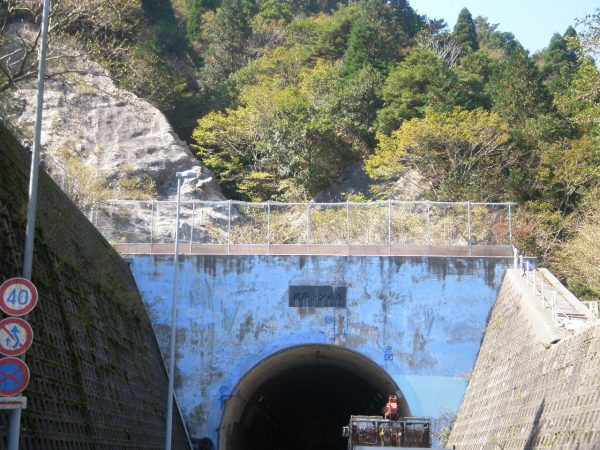
We brought the machine down to the worksite.
So, how are we going to get the machinery up to that slope 50 meters above us?
The options for slope stabilization work are limited.
1. Mobile crane (with a reach extending to the top)
2. Monorail (taking the weight of the machinery into account)
3. Cableway (taking the weight of the machinery into account)
4. Transport using a backhoe (BH)
5. Transport using an all-terrain vehicle
6. Gradually raise the structure using cantilever scaffolding (lift it straight up using a chain hoist or similar device).
Most work sites fall into this category.
In other words, I don't think there are any other options.
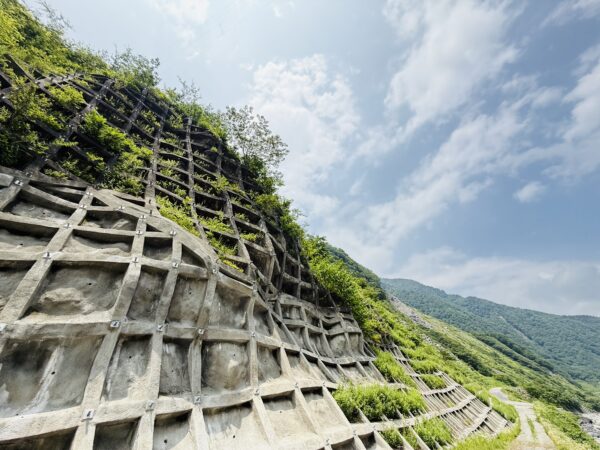
At a job site like this, how would you get the machine up there?
For 25- to 50-metric-ton rough-terrain cranes, the vehicle width is around 2.7 meters, and
The maximum overhang is about 7.5 meters.
Can I go to the site?
If we can get by with the maximum overhang on one side, we'll just make do with that as a last resort. (Depending on the site, though... *mumble, mumble*)
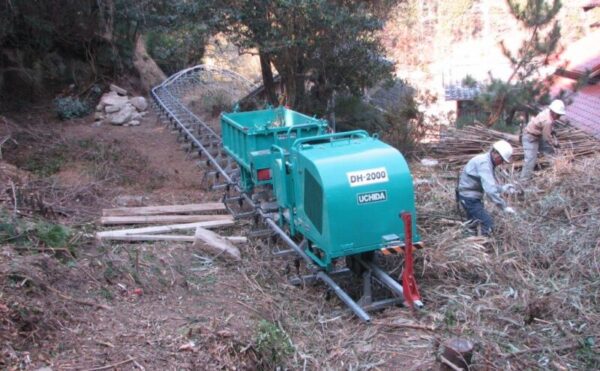
Is there a monorail route?
How many metric tons does the machine weigh?
What is the weight capacity of that monorail?
Single-axle, 0.7 metric tons or less; installation width 1.5 meters
2-axle, 2.0 metric tons or less; installation width 2.0 meters
3-axle, 4.0 metric tons or less; installation width 3.0 meters
(The installation width is only a guideline; however, if the space is too narrow, the machine may protrude and hit the wood, causing problems.)
We'll decide based on the route and the distance to the site. (It's effective if the distance is long.)
To be honest, the monorail is expensive. (And if they start saying things like “we won’t factor in construction delays,” it’ll be total hell lol.)
It usually ends up costing more than the estimated price, so I’d rather not take on subcontracts whenever possible lol
I think the general contractor would hate that, too.
After all, a fair amount of money goes out every month.
And then there are sites where we can't start construction because there just aren't enough contractors...
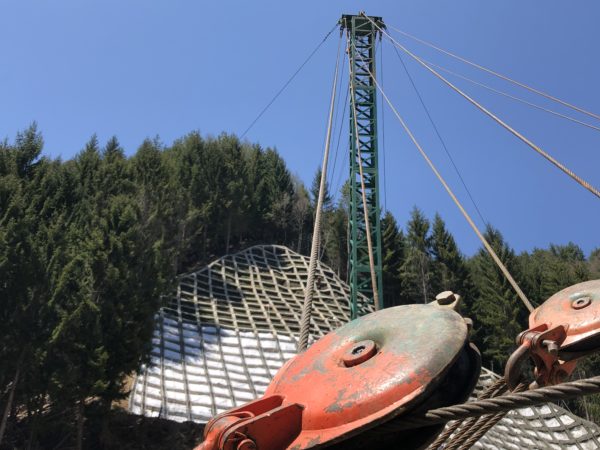
In the case of a cableway, are there any trees at the top where the cable can be strung?
Could the local foresters' association help us out?
Is it possible to route the path right through the center of the worksite as much as possible? (At worst, the edge is fine, but we also need to consider moving the heavy objects once they’re delivered.)
Is there enough space below the worksite to set up a log yard for the log loader?
It's really scary when the angle is too steep.
I imagine there are some mechanics reading this blog who have had problems with failed clutch shifts or brakes that won't work...
There are quite a few people like that, aren't there?
There are a lot of automatic ones these days, so they give me a sense of security, but log loaders are scary if you're not used to them lol
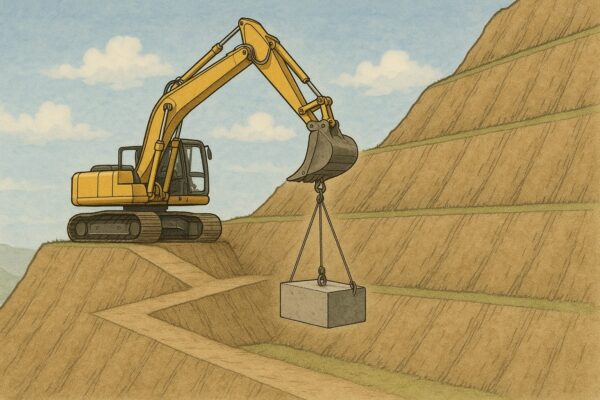
At the end of the day, no matter what anyone says, transporting materials with a backhoe is definitely the most reliable method.
Even if the distance is a bit far, you can definitely move it if you carry it little by little.
There are times when it’s actually faster to move forward with what can be done—for example, by transporting materials bit by bit using a forklift—rather than waiting for other work to be completed before starting!
In this area, it would really help the general contractor if the government agencies thoroughly reviewed the temporary housing plans or if the consulting firm’s design could accommodate them.
It would be good to have a clear understanding of how many times and how many round trips we'll need to make, right?
For example,
A so-called 0.7BH (zero-point-seven BH) can lift and transport about 2.5 metric tons.
With a 0.45BH (zero point four five BH), you can just about haul about 2.0 metric tons.
With a 0.25BH (Commany Go), you can just about haul a little less than 1.0 metric tons.
If we can establish the pilot road (temporary road) as firmly as possible, larger machinery would be best.
That's all for now.
I'll cover the remaining two next time.
See you later.