 Hello, everyone.
This is Enta.
A while back, a young field supervisor from another company asked me, “Do you pay attention to the soil conditions when drilling holes for ground anchors?”
(No, seriously, you should really care about this, lol)
If you underestimate the soil conditions when estimating costs, you'll be the one crying about it later.
But that's beside the point.
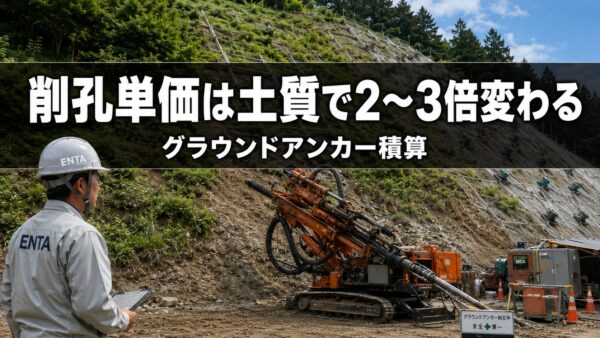
The unit cost for drilling in ground anchor construction can literally “more than double” depending on the soil conditions.
A lot of construction companies just kind of throw out a quote, thinking, “Honestly, this is probably about right,” don’t they?
I know exactly how you feel!
But I think you know it’s definitely better to review the design specifications carefully to confirm the stiffness before submitting a quote.
In this session, we’ll explain how to prepare a cost estimate while reviewing the 2026 cost estimation materials.
Cost Estimation for Ground Anchor Drilling Is Based on a Package System
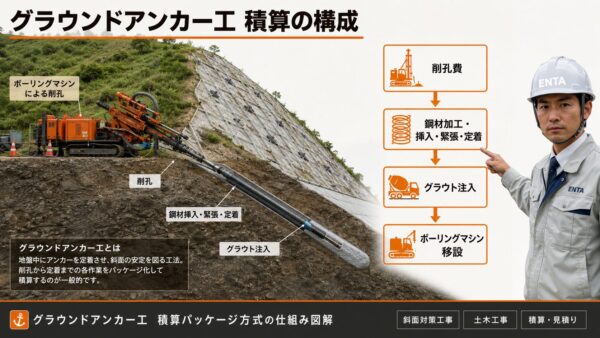
First and foremost, cost estimation for ground anchor work is based on a package system.
The term “package” refers to a system in which a series of tasks—such as drilling, grout injection, steel fabrication and assembly, tensioning and anchoring, and head finishing—are each billed as separate line items.
According to the Ministry of Land, Infrastructure, Transport and Tourism’s construction package-based cost estimation standards, when drilling for ground anchor work, “costs shall be calculated separately for each soil type.”
In other words, when there are mixed soil types at a site, the basic principle is to calculate quantities separately for each soil type.
"Just classifying everything as cohesive soil" is a no-go.
(I'll be in for a world of trouble later, lol)
Incidentally, in this year’s cost estimation guidelines (2026 Cost Estimation), as in the past, the following work items are listed separately in addition to drilling costs.
– Drilling machine relocation service: 56,040 yen per visit
– Grout Injection Worker: 65,840 yen per cubic meter
– Steel processing, assembly, insertion, tensioning, anchoring, and head treatment: Vary depending on standards, load ratings, and corrosion protection specifications
It is only when all these factors are taken into account that the “unit price per anchor” is determined.
That’s exactly why it’s pointless to judge whether something is “cheap” or “expensive” based solely on the drilling costs.
Why Unit Prices Vary by a Factor of 2 to 3 Across the Five Soil Classifications
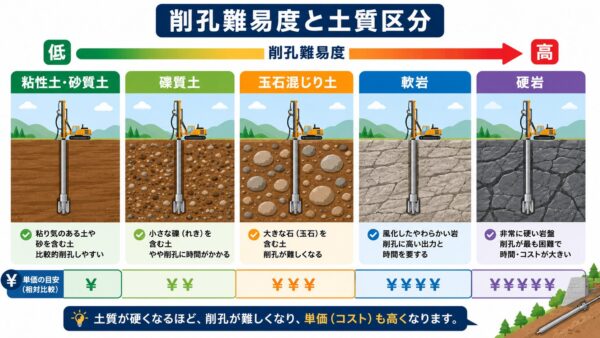
Soil classifications for ground anchor drilling are broadly divided into five categories.
1. Cohesive soils and sandy soils
2. Gravelly Soil
3. Soil with a mixture of good and bad stones
4. Soft Rock
5. Hard Rock
The unit price for drilling varies significantly across these five categories.
As for why things change...
Basically, it’s because the “cutting speed (drilling efficiency)” varies greatly depending on the soil type.
In cohesive soil, the boring machine moves along smoothly, but when it hits hard rock, it takes several times as long to drill to the same depth.
The longer it takes, the higher the labor and equipment costs will be.
It's as simple as that: the unit price goes up.
As of March 2017, the unit prices listed on this blog (skid-type, double-pipe system, borehole diameter 90 mm) were as follows.
Soil Classification: Unit Prices as of March 2017 (yen/m)
Clay and sandy soils ... 6,453
Gravelly Soil... 10,610
Soil mixed with stones... 16,230
Soft Rock... 13,080
Hard Rock... 17,240
When comparing cohesive soil to hard rock, there is a difference of approximately 2.67 times.
(If you estimate this by thinking, “It’s pretty much the same, right?”, you’re in big trouble lol)
Please note that the unit price shown 👆 is for reference only and reflects the price as of March 2017.
Since the current unit prices are revised annually, please be sure to always check the most up-to-date civil engineering construction unit prices. 👇
Current Drilling Unit Prices Based on 2026 Cost Estimation Data
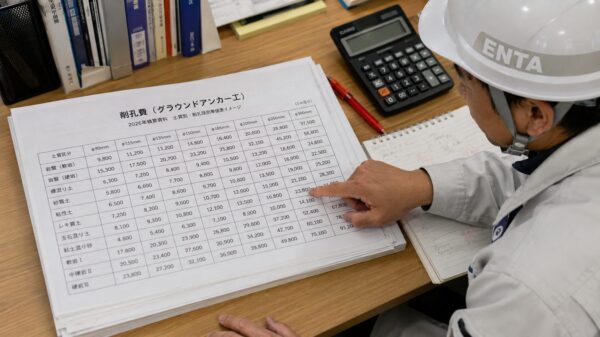
These are the drilling costs from the 2026 cost estimate documents that Enta has on hand.
The unit prices (yen/m) by soil type for a borehole diameter of 90 mm are as follows.
Soil Classification Unit Price (yen/m)
Clay and sandy soil... 9,387
Gravelly soil... 15,450
Soil mixed with stones... 23,680
Soft Rock... 19,070
Hard Rock... 25,120
Compared to 2017, prices have risen across all categories.
Looking at clay and sandy soils, the price has gone from 6,453 yen to 9,387 yen, which is about 1.45 times as much.
Although the unit price increases as the hole diameter gets larger, we are comparing them based on a diameter of 90 mm in this case.
The price per unit for φ115mm, φ135mm, and φ146mm is listed in the documentation; however, since the specifications vary depending on the diameter, please check the design carefully.
Also, please note that this unit price applies solely to the “drilling cost.”
The costs for the boring machine relocation, grout injection, and steel fabrication and assembly mentioned earlier are billed separately.
To be honest, there are quite a few documents that try to determine the unit price for the entire anchoring project based solely on drilling costs, and it’s risky to make a judgment based on that lol.
(Which means it costs 56,040 yen just to move it once, lol.)
Make sure your quote includes all the items specified in the design!
👇👇👇2026 Drilling Unit Price
| Drill Hole Diameter | Clay and Sandy Soil | Gravelly Soil | Soil mixed with stones and pebbles | Soft rock | Hard Rock |
| 90 | 9,387 | 15,450 | 23,680 | 19,070 | 25,120 |
| 115 | 13,790 | 19,100 | 28,800 | 23,150 | 30,010 |
| 135 | 16,940 | 23,220 | 33,350 | 28,300 | 36,130 |
| 146 | 20,340 | 28,190 | 40,070 | 34,360 | 47,410 |
Points to Keep in Mind When Preparing Estimates and Cost Calculations
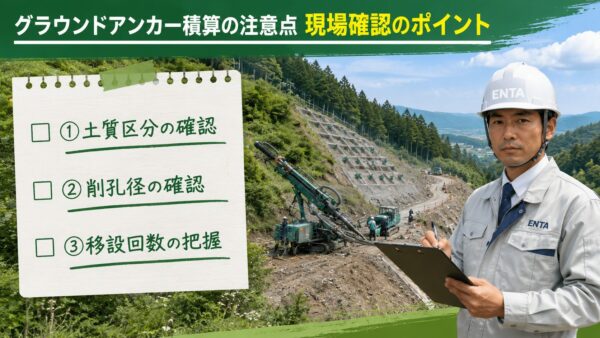
There are three points in particular that you should pay close attention to when preparing estimates and cost calculations:
① Be sure to record the number of times the drilling machine is moved
According to this document (2026 Aichi Prefecture Cost Estimates), the cost for relocation work is 56,040 yen per instance.
The total cost varies significantly depending on how many anchors are installed and how many times they are relocated on site.
Please carefully check the site layout and anchor placement.
This is a basic concept, but let's say, for example, there are three levels of scaffolding. You lift it up to the first level of the on-site scaffolding. That counts as one lift.
Lower it to the second level. That makes two times.
Next, we'll lower it onto the ground. This isn't the third time, though...
Therefore, if there are three levels, the relocation work will take place twice.
② Carefully calculate the amount of grout to be injected (the terms of the estimate are important)
The cost for grout injection work is 65,840 yen per cubic meter (based on the 2026 Aichi Prefecture cost estimate).
The formula for calculating the grout injection volume is based on the borehole diameter and length; in the case of quantity takeoff, this is specified in the design quantities, but
Since experience is factored into the estimate, please make sure to calculate it carefully lol
③ Steel fabrication and assembly costs vary significantly depending on the load classification, corrosion protection specifications, and whether assembly is performed in a factory or on-site.
According to the 2026 Aichi Prefecture Cost Estimation Guidelines, the unit price is 40,860 yen per piece for double corrosion protection, PC steel strands, on-site assembly, lengths of 10 meters or less, and f < 400 kN, provided that end treatment is included.
Even with the same double anti-corrosion coating, the price drops to 18,570 yen per unit when assembled at the factory.
(Even though there’s a difference of about 2.2 times, factory processing is still cheaper because of the on-site assembly costs.)
| Anchor Steel Processing, Assembly, Insertion, Tensioning, Anchoring, and Head Finishing (Anchors) | |||||
| Types | Length | Load | Whether or Not the Head Is Processed | Unit Price | |
| Double Corrosion Protection | PC steel strand | Within 10 meters | f < 400 kN | Available | 40,860 |
| On-site Assembly | None | 37,040 | |||
| 400 ≤ f < 1300 kN | Available | 44,560 | |||
| None | 40,750 | ||||
| 130 kN ≤ f < 2000 kN | Available | 56,960 | |||
| None | 53,140 | ||||
| More than 10 meters | f < 400 kN | Available | 42,370 | ||
| None | 38,550 | ||||
| 400 ≤ f < 1300 kN | Available | 46,080 | |||
| None | 42,260 | ||||
| 130 kN ≤ f < 2000 kN | Available | 58,470 | |||
| None | 54,650 | ||||
| PC Steel Strand (Factory-Assembled) | f < 400 kN | Available | 18,570 | ||
| None | 14,750 | ||||
| 400 ≤ f < 1300 kN | Available | 21,110 | |||
| None | 17,290 | ||||
| 130 kN ≤ f < 2000 kN | Available | 30,020 | |||
| None | 26,200 | ||||
| Basic Corrosion Protection
(Temporary) |
PC steel strand | Within 10 meters | f < 400 kN | Available | 28,070 |
| On-site Assembly | None | 24,250 | |||
| 400 ≤ f < 1300 kN | Available | 37,590 | |||
| None | 33,770 | ||||
| 130 kN ≤ f < 2000 kN | Available | 56,960 | |||
| None | 53,140 | ||||
| More than 10 meters | f < 400 kN | Available | 29,580 | ||
| None | 25,760 | ||||
| 400 ≤ f < 1300 kN | Available | 39,100 | |||
| None | 35,280 | ||||
| 130 kN ≤ f < 2000 kN | Available | 58,470 | |||
| None | 54,650 | ||||
| PC Steel Strand (Factory-Assembled) | f < 400 kN | Available | 17,470 | ||
| None | 13,650 | ||||
| 400 ≤ f < 1300 kN | Available | 20,010 | |||
| None | 16,200 | ||||
| 130 kN ≤ f < 2000 kN | Available | 28,920 | |||
| None | 25,100 | ||||
In particular, I’d like companies that rely solely on subcontracting to make sure they adjust their unit prices for each item.
You must not use a "lump-sum" contracting method!
Sandy soil ○○ m; unit price × design length =
Soft rock ○○ m; unit price × design length =
Please give me a quote based on that.
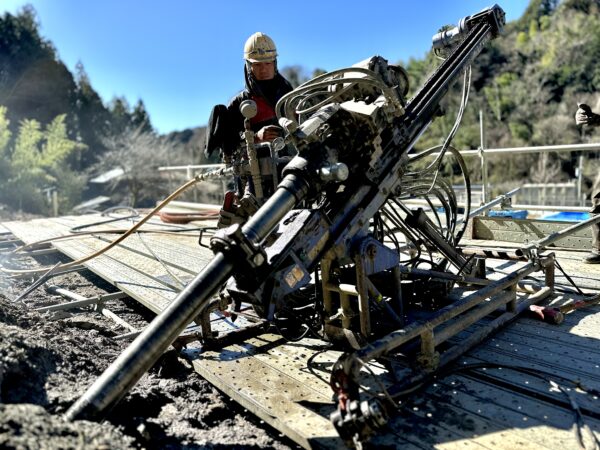
As I’ve mentioned in previous articles, this is an issue that remains unresolved to this day.
The unit price has been rising slightly every year.
According to documents from the Ministry of Land, Infrastructure, Transport and Tourism, the Standard Unit Price Table for the Construction Package Cost Estimation Method is updated every fiscal year, and
We have updated the base dates for machinery, labor, and material unit costs, as well as market unit prices, to reflect changes in prices.
Unit prices are rising.
But when it comes to the reality of the bidding process, even if unit prices rise, if the volume of work decreases, companies will compete to lower their prices.
The trend of going after new business—even at the expense of social insurance premiums and company profits—remains unchanged to this day.
The real question is, how many companies are actually making a profit while paying their social insurance and taxes in full?
While the government is raising labor rates and urging companies to “improve working conditions,” the reality is that competition is driving down rates at the front-line level.
Gain a thorough understanding of the cost estimation process and prepare estimates using accurate unit prices.
I believe that is the only way to survive in the long run.
The latest drilling rates are updated every April and July.
Be sure to check the latest edition of the “Civil Engineering Construction Unit Prices” or the contracting agency’s cost estimation standards every year.
By the way, I’m thinking of using AI to create a calculation tool specifically for slopes that anyone can use, but I’m wondering if there’s actually a demand for it—so for now, I’m just steadily working on other things lol.
Personally, I’d like people who’ve never done cost estimation and have no idea how much money the general contractor gets from the government to use this.
I'm thinking that if I do that, I might start to get a better sense of unit prices, even if just a little.
See you later.