Hello, everyone.
This is Enta.
Now that we're into the second half of May, it feels like things are gradually getting back on track on site.
This year, it feels like we’re just barely managing to keep our business afloat.
So, lately, no matter which company I visit, the conversation always turns to foreign workers lol.
"We're getting a new employee from Vietnam soon..." "They say they're going to have him get the Specific Skilled Worker Type 2 visa," and stuff like that.
This trend is just going to keep gaining momentum.
Going forward, we’ll see an increasing trend of people joining and leaving that company.
But that's beside the point.
In this article, we’ll start with an article titled “Salaries for Construction Technical Trainees: Significant Increase in Category 3, Exceeding 300,000 yen,” which appeared in the Ken-tsu Shimbun on May 19, 2026, and
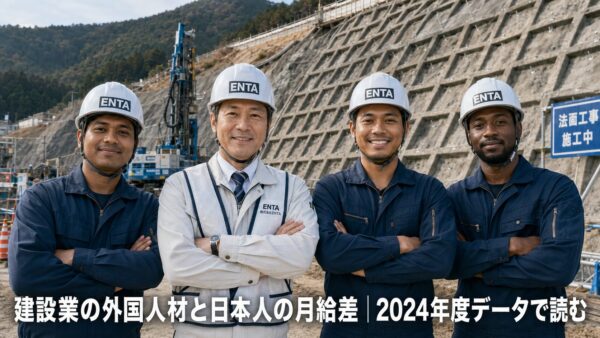
As a slope maintenance contractor, I’d like to examine the difference in monthly salaries between Japanese workers and Technical Intern Training Program participants (Categories 1, 2, and 3) and Specific Skilled Workers.
Let's lay out the numbers clearly and see if they match our on-the-ground experience.
And what do those who call the technical intern program “slavery” think when they see these numbers? I’m curious about that, too...
Taking an Unbiased Look at the Data from the Ken-tsu Shimbun (FY 2024 Results)
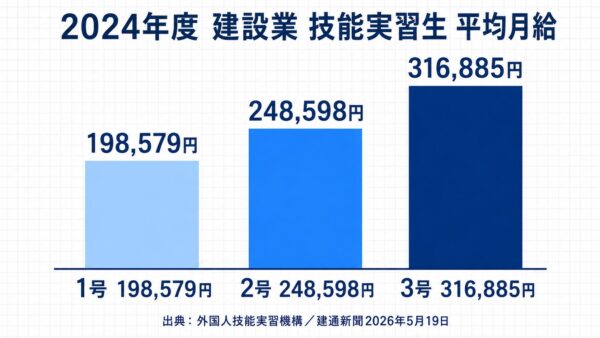
According to an article in the Kentsu Shimbun dated May 19, 2026, based on data compiled by the Organization for Technical Intern Training, the average monthly salary for technical interns working in the construction sector for fiscal year 2024 was broken down as follows:
| Category (Construction Industry) | Regularly Paid Salary | Special Pay | Total (Monthly) | Year-over-year |
|---|---|---|---|---|
| Category 1 Technical Intern | 189,879 yen | 8,700 yen | Approximately 198,579 yen | +1.11 TP3T / +14.11 TP3T |
| Category 2 Technical Interns | 212,300 yen | 36,298 yen | Approximately 248,598 yen | +4.61 TP3T / +18.91 TP3T |
| Category 3 Technical Interns | 260,290 yen | 56,595 yen | 316,885 yen | +0.81 TP3T / −1.61 TP3T |
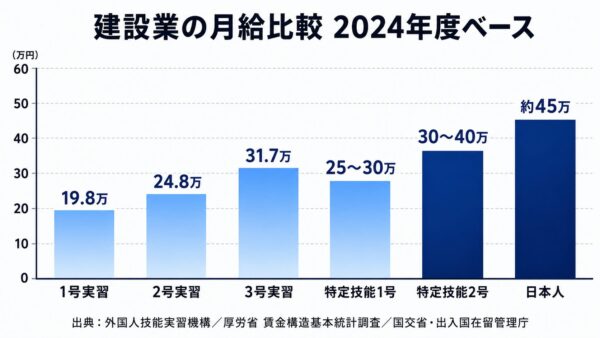
Category 3 exceeded 300,000 yen for the second consecutive year. Compared to the average across all industries, Category 1 fell short, Category 2 was roughly on par, and Category 3It exceeded 36,256 yenIt says
(Ken-tsu Shimbun, May 19, 2026 / Source: Organization for Technical Intern Training).
I’ll take a moment here to jot down a few points that, as a civil engineer, made me think, “Ah, that’s just like it is on a real job site.”
Type 1 workers are in their first year in Japan and are still developing their Japanese language skills and technical abilities; Type 2 workers are in their second or third year and are starting to understand how things work on the job site; and Type 3 workers are in their fourth or fifth year and can perform tasks almost as well as young Japanese craftsmen.
The fact that monthly salaries rise in steps is exactly as this sense of reality suggests.
How different are they compared to Japanese construction workers?
This is where the title really comes into play, isn't it?
How much does the monthly salary differ between Japanese employees and foreign workers?
Based on the figures for the construction industry (Major Industry Classification D) from the Ministry of Health, Labor and Welfare’s “Reiwa 6 Basic Survey on Wage Structure,” here’s a rough summary.
In the construction industry,The "regular cash wages" for male general workers are approximately 350,000 yen per month,
When annual bonuses and other special payments are prorated on a monthly basis, the total comes to approximately 450,000 to 470,000 yen.That seems to be the scale of it.
*Please note that these figures should be viewed solely as indicative trends based on industry data.
*For detailed figures, please refer directly to the “Overview of Results from the Reiwa 6 Basic Survey on Wage Structure” on the Ministry of Health, Labor and Welfare website.
If we organize this based on Japanese people, it roughly looks like this.
| Category | Estimated Monthly Salary Range (Approximate) | Percentage of Japanese People |
|---|---|---|
| Category 1 Technical Intern | Approximately 198,000 yen | Approximately 40 to 451 TP3T level |
| Category 2 Technical Interns | Approximately 248,000 yen | Approximately 551 TP3T |
| Category 3 Technical Interns | Starting at approximately 317,000 yen | Approximately 701 TP3T |
| Japanese (Construction Industry Average) | Approximately 450,000 yen (monthly average including bonuses) *For foremen | 100% |
If you look at the numbers alone, it might seem as though “Japanese people receive 1.4 times as much as those in Category 3,” but there’s an important caveat here.
The figure of 450,000 yen for Japanese workers represents the average for experienced, certified employees who work a fair amount of overtime.
There is a difference in the data structure: the number of technical interns is concentrated in the 20s age group, while foremen are almost entirely excluded.
In other words, the general consensus on the ground is that “if you compare people doing the same work, the difference isn’t this big.”
While there’s still a gap when comparing a Type 1 worker to a Japanese newcomer, once you reach the Type 3 level, it’s not uncommon for them to be treated with virtually the same salary expectations as young Japanese workers on the job.
Furthermore, in the case of interns, the company covers a significant portion of the costs, such as union dues and dormitory fees.
Depending on the region, the cost per trainee is roughly 50,000 to 70,000.
In other words, it’s actually the case that it costs more than it does for Japanese people.
What About Specific Skilled Worker Categories 1 and 2? “Equivalent to or Better Than Japanese Workers” Is the Ministry of Land, Infrastructure, Transport and Tourism Rule
This is where the difference from the Technical Intern Training Program becomes clear.
For the Specified Skilled Worker (Construction Sector) program, the Ministry of Land, Infrastructure, Transport and Tourism’sCertification of the “Specific Skilled Worker Acceptance Plan for the Construction Industry”A separate rule like this is added.
This rule stipulates that construction companies hiring foreign workers under the Specified Skilled Worker program must submit their employment terms to the Ministry of Land, Infrastructure, Transport and Tourism and obtain certification.
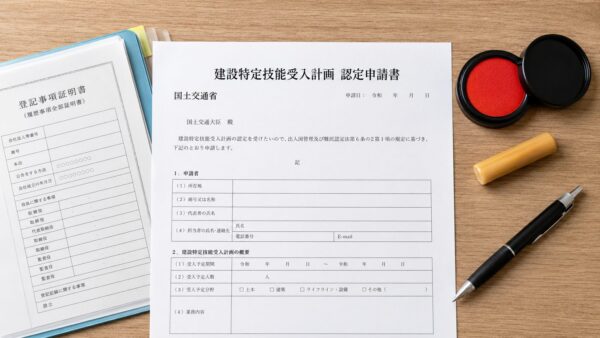
The key point is the reward requirements,
"To continue to pay, on a stable basis, compensation that is equal to or greater than that paid to Japanese workers with equivalent skills."
"The fact that it is a monthly salary system"
...is now required.
In other words, it’s already been decided at the policy design stage that “they must be paid the same salary as Japanese workers.”
Ministry of Land, Infrastructure, Transport and Tourism: “Policy on the Operation of the System Concerning the ‘Specified Skilled Worker’ Status of Residence in the Construction Sector.”
The specific average monthly salary varies depending on the source.
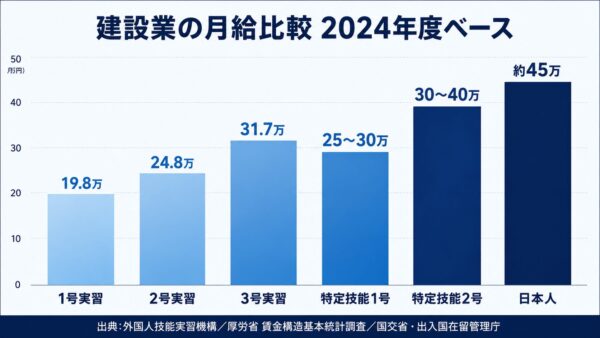
- According to slightly older data from Reiwa 3 released by the Immigration Services Agency, the average monthly salary for foreign workers with “Specified Skilled Worker” status in the construction sector is approximately285,339 yen
- As for trends in industry reports around 2024, regarding the Specific Skilled Worker (Construction) (Category 1) program, generally250,000 to 300,000 yen per month.
- Since Specific Skilled Worker Category 2 is intended to fill roles such as on-site team leaders and foremen,300,000 to 400,000 yen per monthIn some cases, it even reaches...
Once they obtain Specific Skilled Worker status, their Japanese language skills and work performance are generally quite solid, so they’re a huge asset to the company!
If anything, they have even more vitality than the Japanese.
| Category | Monthly Salary Ranges (Construction Sector—Estimates) | Regulatory constraints |
|---|---|---|
| Category 1 Technical Intern | Approximately 198,000 yen | Above the minimum wage (though many are just barely above the de facto minimum) |
| Category 2 Technical Interns | Approximately 248,000 yen | At least the minimum wage |
| Category 3 Technical Interns | Approximately 317,000 yen | At least the minimum wage |
| Specified Skilled Worker Category 1 | Approximately 250,000 to 300,000 yen | At least as good as Japanese people+ Monthly Salary System + Registered with the Construction Career Advancement System |
| Specific Skilled Worker Category 2 | Approximately 300,000 to 400,000 yen | Equivalent to or better than Japanese workers; expected to be at the foreman level |
| Japanese (Construction Industry Average) | Around 450,000 yen | ― |
The key point about the Specified Skilled Worker program is not so much that the wages are high, but rather that the system requires them to be paid on the same terms as Japanese workers.
While the Technical Intern Training Program is structured around “training,” the Specified Skilled Worker program treats participants as “fully qualified workers.”
Therefore, your starting monthly salary will be on par with that of Japanese employees.
And there are ongoing costs here as well, such as association fees!
Why Is the Increase Larger from Category 1 to Category 2 to Category 3 in the Construction Industry?
As mentioned in an article in the Kenshu News, the construction industry shows a more significant increase in monthly wages during the transition from Category 1 to Category 2 to Category 3 compared to other industries.
There's a reason for this.
One reason isMastery of skills tends to have a direct impact on compensationThat’s the structure of the industry. (It’s a fairly straightforward industry.)
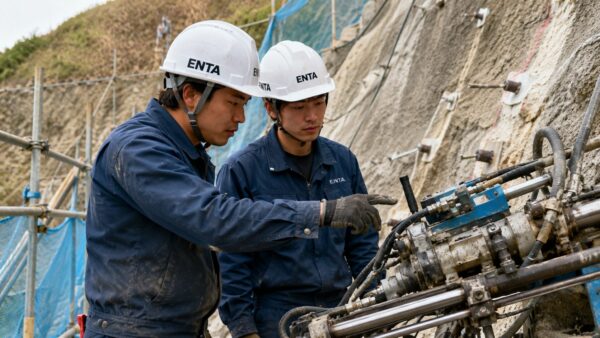
In the field of slope construction, mastering each step—such as installing lath, assembling formwork, and using a trowel—directly translates to your ability to perform effectively on-site.
When it comes to young Japanese players, the way they rely on their teammates on the field is completely different between their first and fourth years.
The point is that the same thing is happening to technical interns as well.
Japanese people are the same, though, lol.
To be honest, for small and medium-sized slope construction companies like ours, Category 3 and Specific Skilled Worker Category 2 workers are becoming the “backbone that keeps our job sites running” as the number of veteran Japanese workers continues to decline.
As long as young Japanese people aren’t entering the field, we can no longer avoid the trend of training skilled craftsmen through the Technical Intern Training Program.
Ultimately, this is all about “unit price” and “career.”
I’ve presented a series of figures, but as someone working on the front lines, there’s one thing I’d like to emphasize.
The reason monthly salaries for foreign workers in the construction industry are rising is not simply because “they’re foreigners,” but rather,
The trend in which the Ministry of Land, Infrastructure, Transport and Tourism revises labor unit rates for public works projects annually, thereby raising rates across the entire industryIt is linked to that.
Labor rates go up → The general contractor’s estimate goes up → Subcontractors’ rates also go up → Ultimately, everyone—including technical interns, Specific Skilled Workers, and Japanese nationals—ends up paying more.
It is only because of this series of factors that the salary levels of 310,000 for Category 3, 300,000 to 400,000 for Specific Skilled Worker Category 2, and 450,000 for Japanese nationals are established.
For small and medium-sized slope construction companies like ours, the idea that “foreign workers are cheaper to hire” simply won’t hold water on construction sites in 2026.
It's just an impossible structure to begin with.
Slavery? I'm like, "Are you kidding me?" lol
What do you think of this paycheck??
Under the Specified Skilled Worker program, wages are equal to or higher than those of Japanese workers by design, and even Category 3 trainees earn over 300,000.
Unless we treat them not as “cheap, young labor” but as “valuable assets who deliver skills commensurate with their pay,”
They themselves will be gone as well.
The problem is that it's us who are in trouble.
However, if you look at the numbers objectively, both technical interns and Specific Skilled Workers are “exactly the same as young Japanese people!”
To survive in the workplace going forward, it’s not about where you’re from, but rather,
I believe that, ultimately, the most important thing is to evaluate people based on “what they can actually do on the job.”
See you later.