The term “Construction DX” has been bandied about for quite some time now, but how does it actually feel to those of you working on the job sites?
"In the end, they tell me to submit it on paper," "The system is hard to use"...
I can almost hear that kind of grumbling.
In December 2025, the Japan Construction Management Software Industry Association (J-COMSIA), a general incorporated association, released the results of a “Survey on the Current State of Construction Digital Transformation and Business Processes” conducted among local government employees nationwide.
What we saw there was the stark reality of the front lines—hampered by “paperwork” and “labor shortages”—in stark contrast to the glamorous rhetoric surrounding digital transformation.
What’s causing problems on-site are “blueprints” and “documents.”
First, let’s take a look at the survey results regarding the “most demanding phase” of construction management.
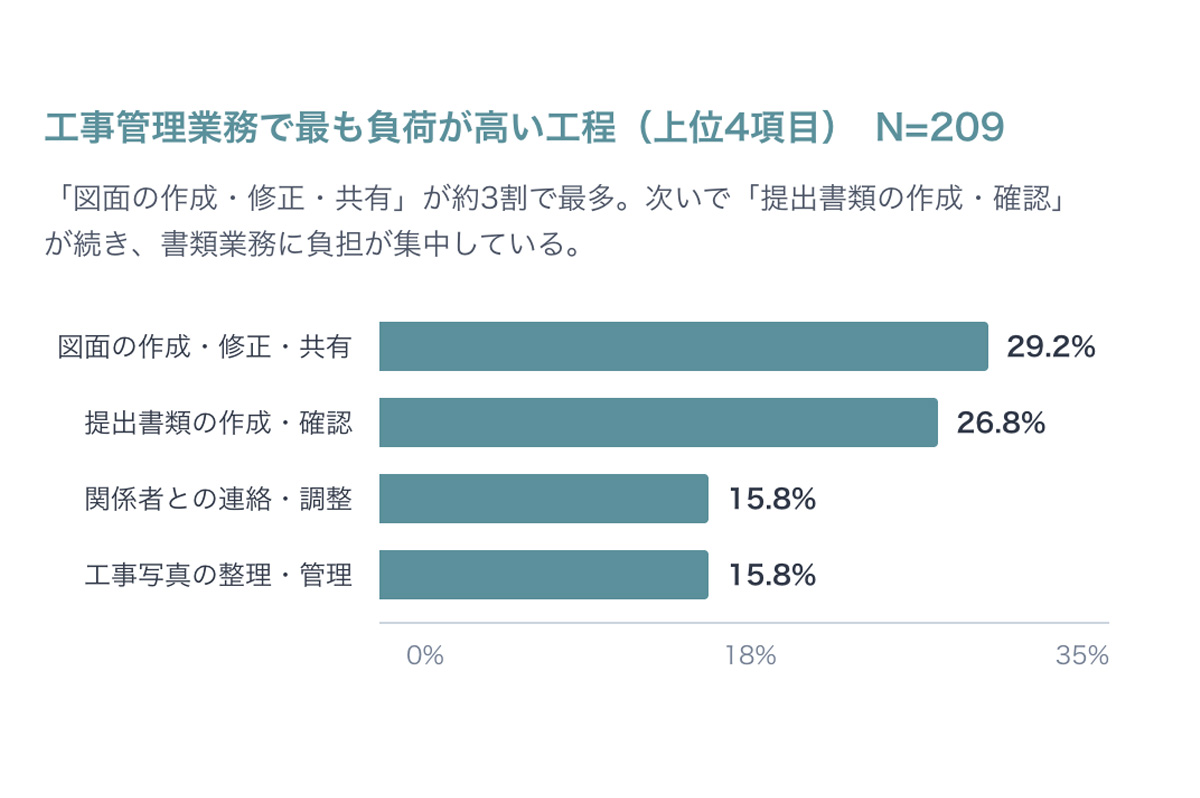
The Four Most Demanding Phases of Construction Management / Source: Japan Construction Management Software Industry Association (https://www.jcomsia.org/about/pressrelease/20251225)
"Creating, modifying, and sharing drawings (29.2%)" and "preparing and reviewing submitted documents (construction plans, daily reports, etc.) (26.8%)" alone account for more than half of the total.
Rather than focusing on “core tasks” such as on-site safety and quality control, both the contractor and the client (the local government) are swamped not only with drawings, documents, and photographs, but also with the preparation and inspection of fruit.
Another point worthy of particular attention is “how drawings and equipment ledgers are managed.” Surprisingly, the most common response—at 41.6%—was “paper drawings and ledgers are the official copies and are stored in archives or similar facilities.” More than 40% of local governments reported that “paper is the official copy.”
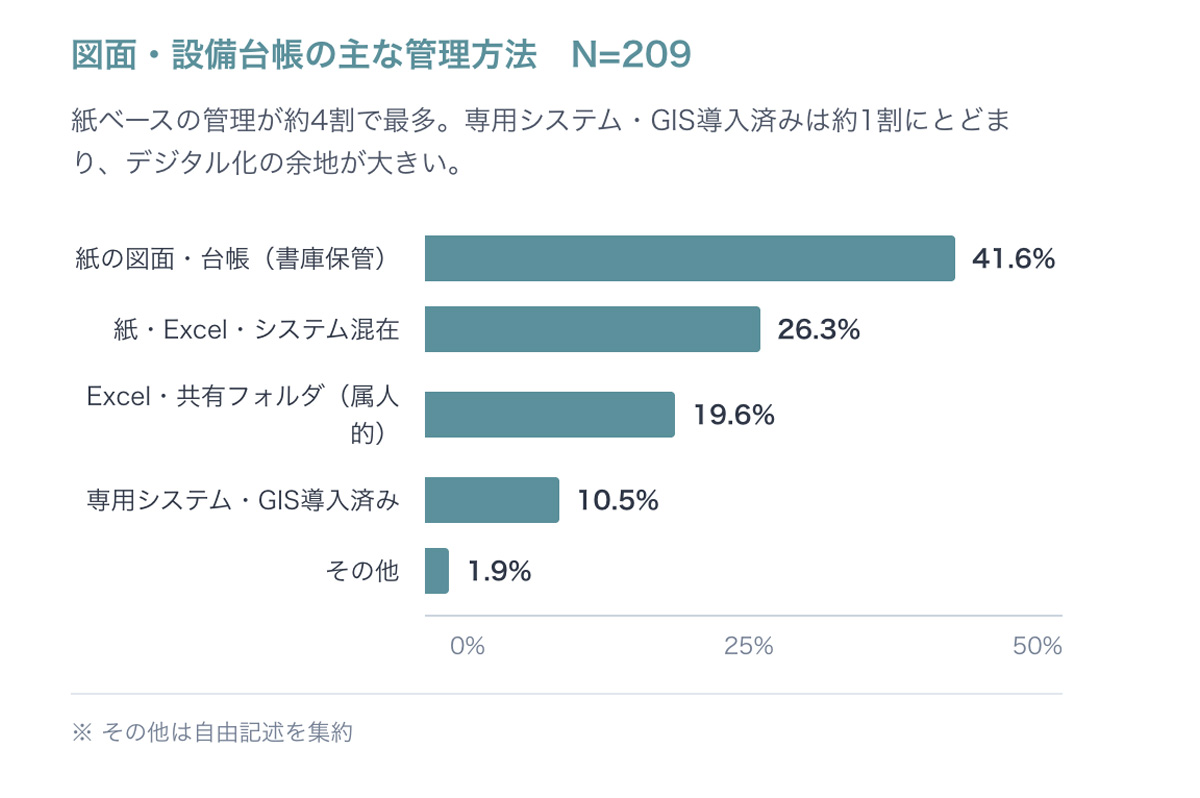
Main Methods for Managing Drawings and Equipment Registers / Source: Construction Management Software Industry Association (https://www.jcomsia.org/about/pressrelease/20251225)
If we include the responses indicating a “mix of paper, Excel, and dedicated systems,” it’s safe to say that very few local governments are able to manage their data in a truly centralized manner.
Under these circumstances, even if you want to “check the past repair history for that site,” just digging out the King File from a dusty archive would take up half a day.
In fact, surveys show that “searching past records takes too much time (53.0%)” ranks among the top challenges.
"Over 80% Still Use Phone and Fax for Communication"
Even when it comes to “means of communication”—one of the very basics of digital transformation—the reality is harsh.
When asked about the tools they use to communicate with contractors, the most common response was “email (84.2%),” followed by “phone and fax (81.8%).”
The adoption rate for business chat is just 4.8%. The adoption rate for ASPs (information-sharing systems) also remains at 16.7%.
Given that chat tools and ASPs—which are designed to prevent “he-said, she-said” disputes and reduce travel time—haven’t become nearly as widespread as they could be, it’s no wonder that the Showa-era work style—where people spend their days fielding phone calls and their evenings sending faxes—just won’t go away.
Is “3D data” just a pipe dream?
This survey also revealed that a “polarization” is occurring regarding the implementation status of DX initiatives.
Regarding foundational tools such as electronic submission and ASPs, approximately 40% of respondents indicated that they are either “in operation” or “under trial,” indicating a certain level of adoption.
However, when it comes to advanced initiatives such as BIM/CIM, remote presence, and point cloud utilization,A majority of respondents said, “I’m interested, but I have no plans.”accounted for.
While the adoption of BIM/CIM as standard practice is progressing in projects directly managed by the Ministry of Land, Infrastructure, Transport and Tourism (MLIT), the reality is that in local government projects—which involve many site supervisors—even “basic digitization” remains elusive, let alone advanced ICT-based construction methods.
Although initiatives such as electronic submission are gradually being implemented, measures that require local governments to invest in equipment—such as “3D simulations”—remain a distant prospect. Shouldn’t the priority be to first address immediate needs, such as “make it easier to organize photos” and “allow remote participation in inspections”?
The obstacles are “budget,” “staff,” and “not knowing how to proceed.”
So, why can’t local governments change?
It is by no means the case that the staff are slacking off. What the survey revealed were structural challenges unique to local governments.
The factor that received the most votes as an obstacle to DX implementation was “difficulty securing a budget (56.5%).” This was followed by “shortage of personnel (52.6%)” and “lack of understanding of the initiatives (47.4%).”
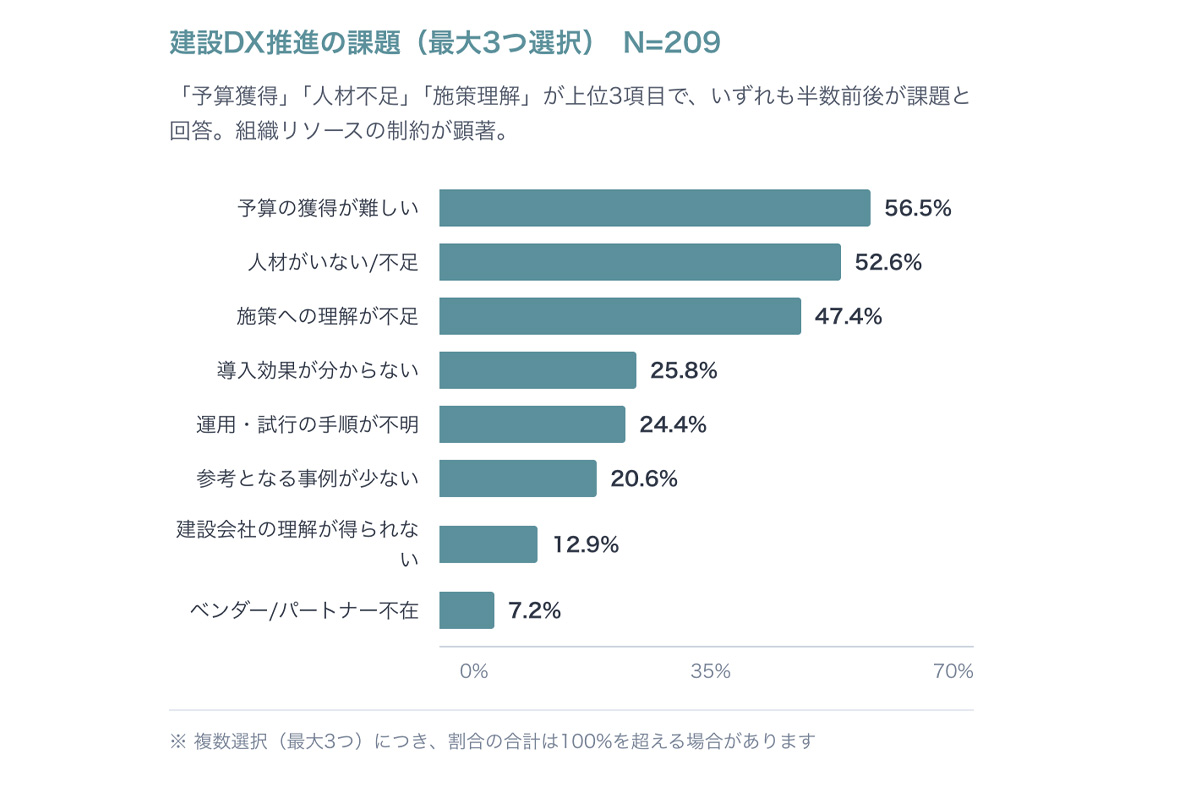
Challenges in Promoting Digital Transformation (DX) in Construction / Source: Construction Management Software Industry Association (https://www.jcomsia.org/about/pressrelease/20251225)
Behind the response that “there is no budget” seems to lie the fact that it is difficult to gauge the cost-effectiveness—that is, how much of the workload would be reduced for a given budget allocation.
In a government organization where following precedent is the norm, allocating a budget for digital transformation (DX) tools with unknown effectiveness is an extremely difficult task. This has highlighted the dilemma that officials cannot move forward without concrete data—such as “How are other municipalities handling this?” or “How much did they spend on it?”
"Please standardize the document formats!"
Finally, I’d like to present the data from this survey that is likely to resonate most with site supervisors.
When asked, “Which items would you like the government or industry associations to unify or standardize?” an overwhelming majority (58.4%) responded, “Standard Formats for Submitted Documents (Construction Plans, Daily Reports, etc.)" took first place.
Formats that vary slightly from one local government to another, and corrections to grammatical details that are pointed out every time a new staff member takes over... I imagine these are areas where site supervisors struggle on a daily basis, but simply standardizing these elements should dramatically reduce the amount of overtime worked by local government employees.
While flashy technologies like 3D data and AI are important, what the front lines truly need are these unassuming yet highly effective, grassroots initiatives.
Let's start with "Defensive DX"
J-COMSIA, which conducted this survey, states that what local governments need right now—even before introducing advanced technologies—is the “digital organization and standardization of drawings and documents (Digital Transformation in Defense) concludes that...
That’s absolutely right. Even if you’re using state-of-the-art equipment and software, productivity won’t improve if you’re still printing out reports on paper, stamping them, and bringing them in person.
J-COMSIA has announced that it will move forward with initiatives such as workshops for local governments and efforts to visualize the benefits of implementation. We sincerely hope that these common frustrations—which often sound like cries for help from the field—will be resolved, creating an environment where everyone involved in the construction industry can focus on the true essence of “craftsmanship.”
[Survey Overview]
- Survey Period: November 1, 2025 – December 15, 2025
- Survey Method: Questionnaire survey of local governments
- Number of valid responses: 209
- Organizer: Japan Construction Management Software Industry Association (J-COMSIA)
*Source: [Research Report] The Current State of Construction DX in 209 Municipalities Nationwide. “Challenges Preceding DX” Come to Light (https://www.jcomsia.org/about/pressrelease/20251225)