

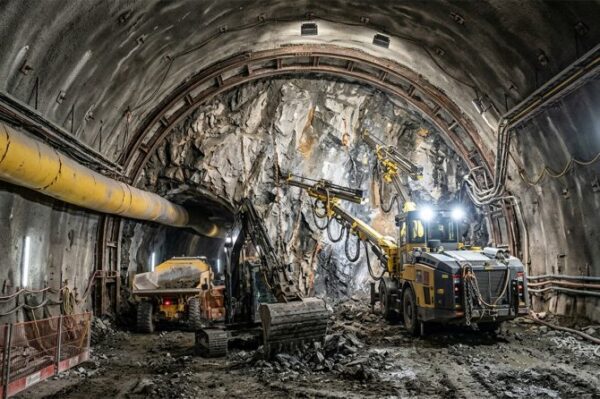
"Excuse me!!! Can I take a picture?!!!"
Standing in front of the tunnel face, I was shouting. The other person was up on a piece of heavy machinery. It was incredibly loud inside the tunnel, so even if I shouted at the top of my lungs, my voice probably wouldn’t reach him. Still, if I didn’t take the photo, the work wouldn’t move forward, so I just kept shouting. Just when I thought he’d finally noticed me, all I got in response was a single word.
"Hurry up!!"
"Don't run at the scene." That's the first thing everyone is taught. But in that moment, that rule completely flew out of my head.
I’d dash all the way to the edge of the pit, set a huge blackboard on the ground, take a photo, then carry the blackboard back while running. This was back in the days before digital whiteboards.
"We're done taking photos!! Thank you so much!!!"
As I bowed my head, this is what I was thinking to myself.
――"It's over," he said.
This was just a typical day for me during my first year working as the “prime contractor” on a mountain NATM tunnel project.
Last-Minute Photos: Steps to Take a Single Shot
If I explain the steps calmly, here's how it works.
After blasting, the excavated rock is loaded onto a heavy-duty dump truck using a wheel loader. Once the sweeping is complete, we move on to the next step—using a breaker to dislodge loose rocks, a process known as “kosoku.” The only moment I can take a photo of the face is right after the rock removal following kosoku is finished and just before we begin the spraying process.
It’s noisy inside, so I wait about 50 meters behind the heavy machinery at first. Once the operator can see me, I wave my arms widely to signal him. When he notices me, he’ll stop the machine, so I say, “Excuse me, may I take a photo?” If I hear “Go on, hurry up,” I’ll dash over with the chalkboard. I’ll set up on my own, snap the photo, and as soon as I’m done, I’ll put the chalkboard away, say, “I’ve got it, thank you very much,” and step back from the face of the tunnel.
That's finally one take.
Just to be clear, running on the job site is something that should never happen, and I would absolutely never do it now. Also, it was us who were making the miners stop working at that dangerous face. Looking back now, it’s no wonder the miners were getting frustrated and yelling, “Hurry up!” But back then, I didn’t have the mental bandwidth to think about any of that...
Even as the general contractor, you can't take a single photo without saying "Excuse me."
When you hear the term “construction management for a general contractor,” you might imagine a role that involves running the job site based on blueprints and scheduling. That’s exactly what I thought when I first started in the field.
In reality, though, all I could do was bow my head to the miner and ask him to make the arrangements, and try to handle the situation in a way that wouldn’t upset him.
Even just to take a single photo, I couldn’t proceed without saying, “Excuse me.” My title as the general contractor held no weight here.
Looking back now, I’m sure there were many times when I, as a first-year employee with no experience, must have caused trouble on the job without even realizing it. But back then, I was so desperate just to get through each day that I didn’t even have the mental bandwidth to think about it.
The atmosphere on the face team and the lining team is polar opposites.
However, this doesn't cover the entire job site. Even within the same tunnel, the members of the tunnel face team and the lining team were completely different, and the atmosphere on site was polar opposites.
To be honest, working with the team at the tunnel face was really tough. The miners all had their own quirks, and no matter what I did, I’d end up getting yelled at. Normally, I should have gone through the primary subcontractor instead of dealing with them directly, but I just couldn’t see eye to eye with that foreman. There were even times when he gave me explanations that I could only interpret as lies.
Of course, this may just have been how I perceived things as a first-year employee. My lack of understanding and poor communication skills likely contributed to that impression as well. Still, there were definitely incidents back then that made me feel that way.
The worst part was during the 6:00 a.m. morning meeting, when I’d be told, “He said this,” based on something I’d never actually said, and then publicly humiliated in front of everyone. The term “public execution” fits this situation best. Even if I replied, “I didn’t say that,” it didn’t change anything in the moment.
On the other hand, the formwork team was different. The foreman was a really capable guy who actually listened to what we had to say. That said, I was only in my first year. I kept making mistakes—misreading the height for cutting out the box or when setting the center—and got scolded pretty harshly. Looking back now, I realize I was just being scolded for making obvious mistakes, but at the time, I was really struggling.
The lining work was a long process involving over 100 blocks. As we worked side by side more and more, we ended up getting along really well by the second half of the project.
What's interesting is that, even within this lining team, the foreman and I ended up communicating directly with each other without going through the primary subcontractor.
The person in charge of cladding at our primary subcontractor was just standing in a corner on the second floor of the Center, looking at us and going, “Hmm,” without doing anything. Whether it was a good team or a bad one, we ultimately couldn’t count on the person who was supposed to step in and sort things out.
The workplace I thought I was done with has become the foundation of where I am today.
There’s one thing I learned for sure on this job site: no matter how accurate the blueprints or work procedures are, the site won’t run smoothly if the people involved aren’t working well together.
And that “person” wouldn’t follow the hierarchy chart of the primary subcontractor. In the end, I had no choice but to build a relationship of trust directly with the foreman myself.
After working on several tunnel projects, I became convinced that the atmosphere on a job site can change completely depending on the team. To be honest, I still feel very strongly that “I’ve had enough of tunnels.”
It’s been nearly 10 years since then, so things might be different now. Interactive whiteboards have become the norm, so I suppose there’s no need for that last-minute dash anymore.
Even so, the sense of “how to motivate people” that was drilled into me during those days has become the foundation of who I am today.
It was way too tough to handle in my first year, but looking back, that job site was definitely a valuable experience.