Hello, everyone.
This is Enta.
The other day, I wrote about the appearance of the site.
I think I'll write about that again.
Why is it better to be beautiful?
Have you ever thought about that?
A clean worksite, neat workmanship, and well-organized paperwork.

When I was young, I wouldn't have bothered to look at a document like this, would I?
I used to think things like, “Who cares about this part, anyway?”
However, when I looked at the documents prepared by my senior and the general contractor, I saw that they had been put together with incredible attention to detail and thoroughness.
Their paperwork and on-site work are flawless!
Construction management is thorough and meticulous, with no oversights.
I think that's around the time I started paying particular attention to how I prepared documents.
The same applies to the field.
Inspections go smoothly at a clean worksite.
Naturally, those individuals scored quite high on their on-site evaluations, and the inspectors gave them their full endorsement, saying, “Great job!”
The inspection process starts with a document review.
Once the document review is complete, we'll head to the site.
First, your documents will be reviewed, and the inspector’s impression of you at that stage is completely different.
Are they already suspicious of me at this stage!? I can really feel that they trust me.
I think this is something I can only understand because I’ve been through inspections for both subcontracted and prime contractor projects, lol.
First of all, when the paperwork looks neat and organized (and is easy to read), the inspector tends to be kind.
Otherwise, I get all on edge lol
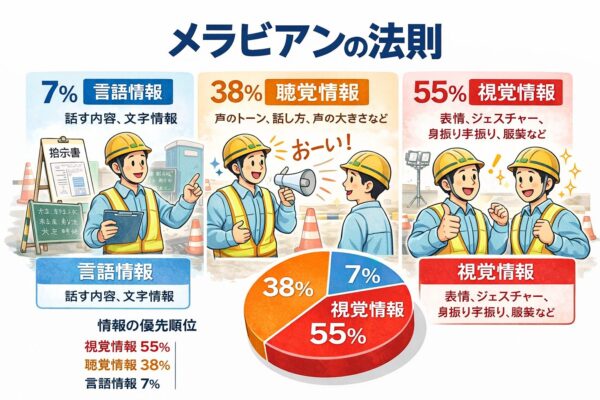
This is exactly what's known as Mehrabian's Law, isn't it?
What Is Mehrabian's Law?
When people interpret the emotions and attitudes of others,
① Visual Information (Facial Expressions and Gestures) 55%
② Auditory Information (Voice Tone) 38%
③ Linguistic Information (Content of Speech) 7%
A psychological principle stating that it has an impact in the following proportion
Considering Mehrabian's Law from a Practical Perspective
To put it simply from a practical standpoint, rather than asking, “What work was done?” the key questions are: How did the work look, and how was it conveyed during the inspection?!
The same applies to patrols.
① Visual information (55%)—Most directly linked to ratings
The factors that are “first and instinctively” assessed on-site are
Overall Organization and Tidiness of the Worksite
(How materials are stored, ensuring clear walkways, and the care taken in protective covering)
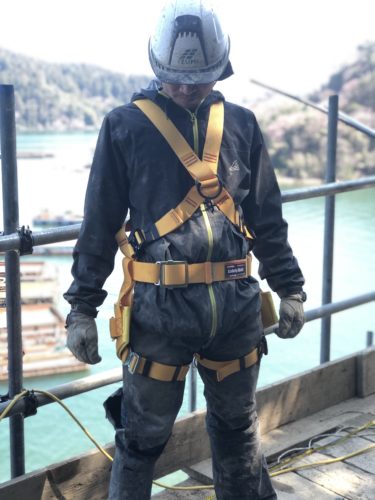
Workers' Appearance
(Use of Helmets, Clothing, and Safety Equipment)
Appearance of Site Bulletin Boards and Construction Documents
(Installation location, text alignment, presence of stains, creases, or correction marks)
The Beauty of the Finished Work
(Uniformity of spray application, alignment of vertical and horizontal beams, edge treatment)
Ease of Photo Management
(Focus, Composition, Organized Records)
"A well-organized worksite = a worksite you can trust"
This means that this impression is often already formed before any explanation is given.
② Auditory Information (38%)—A Factor That Influences Trust
Even with the same explanation, the way you deliver it can completely change how it’s received.
Volume of Voices from Site Representatives and Staff
Calm manner of speaking and pace
Overuse of technical terms / Plain-language explanations (explanations that even laypeople can understand)
Unhesitating responses, crisp and clear
How to Respond to Complaints and Criticisms
A confident tone (stating things definitively, leading with the conclusion)
Speaking in a low, muttered voice → Anxiety, unreliability
Calm and concise → “I can trust this person!”
Even if the content is the same, the “sound” can completely change how it’s perceived.
To put it bluntly, even if it’s a bit of a gray area, if you say “It’s fine!” with total confidence, it might just fly!?
(I think everyone’s been through this before, lol)

③ Linguistic information (7%)—Actually, this is the lightest
"Clarity" Over "Correctness"
Contents of Documents (How to Write Construction Plans, Consultation Documents, and Reports)
Contents of the Meeting Minutes (Wording, Attachments)
Details of Corrections and Explanation of Reasons (Clarity)
Presentation of Figures, Standards, and Rationale (Preparation of Supporting Data, etc.)
Explanation of Construction Methods and Processes (Manufacturer’s Explanation Alone Is Insufficient)
No matter how accurate what you write may be, if your handwriting is messy, hard to read, or you lack confidence in your writing style,Ratings tend not to increase easilyto.

"Reversal Phenomena" Commonly Observed in the Field
High technical skills but a messy work environment → Low evaluation
Workmanship is average, but they are neat and organized and provide thorough explanations → Highly rated
It doesn't look safe.
It comes across as unsafe behavior.
I feel anxious about giving vague answers.
From the other person’s perspective (like an inspector or patrol officer), might they get the wrong impression that I’m disliked? lol
Construction Evaluation: It’s Not Determined by Technical Capability Alone
Construction work is not just about the “as-built” condition, but also...
People are judged by their appearance, the way they speak, and how they communicate; 93% of that judgment is based on visual and auditory cues.
The content of the documents (language information) accounts for the final 7%
"Just saying 'You did a good job' isn't enough!"
It’s important that your work “looks good” and “comes across well”!!
The point is that it's important to make the construction work more visually appealing.
Turn the Workplace into Entertainment!
See you later.