Hello, everyone.
This is Enta.
Methods for Maintaining a Constant Ambient Temperature During Winter Curing
Guidelines for Diluting Cement Slurry with Hot Water Based on Finished Mix Temperature
Hot sake is the best drink for winter construction, right!?

The other day, I wrote about the mixing temperature of mortar as a measure to prevent freeze damage.
We're in the middle of it right now—we're doing spray application work in Nagano.
I went out to get a feel for the atmosphere there!
I’d like to compare the theoretical values with the actual results.
Theoretical Value from Last Time
The outside temperature is the same as the temperature of the sand and cement.
The water temperature is set to a fixed 50 degrees.
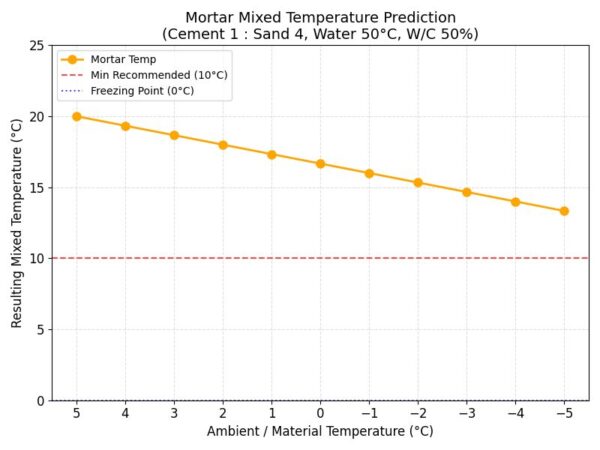
Mortar Mixing Temperature (1 part cement to 4 parts sand, water-cement ratio of 50%)
Vertical axis: Resulting Mixed Temperature (°C) Final mixing temperature (°C)
Horizontal axis: Ambient / Material Temperature (°C) — Ambient temperature and the temperature of the materials (sand and cement)
Red dotted line: Recommended minimum temperature
| Outdoor Temperature (Material Temperature) | Mixing Temperature |
| 5°C | 20.0°C |
| 4°C | 19.3°C |
| 3°C | 18.7°C |
| 2°C | 18.0°C |
| 1°C | 17.3°C |
| 0°C | 16.7°C |
| -1°C | 16.0°C |
| -2°C | 15.3°C |
| -3°C | 14.7°C |
| -4°C | 14.0°C |
| -5°C | 13.3°C |
Actual measurements
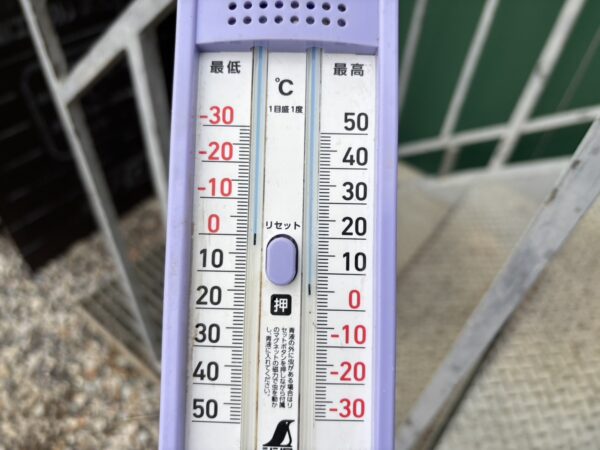
It was relatively warm that day, lol
It was as high as 4°C when I took the measurement...
I would have preferred it to be a little lower, though.
Based on the theoretical values above,The temperature is expected to be around 19.3°C.
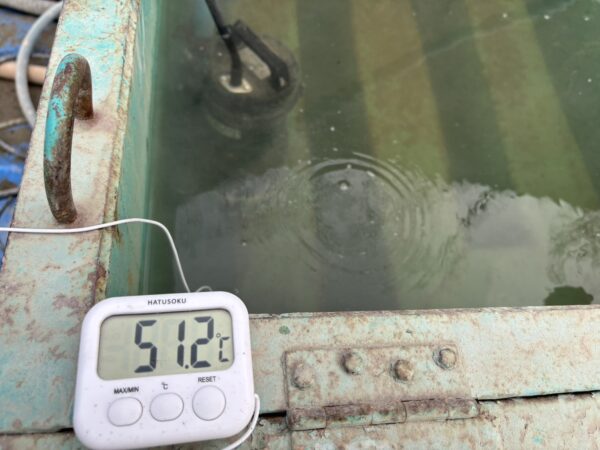
The water temperature is51.2°C
The three hoses are connected to make a total length of 60 meters.
There was quite a bit of wind, so it actually felt pretty cold.

And now for the final kneading temperature.
16.9°C!
It's roughly a little over a 10% decrease.
So, basically, that’s how much the pressure drops when spraying with a 60-meter hose, right?
If it takes longer than this, it might be better to turn up the heat.
That said, there are limits, so the water temperature should be kept between 50 and 60 degrees.
There are also limitations to submersible pumps. (They're fine for high-temperature applications.)
Well...At this temperature, it’s highly unlikely to freeze!
Using low-quality antifreeze will lower the setting temperature.
This is because it lowers the heat of hydration.
Since this experiment was conducted by a government agency, the results are definitely accurate, but it’s a bummer that I can’t make them public… lol
If you really want to see it, I can show it to you if we happen to meet!
If you're in the area, please feel free to give me a call.
See you later.