


If it was self-defense, you won't be held liable.
Article 720 of the Civil Code provides for self-defense.
■Article 720
1. A person who, in order to defend his or her own rights or legally protected interests, or those of a third party, against the tortious conduct of another, is compelled to commit a tortious act shall not be liable for damages.
There was a court case in which X and Y2 got into a fight, X was injured, and the issue at stake was whether Y2 could be found to have acted in self-defense. The incident took place at a waste treatment plant, where Companies A and B had formed a joint venture to undertake the installation of air conditioning, water supply, and drainage systems; Companies C (first-tier subcontractor), D (second-tier subcontractor), and Y1 (third-tier subcontractor) were also involved.
The following details regarding whether a claim of self-defense holds up are quoted from *Hanrei Times No. 1027*.
"Should we really let them have it?" Tensions escalate between second-tier and third-tier subcontractors
Plaintiff X was an employee of Company D, a second-tier subcontractor, and served as the site supervisor. He was 164.5 cm tall and weighed 55 kg. Despite being the site supervisor, she did not attend morning meetings, barely participated in discussions, and did not even understand the basics of the work. As a result, she was regarded as a ”dead weight” on site, and work instructions and communications were bypassed and relayed directly from the section chief at the first-tier subcontractor, Company C, to Defendant Y2, skipping Plaintiff X altogether.
Meanwhile, Defendant Y2 was an employee of third-tier subcontractor Y1. He was 171 cm tall, weighed 78 kg, and had eight months of experience in Aikido. Because X did not understand the work, Y2 had to work overtime to keep the project on schedule.
On the day of the incident, X had been reprimanded by a section chief at Company C for “failing to properly supervise the construction site,” and had been harboring resentment ever since. That same morning, Y2 gathered the materials specified by the section chief at Company C and went to the construction site that afternoon.
So X complained to Y2, saying, “You’re just strolling in now?” Y2 replied, “I’d already prepared the materials. Don’t complain—you haven’t been coming to work at all,” and went back to the office.
X then followed Y2 into the office and hurled threatening remarks at him, saying, “What was that attitude just now? Do you even understand your place?” and “You’re just a subcontractor. I could fire you at any time,” and the two got into an argument.
Y2: "What the hell, you bastard!"
X: "Don't mess with me! Are you really going to do that? Do you want me to knock you out?!"
Y2: "Go ahead and try it if you think you can!"
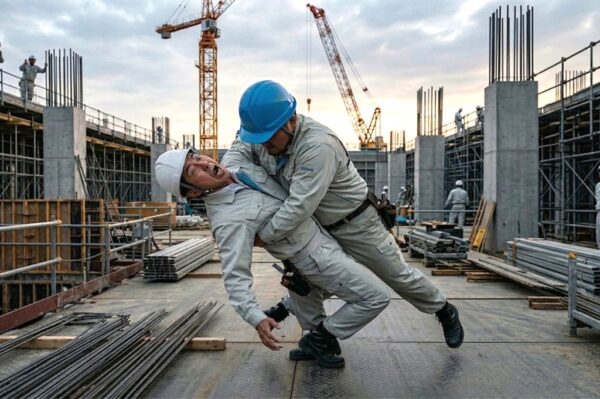
Y2 brought his face within a few centimeters of X’s face. X then headbutted Y2, kicked Y2 while he was crouched on the ground, punched him with his fist, and, with Y2 in a crouching position, wrapped his right arm around Y2’s neck (in a so-called headlock) and attempted to slam Y2’s head against a concrete pillar about one meter away.
Y2 wrapped his arm around X's waist and braced his feet to stop X's movement, but immediately afterward, he fell backward with X, throwing him diagonally behind him (a so-called "backdrop").
As a result, X sustained serious injuries, including a brain contusion, and filed a lawsuit against Y2 and Y1 seeking 19.63 million yen in damages. The trial court ruled in favor of X, and Y1 and Y2 filed an appeal. In the appellate proceedings, they argued that Y2’s actions constituted self-defense. X has since increased the amount claimed to 56.64 million yen.
Is the Backdrop "Self-Defense"?
If self-defense is established and Y1 and Y2’s share of fault is zero, then there is no obligation to pay.
Y1 and Y2 argued that the four elements necessary for a claim of self-defense were met.
- Imminent Unlawful Infringement: Y2 was about to hit his head against the pillar.
- Will to Defend: I want to protect myself because getting hit in the head can cause injury.
- Necessity and Proportionality of Acts of Self-Defense: The only way to defend against it is to counter with a back drop.
- Within the Limits of Self-Defense: Since the only move is the back drop, it falls within the limits of the title defense.
The court ruled that, while it was clear the cause of the assault was X’s persistent and one-sided violence against Y2, Y2 was also at fault.
The reason for this is that,
- Y2 said, “Go ahead and try if you think you can,” and brought his face just a few centimeters from X’s to taunt him.
- Y2 wrapped his arm around X's waist, braced his feet, and "stopped X's movement." At that point, he had successfully defended himself.
lists the following.
Regarding the act of falling backward together while throwing X diagonally behind them (a so-called “backdrop”), the court determined that there was no need to go that far and that it must be deemed an act of excessive self-defense that went beyond the bounds of legitimate self-defense.
The court ruled that this assault case constituted excessive self-defense rather than self-defense, and ordered the payment of just over 5.49 million yen, with X bearing 85% of the liability and Y2 and Y1 each bearing 15%.
Consequently, this assault caseNot self-defense, but excessive self-defenseAccordingly, the court ordered payment of just over 5.49 million yen, with X bearing 85% of the liability and Y2 and Y1 sharing the remaining 15%.
■ Damages to X as Determined by the Court
- Medical expenses: 237,935 yen
- Miscellaneous Hospital Expenses: 34,800 yen
- Transportation expenses for medical visits: 43,520 yen
- Loss of Earnings: 2,090,236 yen
- Loss of Earnings: 25,563,737 yen (loss of earning capacity due to reduced motivation and emotional numbness resulting from permanent disability)
- Compensation for emotional distress: 7,300,000 yen
- Attorney's fees: 340,000 yen
- Other: 1,000,000 yen
Total: 36,610,228 yen
36,610,228 yen × 15% = 5,491,534 yen (Osaka District Court, July 17, Heisei 10)
Y2’s claim of self-defense was not recognized. However, isn’t it impossible for anyone other than a professional fighter to stop moving the moment they counter a headlock with a back drop and bring their opponent to a halt?
Of course, it’s always best to avoid arguments if possible… But I’ve heard there’s a method called “anger management” that serves as a form of psychological training to help control feelings of anger and deal with them appropriately.
The 6-Second Rule for Anger Management
Anger management, it seems, is not about “not getting angry,” but rather about “managing anger effectively.”
One method of anger management is the “6-Second Rule,” which states, “Anger peaks after 6 seconds, so you just need to hold it in for 6 seconds.” It’s recommended by the representative director of the Japan Anger Management Association and neuroscientists. There are also other techniques, such as “deep breathing” and “reframing your thoughts.” Applying this to the Y2 incident, I think it means that after being told, “It’s okay to break my neck,” I should have waited six seconds before saying, “What the hell, you bastard?”
There are videos and comedy routines on YouTube that talk about anger management, so I’d like to look into them a bit. However, I also found myself nodding in agreement with something Sayaka from the comedy duo Rarando said: “If you can hold it in for six seconds, it’s not really anger, is it?”