Hello, everyone.
This is Enta.
When you bring generators or drilling machines to a slope construction site—especially if they’re specialized machines—you’ll often be asked, “Is it an emissions-compliant model?”
Even when buying used machinery, you ask, “What emission standard is this?” lol
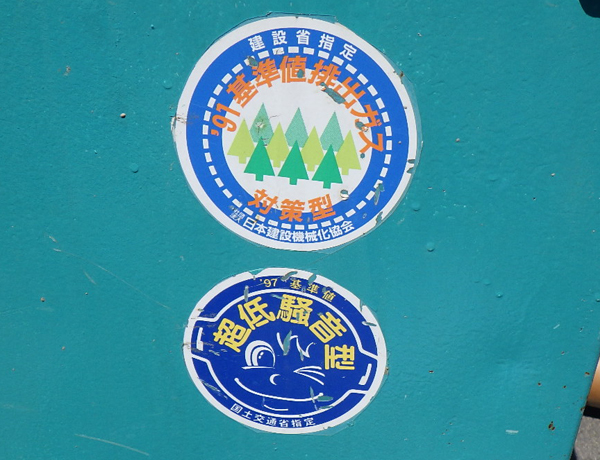
Differences Between the First through Fourth Standards in Construction Equipment Emission Regulations (Designation System for Construction Equipment with Emission Control Measures)And, supporting thatThe Framework of the Off-Road Vehicle Act (Act on the Regulation of Emissions from Specified Special Motor Vehicles, etc.)I’ll try writing this based on the Ministry of Land, Infrastructure, Transport and Tourism’s public notices and guidelines.
You might think, “I don’t need to know this,” but it’s important to know!
Learn what you don't know!
What Are the Emissions Regulations for Construction Equipment?
To put it simply,
Emissions regulations for construction machinery aim to reduce the harmful substances (NOx, PM, CO, HC, and black smoke) emitted by construction machinery equipped with diesel engines,A national designation system for phased reductionThat's it.
There are basically two things:
- Ministry of Land, Infrastructure, Transport and Tourism, “Guidelines for the Designation of Construction Machinery with Emission Control Measures”(Gradually strengthened since Heisei 3 (1991))
- Off-Road Vehicle Act (Act on the Regulation of Emissions from Specified Special Motor Vehicles, etc.)(Enacted in Heisei 18 (2006))
In public works projects, including those directly managed by the Ministry of Land, Infrastructure, Transport and Tourism,Use of designated construction machinery is mandatoryThere are many scenes where this is shown, and
You can check the number of uses for machinery brought to the job site using the stickers (designated labels).
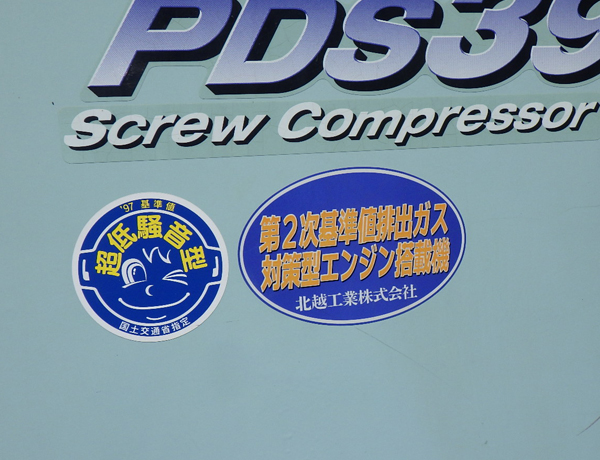
Substances Subject to Regulation
| Substance | Abbreviations | Impact on Health and the Environment |
|---|---|---|
| Nitrogen oxides | NOx | Causes of Acid Rain and Photochemical Smog |
| Particulate Matter | PM | Harmful to the lungs and respiratory system (a precursor to PM2.5) |
| Carbon monoxide | CO | Caused by incomplete combustion; toxic to humans |
| Hydrocarbons | HC(NMHC) | Causes of Photochemical Oxidants |
| Black Smoke | — | Indicators of incomplete combustion; ensuring visibility |
List of Standard Values from the 1st to the 4th Edition
As specified in the Ministry of Land, Infrastructure, Transport and Tourism (MLIT) noticeReference Values for Phases 1 through 4...will be exported by output category.
All provisions are based on the Ministry of Land, Infrastructure, Transport and Tourism’s “Guidelines for the Designation of Construction Machinery Equipped with Emission Control Measures” (as amended by subsequent notices).
First Set of Standards (October 2003–) (Unit: g/kWh)
| Rated Output | NOx | HC | CO | PM | Black Smoke |
|---|---|---|---|---|---|
| 19 kW or more but less than 37 kW | 8.0 | 1.5 | 5.0 | 0.8 | 40% |
| 37 kW or more but less than 75 kW | 7.0 | 1.3 | 5.0 | 0.4 | 40% |
| 75 kW or more but less than 130 kW | 6.0 | 1.0 | 5.0 | 0.3 | 40% |
| 130 kW or more but less than 560 kW | 6.0 | 1.0 | 3.5 | 0.2 | 40% |
Second Set of Standards (October 2006–) (Unit: g/kWh)
| Rated Output | NOx | HC | CO | PM | Black Smoke |
|---|---|---|---|---|---|
| 19 kW or more but less than 37 kW | 6.0 | 1.0 | 5.0 | 0.4 | 40% |
| 37 kW or more but less than 56 kW | 4.0 | 0.7 | 5.0 | 0.3 | 35% |
| 56 kW or more but less than 75 kW | 4.0 | 0.7 | 5.0 | 0.25 | 30% |
| 75 kW or more but less than 130 kW | 3.6 | 0.4 | 5.0 | 0.2 | 25% |
| 130 kW or more but less than 560 kW | 3.6 | 0.4 | 3.5 | 0.17 | 25% |
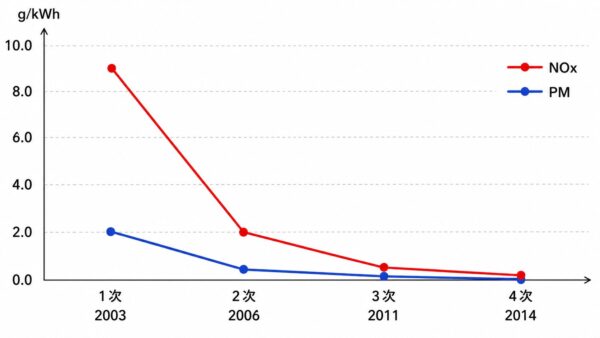
Third Set of Standards (October 2011–) (Unit: g/kWh)
| Rated Output | NOx | HC | CO | PM | Black Smoke |
|---|---|---|---|---|---|
| 19 kW or more but less than 37 kW | 4.0 | 0.7 | 5.0 | 0.03 | 25% |
| 37 kW or more but less than 56 kW | 4.0 | 0.7 | 5.0 | 0.025 | 25% |
| 56 kW or more but less than 75 kW | 3.3 | 0.19 | 5.0 | 0.02 | 25% |
| 75 kW or more but less than 130 kW | 3.3 | 0.19 | 5.0 | 0.02 | 25% |
| 130 kW or more but less than 560 kW | 2.0 | 0.19 | 3.5 | 0.02 | 25% |
The most notable feature of the third phase is,PM (particulate matter) has plummeted by one to two orders of magnitudeWhat I did.
From 0.17 to 0.4 g/kWh in the second phase to 0.02 to 0.03 g/kWh in the third phase.
This is the generation in which the installation of a diesel particulate filter (DPF) has become virtually mandatory.
Fourth Set of Standards (October 2014–) (Unit: g/kWh)
| Rated Output | NOx | HC | CO | PM | Black Smoke (Opacimeter m⁻¹) |
|---|---|---|---|---|---|
| 19 kW or more but less than 37 kW | 4.0 | 0.7 | 5.0 | 0.03 | 0.50 |
| 37 kW or more but less than 56 kW | 4.0 | 0.7 | 5.0 | 0.025 | 0.50 |
| 56 kW or more but less than 75 kW | 0.4 | 0.19 | 5.0 | 0.02 | 0.50 |
| 75 kW or more but less than 130 kW | 0.4 | 0.19 | 5.0 | 0.02 | 0.50 |
| 130 kW or more but less than 560 kW | 0.4 | 0.19 | 3.5 | 0.02 | 0.50 |
The characteristics of the fourth phase are:NOx emissions for power plants with a capacity of 56 kW or more have plummeted from 3.3–2.0 to 0.4 g/kWhWhat I did.
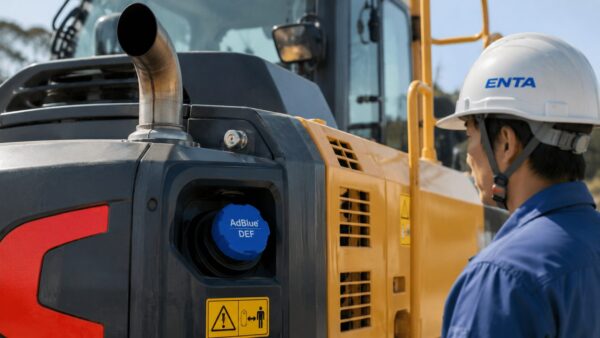
This isUrea SCR (Selective Catalytic Reduction) SystemThese figures are achieved through the inclusion of [...].
The method for measuring black smoke has also changed from the % scale to opacimeter measurements (in units of m⁻¹).
To be honest, things started getting a little weird around this point.
It feels like overkill.
As you all know, urea has made things a whole lot more complicated...
Relationship to the Off-Road Act
Alongside the Ministry of Land, Infrastructure, Transport and Tourism’s designation system, the Off-Road Vehicle Act (Act on the Regulation of Emissions from Specified Special Motor Vehicles, etc.) has been in effect since 2006.
The relationship between the law and the Ministry of Land, Infrastructure, Transport and Tourism (MLIT) notice is as follows:
- Off-Road Act: Jointly administered by the Ministry of the Environment, the Ministry of Economy, Trade and Industry, and the Ministry of Land, Infrastructure, Transport and Tourism. For certain special-purpose vehicles (i.e., work machinery not driven on public roads) that do not meet emissions standards,Legally Regulate the Manufacture, Sale, and Use
- Ministry of Land, Infrastructure, Transport and Tourism Designation Guidelines: Construction machinery that meets the above criteria is “Emissions Control Type" and, in public works projects,Priority UseOperational System to Enable This
In short,The Off-Road Vehicle Act establishes the minimum standards for “machinery that can be brought to market,” and machinery used in public works projects must also receive designation from the Ministry of Land, Infrastructure, Transport and Tourism....it has this two-tiered structure.
From the field staff’s perspective, checking whether the designated sticker is affixed is sufficient for practical purposes.
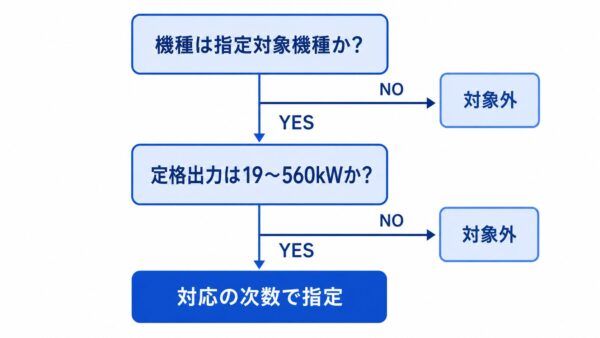
Some machines are not subject to this requirement.
Based on my experience,Not all construction machinery is subject to these regulations.。
The applicable models are listed in the specified guidelines, and
- Applicable Equipment: Hydraulic excavators, wheel loaders, bulldozers, generators (various rated outputs), etc.
- Excluded (in part): Engine-powered sprayers, certain anchor drilling machines, special-purpose machinery, etc.
Since the engine type of the spray machine is not subject to the specifications, you can use it even if it does not comply with the regulations, but
It's not something people use these days, and,Separate consideration must be given to safety and the surrounding environment.That's it.
Since the types of applications for Anchor's core drills vary by model, it is recommended that you check with the manufacturer before purchasing or using them.
Things to Keep in Mind When Buying Used Machinery
What emission standard should you look for when buying used machinery?Buying without paying attentionIn that case, there may be situations where it cannot be used in subsequent public works projects, which could cause problems.
There has been a slight increase in the number of cases where used equipment compliant with the First and Second Standards is not accepted at construction sites these days.That's why.
To check,
- Specification Sticker on the Side of the MachineView (Most Reliable)
- Contact the manufacturer using the model number, type, and vehicle identification number(Can be verified even if the sticker has peeled off)
- Search for the model on the Ministry of Land, Infrastructure, Transport and Tourism’s “Status of Designated Construction Machinery with Emission Control Measures” page
Color of the Emissions Standards Sticker
The sticker on the side of the machine that specifies...The colors and styles vary depending on the reference order.This may occur (varies by region and designated period).
For the most up-to-date version of the accurate sticker reference table, please check the Ministry of Land, Infrastructure, Transport and Tourism’s “Status of Designated Construction Machinery for Emission Control” page.。
Latest Trends | The 5th Regulatory Phase and the GX Construction Equipment Certification System (2024–)
I previously wrote about exhaust emissions in an explanation dated 2016, but,
As for the latest trends as of 2026,Phased Introduction of the 5th Emission Standards and Launch of the GX Construction Equipment Certification SystemThere are two major trends, but
Seriously, I just want you to stop...
If we have to comply with even stricter emissions standards, the machinery won't run properly anymore...
5th Emission Standards | October 2024–: PN Standards Added
The 5th Emissions Regulations will be phased in starting in October Reiwa 6 (2024)...is being done. The major difference from the first through fourth phases is that,
- Addition of PN Regulations: Conventional PM (particulate matter)Mass LimitsIn addition, a new PN (Particle Number) Regulations...will be added
- Scope: Diesel engines with an output of 19 kW or more but less than 560 kW that run on diesel fuel
- Full Implementation:The end of Reiwa 9 (2027)Scheduled to take effect by
PN is an approach that regulates the number of ultrafine particles (nanoparticles)—which are even smaller than PM2.5—by particle count.
These regulations aim to limit the health effects of particulate matter—which cannot be fully captured by mass alone—by setting numerical limits.
| Regulations | Start Year | Major Changes |
|---|---|---|
| First | October 2003 | Regulations Take Effect |
| Second | October 2006 | Gradual reduction across all items |
| The Third | October 2011 | PM levels down by 1 to 2 digits(Assuming a DPF) |
| The 4th | October 2014 | NOx 90% reduction(Assuming urea SCR) |
| The 5th | October 2024– (Full implementation by the end of 2027) | Add a New PN |
GX Construction Machinery Certification Program | Launching in 2023
Apart from emissions regulations,A new certification system for carbon-neutral construction machinery, the “GX Construction Machinery Certification System,” was launched in 2023.
(Ministry of Land, Infrastructure, Transport and Tourism, 2023 press release, “Launch of the GX Construction Machinery Certification System”).
The key points are as follows:
- Scope: Initially, electric construction machinery (battery-powered and corded)
- Future Expansion: Hydrogen (fuel cells, hydrogen engines) and biomass fuels are also being considered
- Initial Application: October 17–December 12, Reiwa 5 (2023)
- Fiscal Year 2024 Grants: Ministry of Land, Infrastructure, Transport and Tourism Establishes Purchase Subsidy Program for GX-Certified Models in Collaboration with Related Government Agencies
- Reference Value: As of 2023, no numerical standards have been established in order to support early adoption, andMaking Energy Efficiency Standards Mandatory in the FutureConsider
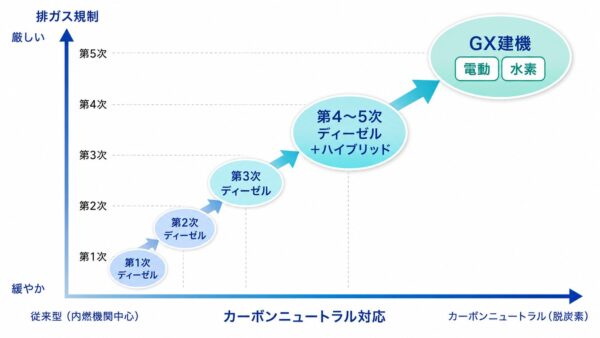
In short,Separate from the extension of existing diesel emissions regulations (Phases 1–5), initiatives aimed at electrification and the transition away from fossil fuels have been launched under the direct supervision of the Ministry of Land, Infrastructure, Transport and Tourism.、
That seems to be the situation as of 2026..................
Selecting Used Equipment (as of 2026)
Given the latest trends, here’s how to play it safe when buying used equipment:
- The third phase and beyond as the minimum standard(This is virtually a sure thing for public works projects)
- If possibleIt is compatible with the 4th generation (models equipped with urea SCR systems from 2014 onward), but,Personally, I think the third-stage exhaust is plenty lol
- If you're buying a new one, I think the manufacturer will be rolling out the fifth-generation update, but,Machine maintenance costs keep going up!
- The first and second phases are difficult to use in public, butActually, there are a lot of great models, and I personally like them, but I’d still recommend the third-generation models.
If you're unsure, first check the "generation number" on the sticker on the side of the machine.
That sticker is all that matters for machinery brought onto public works sites.
When buying a used vehicle, as long as you check the model number with the manufacturer and verify the designation status on the Ministry of Land, Infrastructure, Transport and Tourism’s website—if you keep these two points in mind, you can’t go wrong.
If the sticker is dirty, please contact the manufacturer through the construction equipment rental company to get a replacement.
See you later.
[Related Articles]
- Key Points for Installing Self-Drilling Rock Bolts | Q&A on Drilling and Grouting to Avoid Confusion on Site
- What Is a Reinforcement Installer (Rock Bolt Installer)? | 46 Practical Q&As [Complete Edition]
- On-Site Spray-Applied Formwork: Category List
[References]
- Ministry of Land, Infrastructure, Transport and Tourism, “Guidelines for the Designation of Construction Machinery Equipped with Emission Control Devices” (Revisions to Notifications No. 1 through No. 5)
- Ministry of Land, Infrastructure, Transport and Tourism, “Status of Designated Construction Machinery with Emission Control Measures” (Latest List of Designated Machinery)
- Act on the Regulation of Emissions from Specified Special Motor Vehicles (Off-Road Vehicle Act; enacted in 2006; administered by the Ministry of the Environment, the Ministry of Economy, Trade and Industry, and the Ministry of Land, Infrastructure, Transport and Tourism)
- March 17, Heisei 18, Ministry of Land, Infrastructure, Transport and Tourism Notice No. 348, “Regulations Concerning the Promotion of the Adoption of Construction Machinery Equipped with Emission Control Systems”
- Ministry of Land, Infrastructure, Transport and Tourism, 2023 Press Release: “Launch of the GX Construction Equipment Certification System”
- Ministry of Land, Infrastructure, Transport and Tourism, “Action Plan for Decarbonization of Civil Engineering Works” (April 2025)
- Ministry of the Environment: “Measures to Reduce Exhaust Emissions from Special-Purpose Vehicles” Reference Materials
- Construction Engineering Vol. 66, No. 10 (2014), “Off-Road Act (Emissions Regulations) and the 2014 Amendments: Administrative Information”
- Japan Land-Use Internal Combustion Engine Association (General Incorporated Association), “Emissions Regulations in Japan”
- Japan Construction Machinery Contractors Association (JCMA) Power Unit Technical Committee: Various Technical Documents