Hello, everyone.
This is Enta.
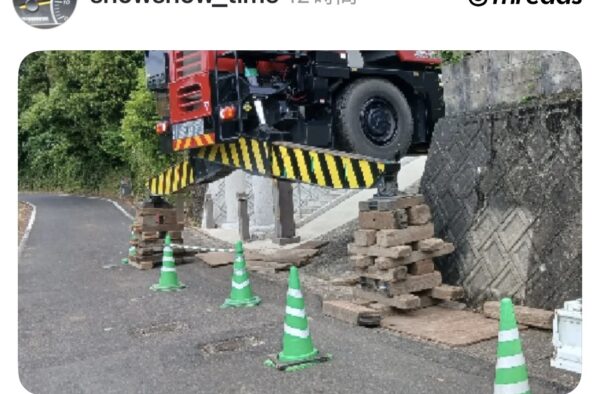
I found this photo the other day, so I posted it on social media.
This photo shows wooden planks laid beneath the crane's outriggers, forming a scaffold about 1 meter high.
At first glance, you might think, “That looks dangerous!”
I think so too, but please take a closer look at the photo.
Since the crane is on a slope, it looks like the front is touching the ground and only the rear is raised.
I'm getting slammed on social media again lol
It's not even my worksite, lol
Especially to outsiders who aren't familiar with the situation on the ground.
It’s true that when outsiders criticize us like this, it can sometimes turn people in the industry off and drive them away, which makes me think, “This isn’t good,” but,
I don't really mind, so feel free to criticize me.
Since most of these kinds of criticisms are made on social media, people don’t actually call me directly or come to the office.
If you have a complaint, take it up with me directly.
Of course, if we were doing that on-site without the general contractor’s permission, that would be a problem, lol.
Basics of Rough-Terrain Cranes
Well, there are a lot of people on social media who have that kind of misconception, but when it comes to whether this is actually illegal, it’s surprisingly not the case.
This is because rough-terrain cranes are generally installed horizontally.
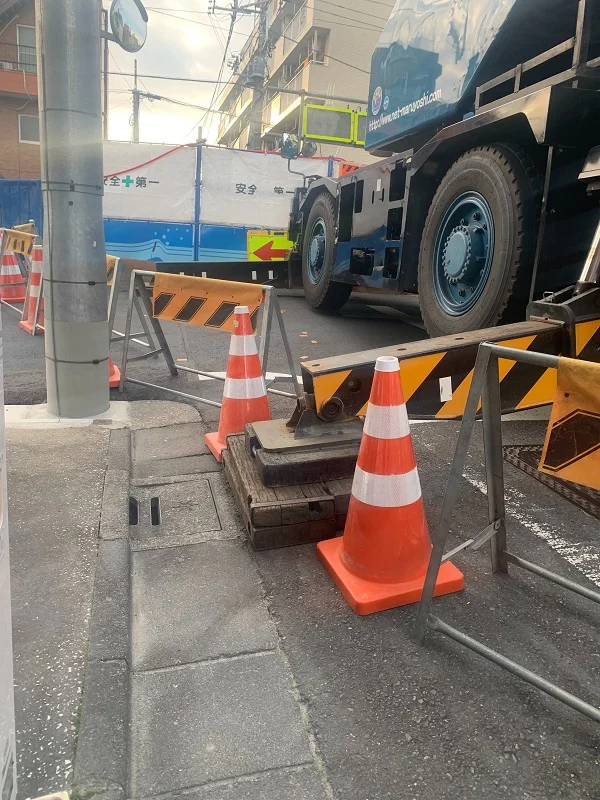
This is just standard practice in our industry, isn't it?
So the photo in this post (the one at the top) isn't wrong, after all.
If you say everything’s dangerous, then everything really is dangerous—which means the only safe thing to do is not work at all, lol.
"Extend the outriggers as far as possible" is the golden rule!
Since I'm at it, I'll go ahead and include the relevant laws as well.
Regarding the outriggers of mobile cranes, Article 70-5 of the Safety Regulations for Cranes, etc. stipulates that the outriggers must be extended to their maximum extent.
However, according to the proviso in the same provision, even if it is absolutely impossible to post the notice to the maximum extent allowed,
However, this does not apply if it is certain that the load will be less than the rated load corresponding to that overhang.
To be specific, I'm talking about situations on the road where, due to one-way traffic restrictions, you can't step out into the adjacent lane.
This means that even in such situations, as long as the load is properly managed, there is still room to carry out the work.
And one more thing. According to the Ministry of Land, Infrastructure, Transport and Tourism’s safety operation manuals, cranes must always be kept level,Choose a site with level, firm ground....If the ground is soft, it is recommended to reinforce it with steel plates or similar materials; these are listed as basic guidelines.
Well, people who say it's dangerous tend to point this part out.
The reason I’m so particular about keeping it level is that the crane’s rated load capacity (the maximum weight it can lift) is,
That's because the calculations are based on the assumption that the vehicle is level and the outriggers are extended as specified.
I think what this means is that if the bike leans, a moment acts on the side toward the fall in proportion to that lean, causing the figures guaranteed by the manufacturer to be compromised.
That’s why, even if it means adjusting the outrigger extension differently on the left and right when driving on a slope, I make sure the vehicle itself stays perfectly level.
Basically, it comes down to “extending as far as possible to the left and right,” “keeping the body level,” and “stabilizing the base.” As long as these three elements are in place,
The point is that no matter how unstable it may seem on the surface, it still makes sense, right?
All that's left is to make sure as much as possible that the force doesn't go toward that scaffold.
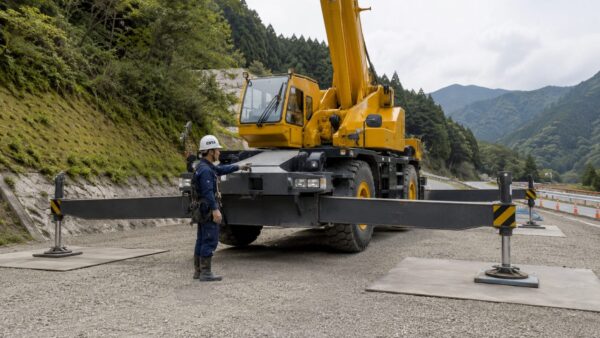
A Construction Job That Had Me on the Edge of My Seat
More than 20 years ago, when I was a site supervisor, we were doing pile driving using a large-diameter down-the-hole hammer at that job site.
That's a retaining pile, isn't it?
I think it was φ650, and when it was removed, they used a 50-metric-ton crane for the job.
The process was the same for both installation and removal; the road was completely closed to traffic during construction.
And the location where the crane was to be set up was on a steep uphill slope.
And it's a curve, too.
As those of you in the industry probably know, when a road curves and goes uphill, it tends to twist, doesn't it?
Since it was a left curve, when I set up the crane facing uphill, I raised the left rear by up to 1.5 meters and the right rear by about 0.5 meters lol.
If you think about it normally, it’s incredibly scary, but this was the only way we could do the work.
Since the load was suspended from the front—which is the standard method—it was still on the safe side.
If we consider the basics of setting up a crane's outriggers, this should ensure the crane is level, so there shouldn't be any problems.
It just looks a little unstable, lol.
How to carry out construction safely under those conditions
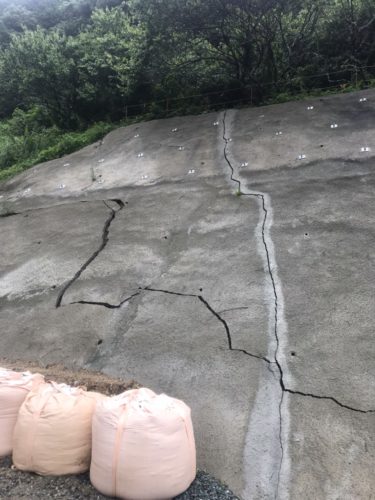
On-site, we do our best to carry out construction work even under the most challenging conditions.
Even in an extremely dangerous situation.
We will exercise the utmost care and ensure the highest possible level of safety within our capabilities.
As a result, there are countless construction sites where the work has been completed without a hitch and is going smoothly.
Even in situations that are generally unacceptable, we manage to get by and bring things under control.
It’s just a matter of course for us construction workers, though.
It isn't accepted by the general public.
Especially on social media, where it catches the eye of a wide range of random people, all I get is criticism lol.
So I can understand why government agencies and NEXCO are reluctant to disclose the locations.
You don't want to go through all that trouble over such a silly complaint, do you? lol
And, of course, there are probably all sorts of other issues, like information leaks, and so on.
Personally, I think they should just keep releasing content and ignore the criticism, but I guess that’s difficult in Japan.
Well, either way, “not doing it” isn’t an option for us, so we’ll find a way to make it happen!
Sometimes, even while exercising the utmost caution and prioritizing safety, you just have to walk a fine line!
It’s just that you aren’t sharing it—but I’m sure everyone is definitely struggling on the job!
I totally get it!
You grow by going through tough times, don't you? lol
See you later.
Be Alert to Heavy Rain Warnings in Mountainous Areas | Risk of Slope Collapses