Hello, everyone.
This is Enta.
Obon is coming to an end, but I'm just going about my usual business, dealing with all sorts of paperwork lol
The scorching sun this time of year really takes a toll on your body, but the machines are wearing out just as fast, lol.
But that's beside the point.
In this post, I’ll discuss consumable parts for rotary percussion instruments in the following order: “Which parts wear out?”, “Why do they wear out?”, “How much do they cost?”, and “How can you extend their lifespan?”
If you work in the anchoring business or drill holes in slopes, you should be familiar with all of these parts.
To put it another way, it’s a part we’re so used to seeing that we simply replace it when it breaks.
Rotary percussion instruments are full of wear-and-tear parts.
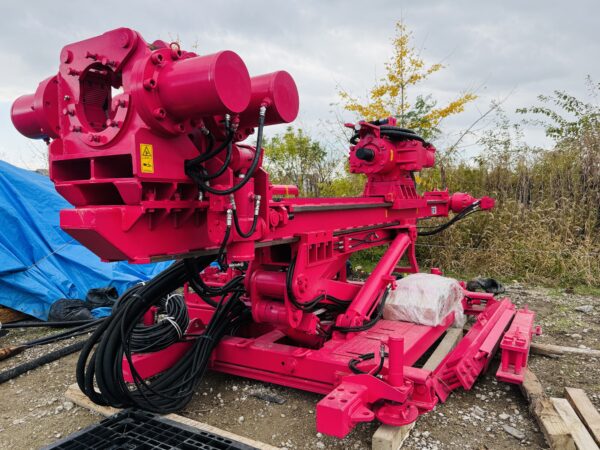
A rotary percussion drill, as the name suggests, is a machine that drills holes by “rotating” and “striking.”
Compared to rotary-only systems, its biggest advantage is that it can advance quickly even through hard bedrock.
However, all of that impact is reflected right back onto the machine itself.
A drifter, shank rod, coupling, rod, bit, casing, swivel, and a cam follower that supports the hammer.
No matter where you look, every part seems to be a "consumable."
To be honest, this is the main reason why people say Anchor-ya’s construction rates are high.
Even when it comes to a single hydraulic hose, some hoses designed for drilling machines can cost more than three times the standard price compared to off-the-shelf products available at your average hydraulic hose shop.
It's ridiculously expensive, isn't it? lol
The Roles of the Cleaning Swivel and Cleaning Adapter
Among these consumable parts, we’ll start by looking at the ones that are particularly expensive and prone to problems.
First off, do you know about this?
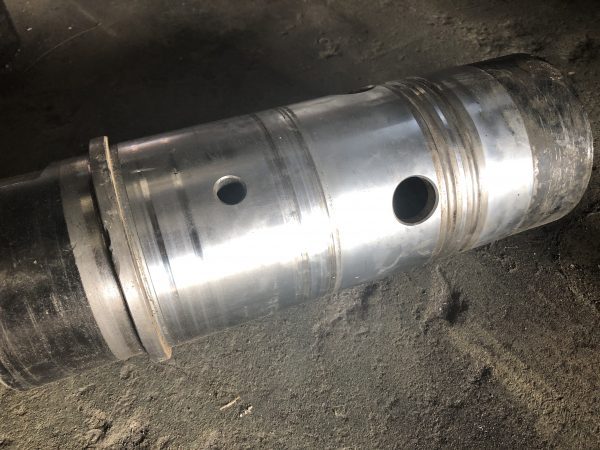
This is a part called a cleaning adapter.
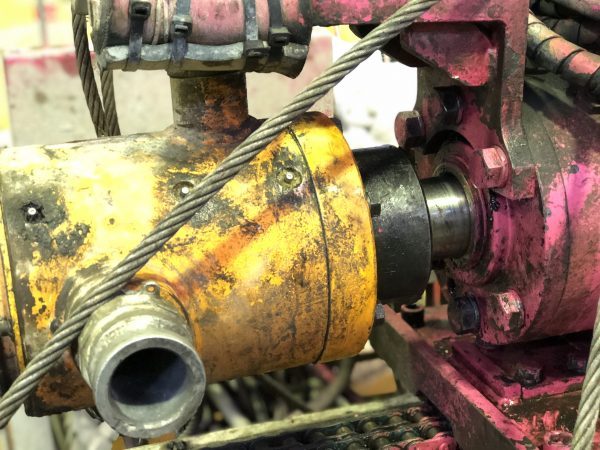
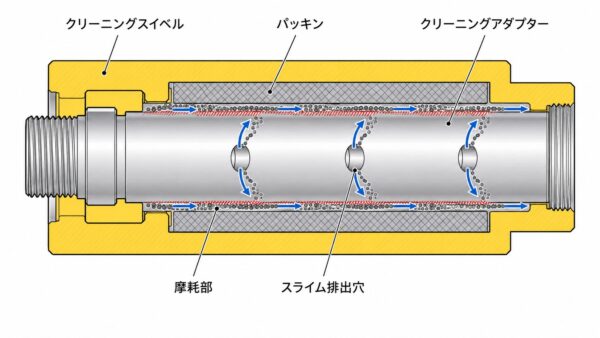
This yellow exterior is the entire Cleaning Swivel unit, and the cleaning adapter I mentioned earlier fits inside it.
Put simply, a cleaning swivel is a component designed to “feed water or air from a stationary pipe into a rotating rod and discharge the resulting slime to the outside.”
Water is fed from the feed pump through the suction port and via the cleaning adapter into the inner rod, and the water exiting from the bit at the tip pushes the slime upward through the gap between the inner diameter of the casing and the outer diameter of the inner rod.
In other words, the exit points for expelling that slime are the several large holes located next to the cleaning adapter.
(The names of parts may vary by manufacturer. Since various companies, such as Koken Kogyo with its “Arrow Cleaning Swivel,” offer similar products, please refer to the user manual for your specific machine and the manufacturer’s documentation for details.)
The problem here is the slime that gets released.
Since both small and large particles are mixed together and pass through while scraping against the sealing surface, friction occurs between the seal and the slime.
And that’s what’s actually being used to grind away this incredibly hard chunk of iron.
If it is worn down, the contact surface will become rough, and the gasket will no longer function properly.
If that happens, it will leak from the cleaning swivel.
A small leak isn't a big deal, but eventually, the cleaning swivel itself will break.
This set—the cleaning adapter and cleaning swivel—cost us about 300,000 yen when we replaced it.
It's even more expensive now! It's seriously crazy expensive lol
It's incredibly expensive.
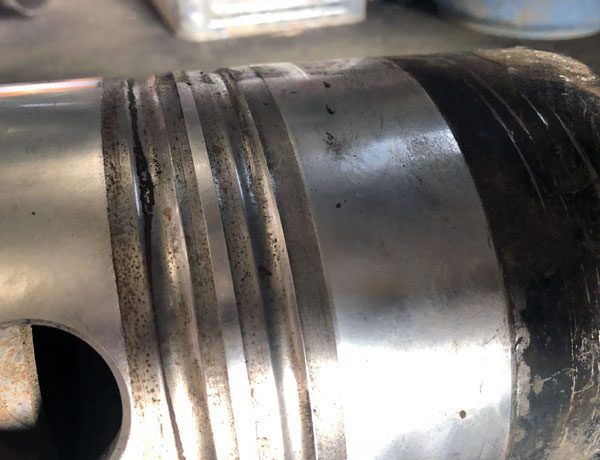
I think about 1.5 mm has been shaved off the cleaning adapter shown in the photo.
At this point, it needs to be replaced, so it can't be used anymore.
The cleaning swivel (the yellow outer part shown in the photo above) is equipped with a grease nipple for lubrication.
I grease this area about twice a day.
Even so, it gets cut.
I know it’s a consumable item, so there’s nothing to be done about it, but service providers naturally want to extend its life as much as possible, don’t they?
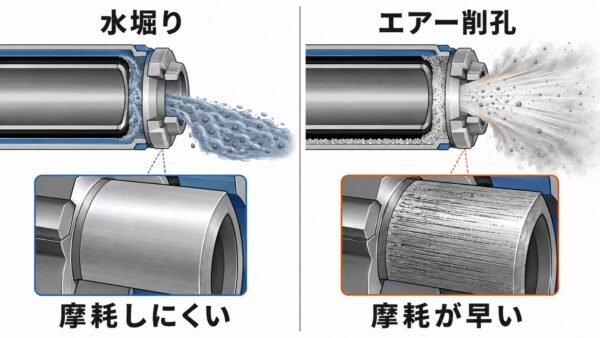
Air Drilling Drastically Shorts the Service Life of Cleaning Adapters
That said, there is one drilling method that you should avoid as much as possible.
Air DrillingThat's it!
Drilling with a swivel uses up air like crazy. Things just keep breaking.
It is said that when double-pipe drilling is performed using air drilling, the service life of the cleaning adapter is 200 hours or less.
Since it only lasts 33 days based on 6 hours of operation per day, it’s basically like throwing away about 10,000 yen a day.
(This figure of "less than 200 hours" is based on actual maintenance records for the equipment, as reported by a mechanic at a leasing company. Please keep in mind that this is not an official figure released by the manufacturer.)
The logic is simple.
With water drilling, the slime flows out along with the water in a thick, gooey stream, but with air drilling, dry rock dust is blown out at high speed.
It’s essentially the same process as sandblasting, but it’s done inside the parts every day.
Well, of course it'll wear down.
Therefore, we recommend using the water-flush method for double-pipe drilling whenever possible.
There are some job sites where water simply can’t be used, but even just reducing the amount of water and adding air makes a big difference.
Since it really helps keep dust down, digging a water trench is definitely the way to go.
Speaking of dust, the Regulations for the Prevention of Dust-Related Illnesses also stipulate measures to keep the source of dust—such as operations involving percussion rock drills—in a moist state.
*I have not personally cross-referenced the text up to the relevant section number. For details, please refer to the full text of the Ministry of Health, Labor and Welfare’s Regulations on the Prevention of Dust-Related Diseases.
I think this is a rare and straightforward example of how extending the life of machinery and protecting workers' health go hand in hand.
Of course, there are geological conditions where using water can destabilize slopes, and it also adds the hassle of drainage treatment.
This depends on the on-site conditions, but the decision will vary depending on whether you factor in the cost of “reduced machine usage when excavating with compressed air” from the outset.
The worst part is when you dig a hole without realizing it and then turn pale when you see the 300,000 bill later, lol.
List the main consumables and their recommended replacement intervals
Let's take a moment to check the consumables related to the rotary percussion system.
Since the cost and lifespan vary significantly depending on the model, soil conditions, and usage, please consider this based on our personal experience and actual results.
This is not the lifespan stated by the manufacturer.
| Body Part | What does this part do? | How It Wears Down and Breaks | Our Company's Guidelines for Replacement (Based on Experience) |
|---|---|---|---|
| Cleaning Adapter | Slime outlet. Features a sealing surface. | The inner surface is eroded by the slime, forming grooves. It may also crack. | I've heard that if you focus on air drilling, it takes less than 200 hours. If you focus on water drilling, it takes considerably longer. |
| Cleaning Swivel Unit | Connecting the rotating side and the stationary side | If you ignore a leak in the adapter, it can damage the main unit as well. | Adapters usually need to be replaced about once every two to three adapters. |
| Shank Rod | Transmits impacts on the inner casing to the rod | Wear on the threaded portion, flat spots on the striking face | If the threaded portion is worn down, replace it with a new one instead of repairing it. |
| Coupling | Connecting the outer casings | Wear, loosening, or seizing of threaded parts | Same as above. Replace immediately if the screw becomes loose. |
| Rod | Transmitting the impact and rotation to the tip | Wear on the outer diameter, bending, and damage to the threaded section | Replace it if the threaded portion is worn down or cracked. |
| Bit | Actually breaking rocks | Wear and Breakage of Cemented Carbide Inserts | It varies greatly depending on the geology. In hard rock, it wears out quickly. |
| Casing | Hole Wall Retention | Wear on the circumferential surface, damage to the threaded section | It depends on the geology and the drilling depth. |
| Cam follower | Supporting the Hammer (Drifter) on the rails | Wear on the outer ring, cracked bearings, defective nipples | Replace them one set at a time before they break. |
As you can see when you line them up like this,If a product has worn-out threads, don't try to repair it—just buy a new one....that's the basic idea.
(It's not that repairs can't be done, but since they'll weaken the item, please assume that they generally aren't possible.)
If the threaded portion of the shank rod or the coupling is worn out, don't even try to fix it—just buy a new one (lol).
After all, we can't repair just anything and everything.
On the other hand, for parts with smooth contact surfaces—such as cleaning adapters—it may be possible to rebuild the surface.
In the next section, I'll share the results of actually sending it in for repair.
Is Repairing (Surface Restoration) of Consumables Really Effective?
I heard some time ago that there’s a technology that can restore this dented surface to its original condition.
What's more, it's cheaper than buying it, and after processing, it becomes harder than it was before.
So, I decided to give it a try.
The other day, that cleaning adapter came back from being machined.
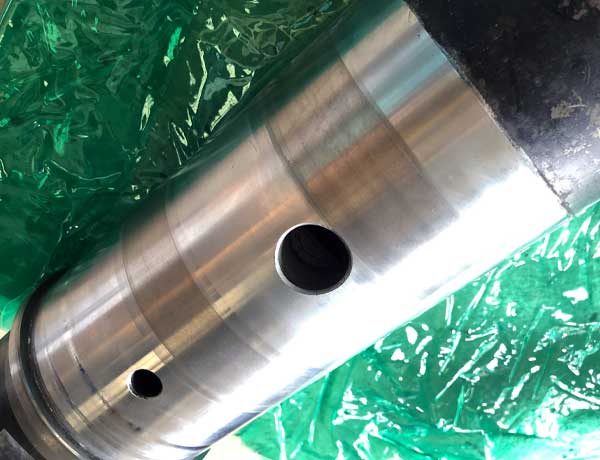
↑↑↑After
What do you think?
↑↑↑Before
It came back without that groove.
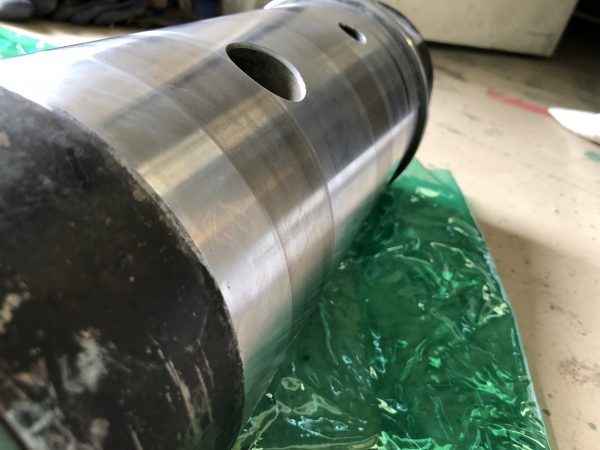
↑↑↑After
It's super smooth.
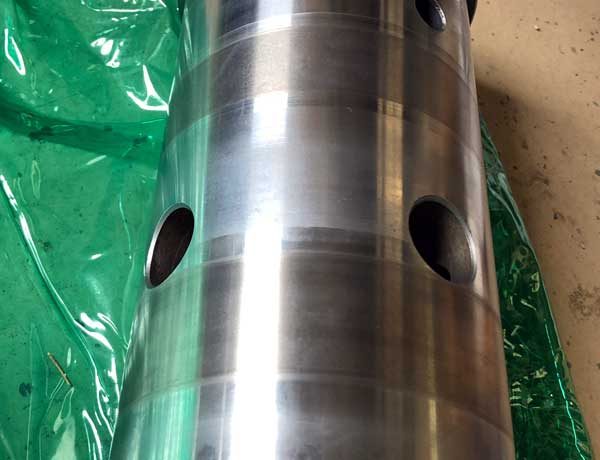
↑↑↑After
You can clearly see where the repairs were made.
You can tell there's a slight difference just by touching it.
Since the accuracy is at the 1/100 level, it should work fine for a gasket.
↑↑↑Before
It came back looking much better—all those dents are gone—so I'm happy with how it looks.
One thing to watch out for during repairs is that the "base material shrinks."
The issue is strength.
That's because this repair method involves lightly grinding down the base material first and then rebuilding the surface.
Removing material from the base metal naturally makes that area thinner, which means the overall strength is reduced.
We were told that the surface treatment itself is stronger than the plating on genuine parts.
Generally speaking, superhard coatings applied via thermal spraying (particularly HVOF, or high-velocity oxygen fuel spraying) are commonly used for surface treatments designed to provide wear resistance, and
According to materials provided by a thermal spraying company, while the hardness is comparable to that of hard chrome plating, its wear resistance is several times greater.
*This is a general explanation based on technical documentation from thermal spray contractors and does not specify the exact process used for the parts we supplied in this instance. When placing an order, please confirm the processing details and coating type with the contractor.
However, no matter how hard the surface becomes, it’s ultimately useless if the base material breaks.
Since this involves both shaving and building up the material, I think the limit is probably around two repair sessions.
Since cleaning adapters usually break at the hole, it’s unlikely that the repaired, smooth surface would break, though...
You won't know until you try it, so it'll be a bit of an experiment for a while.
That said, the repair costs aren't exactly cheap.
Since it’s not exactly dramatically cheaper than the 400,000 yen price tag for a brand-new one, to be honest, there are some aspects where it’s better to just buy a brand-new one.
There is one more risk I’d like you to keep in mind.
It’s quite a hassle when a cleaning adapter breaks inside a hole or inside the machine.
Since it’s extremely difficult to remove, pushing it to the very limit of its lifespan isn’t necessarily the best approach.
It’s no good if you think you’re saving money by extending the equipment’s life, only to end up shutting down operations for a day to handle the cleanup.
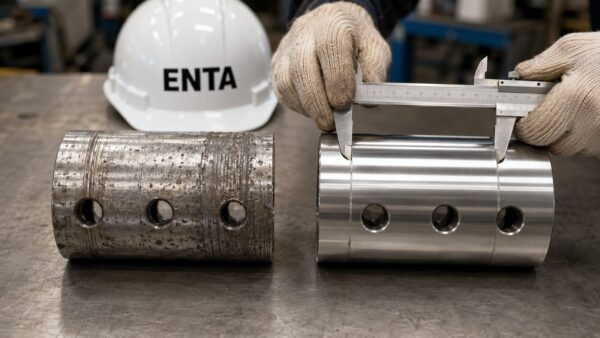
Cam followers are standard wear parts for rotary percussion hammers.
This is a part that anchor shop workers are used to seeing, but if it breaks, it can cause serious problems.
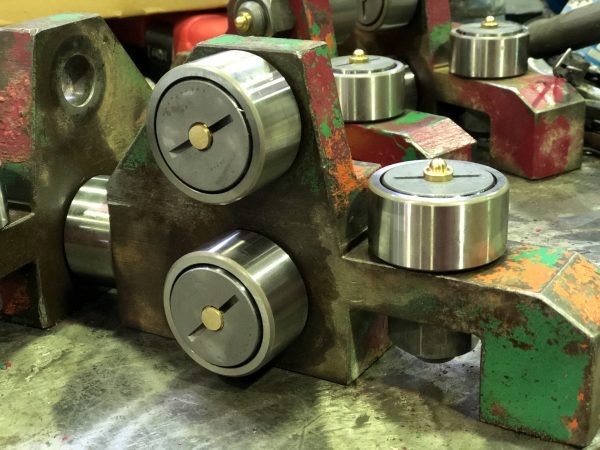
I imagine there are some people who have never heard of it.
This is called a cam follower.
This is a bearing that supports the hammer (drifter) of the rotary percussion mechanism and runs along the rail.
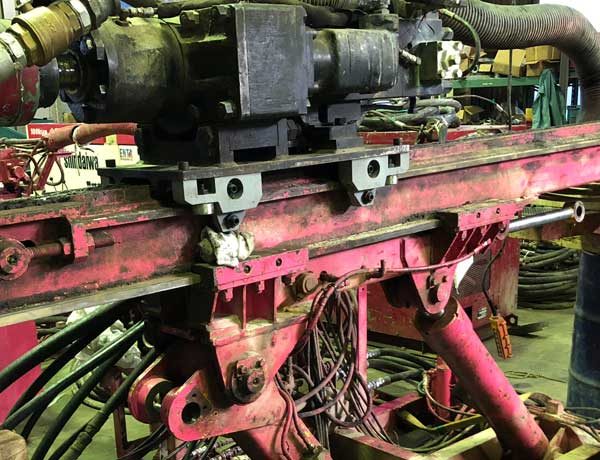
As shown in the photo above, they are attached to the front, back, left, and right corners.
Even when it sways from side to side, it doesn't wobble more than necessary, thereby minimizing mechanical friction.
As a component, the cam follower is a so-called stud-type track roller—a common mechanical component for which NTN and NSK publish catalogs.
The cam follower on a drilling machine is subjected to impact loads day in and day out.
"Greasing regularly" is an absolutely essential part of my daily routine!
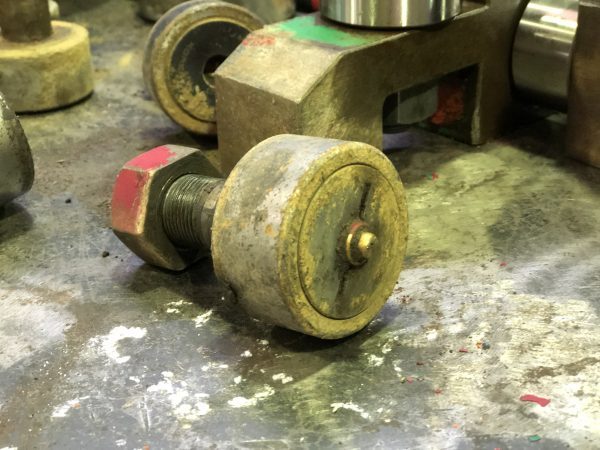
As it gets older, the grease nipple wears out, and the bearing inside starts to crack.
The cam follower in the photo isn't cracked, but in some cases, it can crack completely.
That’s how much force is being applied.
Replace the cam follower as a complete set.
It’s such an important part, but it’s actually pretty expensive, lol.
There are four installation locations, and three are used at each location. That’s why we need a total of 12.
If you replace the parts one by one starting with the broken ones, it should be fine for the most part, but if you're going to replace them, it's less likely to break if you replace them as a set.
The reason is simple: if you replace just one part with a new one, the load will be concentrated on that single part.
Two old ones with reduced outer diameters and one new one with an increased outer diameter.
It goes without saying which one will hit the rail, doesn't it?
Roughly speaking, when we bought them, they were around 4,500 yen each.
If you replace all 12, it will cost in the 50,000 yen range. If you replace 3 in one location, it will cost about 14,000 yen.
It's even more expensive now! The price keeps going up and up—I can't take it anymore...
There are some inexpensive Korean-made products, but they aren't very durable (compared to our products).
As for domestic manufacturers, would it be NTN or NSK?
I'm not really a fan of the press-fit grease nipple, though... lol
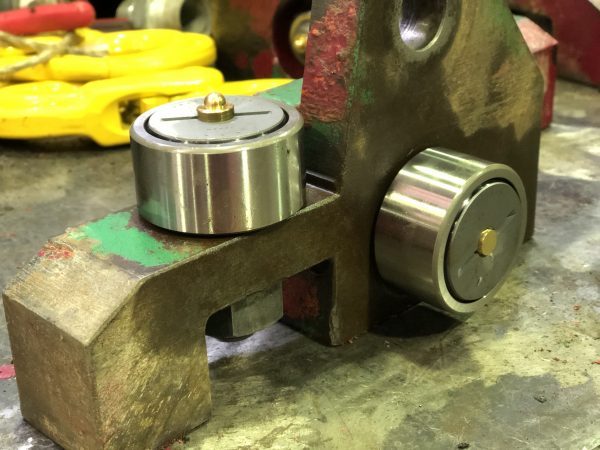
Press-fit nipples have the trifecta of problems: they come loose easily, are hard to insert, and are difficult to grease with a grease gun.
However, if you skip greasing it at this point, the internal rollers could crack, and the broken pieces could damage the rail, leading to the worst-case scenario of having to repair the entire rail.
Even though I complain about the shape of the nipple, I have no choice but to fill it up every day, lol.
Tips for Extending the Life of Consumables That You Can Start Using Tomorrow
Finally, I’ll list the inspections we actually perform (and often skip—only to learn the hard way).
- Grease the grease nipple on the cleaning swivel about twice a day.
- Greasing the 12 cam followers and checking the contact surfaces and play on the outer circumference
- Check the amount of drilling fluid and the color of the return fluid every day. If the return fluid starts to dry out, check the fluid level.
- If you notice a leak from the swivel, don't assume it's "still usable"; treat it as a sign that it's time to replace the seals and gaskets.
- Apply rod grease to the threaded portion of the rod coupling every time. If the thread becomes loose, replace it with a new one without hesitation.
- As a general rule, double-pipe drilling is performed using water. On days when the use of compressed air is unavoidable, the resulting additional consumption must be factored into the schedule and cost estimates.
There isn't a single flashy thing about it.
But what happens when you factor in the difference over the course of a year between a part that wears out after 200 hours—costing 400,000—and a part that lasts twice as long with regular greasing?
That's exactly where the anchor shop makes its profit.
I know I sound like I'm talking down to everyone here, but when things get busy, I completely forget to do inspections.
Actually, there are times when I can't get my paperwork or invoices done on time, lol.
Even so, since the amount we spend on consumables directly translates to cash outflow, this is one area where I want to be really thorough!
The reason people say Anchor-ya's construction rates are high is that these consumables are outrageously expensive.
The same goes for the casing—everything, from start to finish, is just so expensive.
But since we can’t do our jobs without these supplies, we should make sure to do a thorough job on the high-paying projects, right? lol
And unfortunately, with inflation causing parts prices to keep rising, things are likely to get even worse...
Prices and unit costs are out of balance.
See you later.