Hello, everyone.
This is Enta.
A longtime friend of mine passed away the other day.
When you think about it that way, it’s best to see the people who are important to you while they’re still in good health.
Make sure you don't have any regrets, everyone!
But that's beside the point.
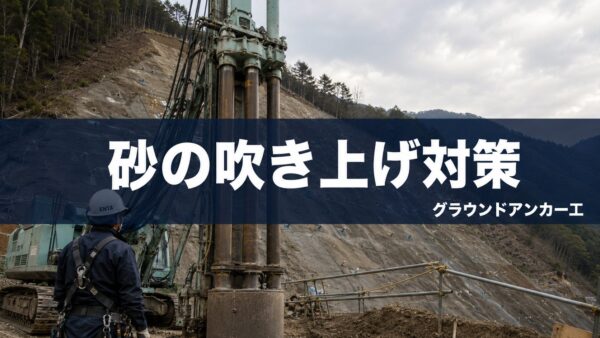
Previously, I wrote a series of four posts titled “Measures to Prevent Sand Blowing Caused by Groundwater Pressure in Anchor Work,” which I presented in the form of a site diary, from Part 1 through Part 4.
This time, I’ve consolidated that content into a single post, reorganizing it so it can be read from start to finish—covering everything from my analysis of the causes to the mistakes I actually made and the solutions I ultimately arrived at.
What's Actually Happening? | Sand "Blowing Up" During Dual-Pipe Drilling
Why Choose Double-Pipe Drilling?
When drilling for ground anchor construction, a double-pipe method is often used in soil conditions such as unstable sandy soil or gravel layers, or in ground where the water table is high. In this method, the outer casing protects the borehole wall while the inner rod is used for drilling and removing cuttings.
Even in soil conditions where the borehole walls would collapse because they cannot stand on their own when using the single-pipe method, the double-pipe method protects the borehole walls as the hole is drilled, making it the standard method for soil prone to collapse.
A long time ago, when ground anchor construction first came to Japan, the ground anchors were apparently installed using single-hole drilling, which reportedly caused a great deal of difficulty.
However, even with this double-pipe system, groundwater pressure itself cannot be completely eliminated, so under unfavorable conditions, “sand blowouts” such as the one described here can occur.
First, I’ll describe what was happening.
Site Conditions
- Drill hole diameter: φ135
- Total Length: 15 m
- Machine: Crawler-type percussion (RPD3A-130C3A)
- Soil type: Gravel and sand
As we continued drilling as usual, we began to experience sudden jamming—a phenomenon in which the casing tightens and becomes heavier—in 2- to 3-meter sections starting around the 7-meter mark.
A small amount of drilling fluid also rises up to the hole opening.
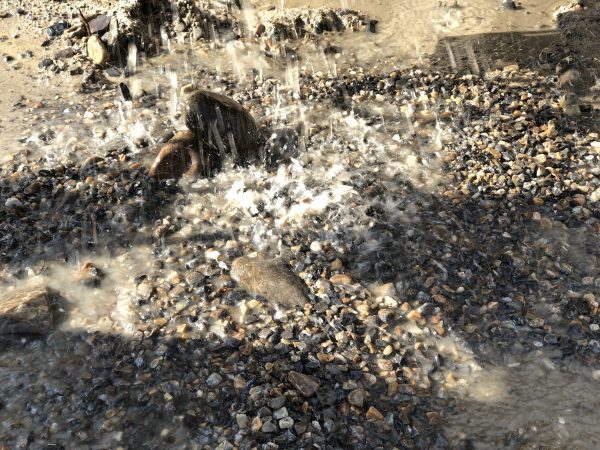
The cause is this river gravel.
This river gravel got packed so tightly into the gap between the outer casing and the inner casing that it got stuck on the swivel side lol.
Once you pass through this layer, it becomes a solid sand layer, and because the internal pressure is high, sand pours right into the inner casing.
Even during that brief moment when connecting the double pipes, if you let your guard down, sand will get inside the inner pipe and cause a clog.
We installed 13 anchors at that site, but with about three of them, the sand inside the inner casing got stuck, so we ended up having to pull them up along with the inner casing to retrieve them (I was like, “Oh nooooooo!” lol).
This is where things get tricky: after completing a 15-meter borehole and inserting a measuring rod, we found that even after accounting for the remaining length, the actual borehole length was only about 13 meters. Even though we’ve been thoroughly flushing the borehole, sand keeps being blown up into the casing.
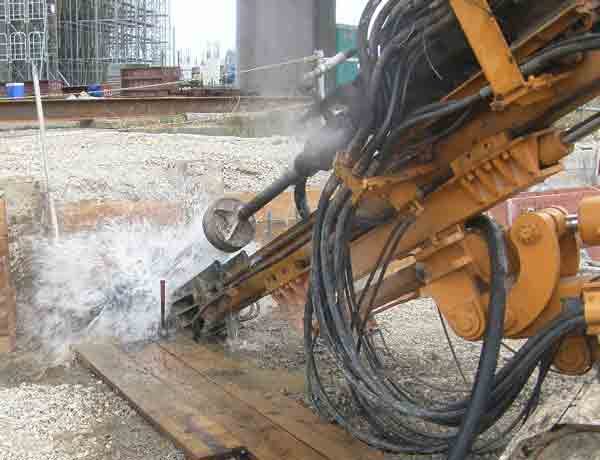
Even after reinserting the liner and re-digging, and—out of caution—digging a bit deeper than planned and reinserting the measuring rod, the result was still that sand had blown up to a depth of about 1 meter.
The tough part is that drilling through sand layers tends to turn into this kind of low-key, mentally draining battle for us on the operations side, lol.
Considering the Causes | The Quicksand Phenomenon and Clogging of River Gravel
I’ll try to explain why sand is blown up inside the borehole, not just based on on-site observations but also using principles of geotechnical engineering.
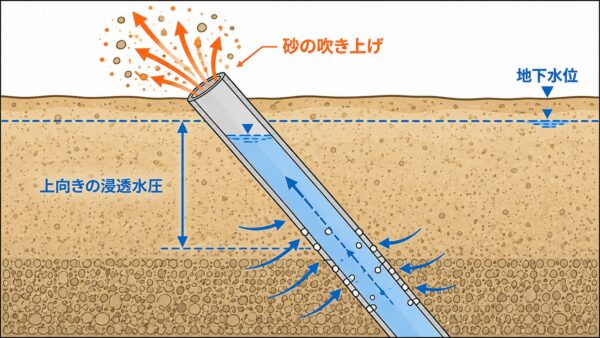
According to standard geotechnical engineering theory, when the upward force exerted by water (seepage pressure) in sandy soil with a high water table exceeds the resistance provided by the weight of the soil particles, the soil particles effectively float in the water, causing sand to spout out toward the ground surface or into the borehole.
This is generally referred to as the “quicksand phenomenon” or “boiling,” and when it occurs along weak sections of the sand, it is specifically called “piping.” (This happens inside the casing.)
In the case of double-pipe drilling, a difference in water level and pressure tends to occur inside and outside the casing as drilling progresses; specifically, conditions similar to this phenomenon are likely to occur within the borehole, particularly in sand and gravel layers where the groundwater table is high.
I’ve heard that the benchmark for whether this difference in water levels exceeds the resistance of soil particles is called the “critical dynamic water gradient,” but to be honest, I don’t think there are many workers who actually calculate this on the spot while drilling. In reality—including at our company—we operate based on a rule of thumb: “At this depth and with this soil type, the water will typically rise to about this level.” However, I believe that understanding the underlying principles behind these rules of thumb makes it easier to make an educated guess even when encountering site conditions for the first time.
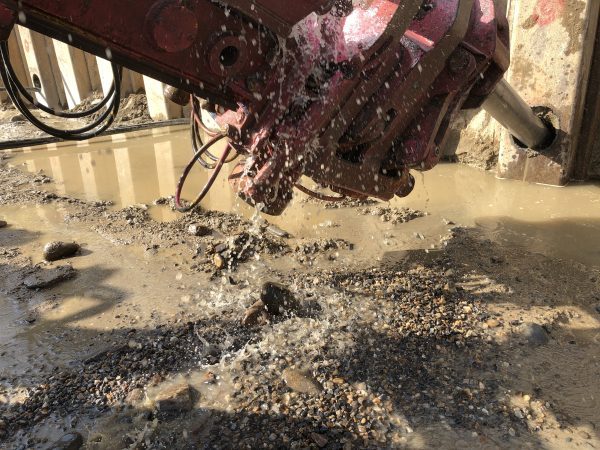
River gravel makes the situation even more troublesome. When gravel of a size that can get wedged into the gap between the outer and inner layers—as is the case at this site—is mixed in, it gets stuck instead of being expelled through the swivel, causing simultaneous, widespread jamming and blowbacks.
Once I became able to predict when it would happen to some extent, I was able to reduce the damage by making sure to clean the inside of the casing regularly; however, cleaning alone cannot eliminate the root cause—the groundwater pressure itself.
Two Mistakes I Made: Choosing a Pump for Insufficient Water Flow and the Trap of Over-Excavation
Now that we know the cause, I’ll describe two mistakes I actually made.
Failure 1 | Insufficient Capacity of the Water Pump and Compressor
At first, I underestimated it a bit and brought along a Koken Kogyo MG-5 pump.
As a result, there isn't nearly enough water, and the slurry (drilling cuttings) can't be flushed out fast enough.
We had also prepared a 50-horsepower compressor, but we found that even that wasn't powerful enough to pump the slime all the way up.
So, when I upgraded from the MG-5 to the MG-10, the slime yield improved noticeably, and river gravel started being discharged at a rapid pace.
This means that, with the increased water flow, it has become possible to drill while pushing the sand aside to some extent.
Unlike mountain terrain, sites near rivers require a specific amount of water and pressure when dealing with sand layers and clay layers.
I guess the more experienced a craftsman is, the more naturally these things become second nature, but when it comes to selecting machinery like this, it’s better not to leave it as an unspoken understanding—it’s best to write it down clearly and keep a record of it, lol.
For borehole diameters in the φ135 range, it’s better to choose a pump that’s one size larger from the start, as this will ultimately result in fewer reworks.
It’s much more painful to realize there isn’t enough capacity after arriving on site and having to call for more equipment.
Better safe than sorry!
Failure 2 | The anchor body sank 1 meter due to excessive digging
After drilling is complete, when we insert a measuring rod, sand rises up to about 7 meters at its highest, filling the casing with sand and preventing the measuring rod from entering.
Even though the drilled hole is the correct length, the anchor body won't fit as it is.
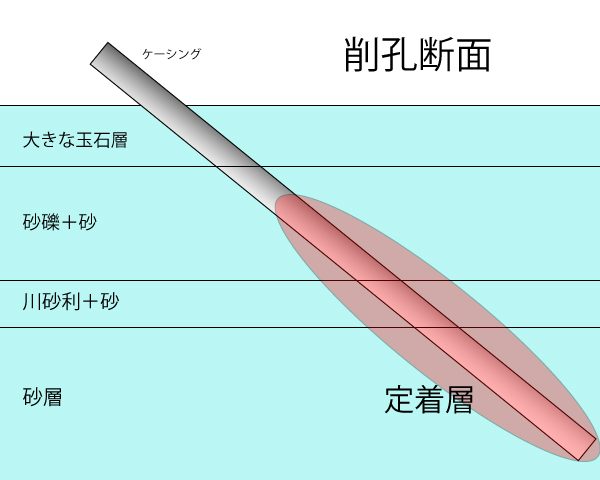
So, without removing the inner casing, we filled the casing with water and, while pumping water through the MG-10, applied rotational and percussive forces to repeatedly dislodge and discharge the sand that had been pushed upward by the water pressure.
If you repeat this process several times, the amount of sand discharged will decrease, but some will inevitably remain in the end.
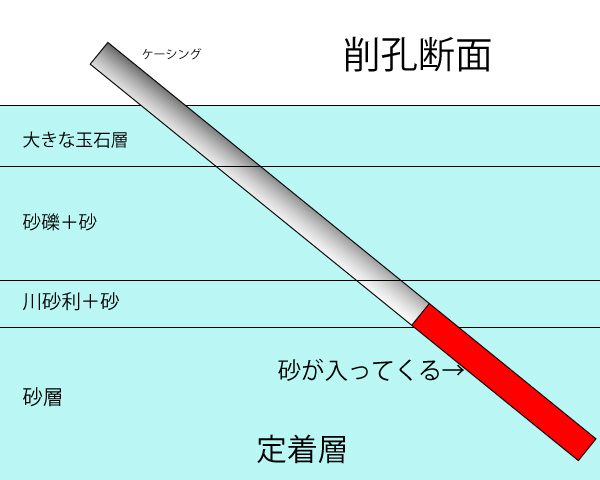
At that time, I drilled a hole that was about 1 meter deeper than planned. That was a mistake.
After excavating a little over 1 meter, the sand stopped right at the anchorage depth, so we filled the hole with grout using a displacement injection method. After confirming that the grout had filled the hole completely through the borehole opening, we inserted the anchor body.
However, surprisingly, the anchor body won't go in.
It appeared that backflow was occurring inside the borehole during the replacement injection.
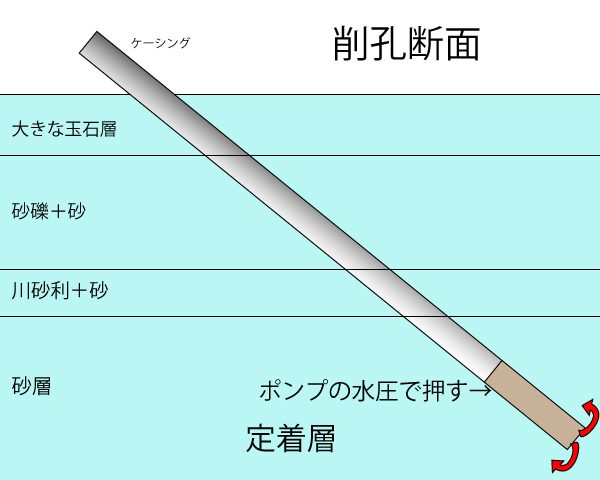
We extended the casing in short sections, driving it into place while rocking it up and down, and although we were eventually able to retrieve the casing, the anchor body had sunk all the way down into the 1-meter-deep over-excavation.
The cause is likely the pressure applied to the grout. It is believed that the injection pressure forced the sand out of the over-excavated area, causing the anchor body to sink by that amount.
Because sand layers drain quickly, it is virtually impossible to pull up an anchor that has sunk into them.
What's more, since it was a temporary anchor, the polyethylene hose had a thin outer layer, so it would tear easily when I wrapped the wire around it and pulled.
In the end, we were only able to secure 1 meter of slack where 2 meters were required, so we took measures to extend the slack.
It was a hassle, but it was the only option I had.
When excavating in sandy soil, you should keep it to a reasonable extent.That’s the biggest lesson I learned from this failure (hehe).
Current Conclusion | The "Pre-injection of Grout" Approach
Based on the mistakes I’ve made so far, I’ll outline the measures I’m currently using on the job.
| Countermeasures | Contents | Objective |
|---|---|---|
| 1. Increase the water flow | Upgrade the pump to the next size up (e.g., MG-5 to MG-10) | Ensure adequate slime and sand discharge capacity |
| 2. Upgrade the compressor | In the 50-horsepower class, the engine tends to lack power when driving on sandy terrain. | Use in conjunction with drilling fluid to stabilize discharge |
| 3. Don't overdo it with the digging | Do not dig excessively deep | Preventing the Anchorage Body from Sinking by Applying Pressure to the Grout |
| 4. Wait until the sand settles | Repeat the cleaning and water-flushing steps without rushing | Wait for the amount of steam to subside |
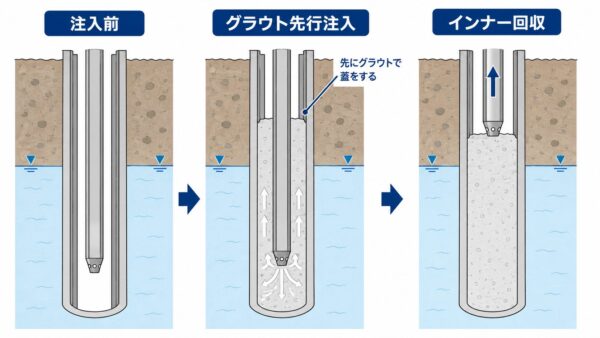
Another method I’ve actually tried that proved effective is “pre-injection of grout.”
Normally, after double-pipe drilling is complete, the inner casing is retrieved before the anchor body is inserted; however, at sites where sand blowout is particularly severe, we changed the procedure to first inject grout through the tip of the inner casing and then retrieve the inner casing.
Think of it as sealing off the inside of the casing with grout first.
The typical unit volume weight of cement paste varies depending on the water-to-cement ratio, but it is generally around 1.8 relative to the specific gravity of water (1.0).
Since it is definitely heavier than water, it is less likely to be forced upward under conditions where the groundwater pressure is not that strong.
However, if the water level is too high or the water pressure itself is too strong, the grout might get pushed back out, so it’s not a one-size-fits-all solution lol.
In that case, we'll have to try a different approach.
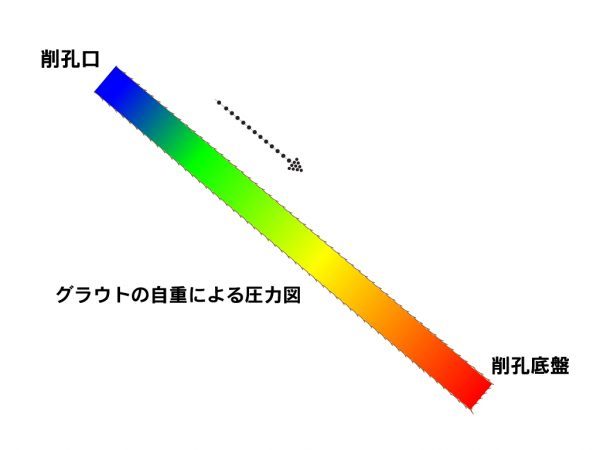
This method also has its drawbacks.
- Since the anchor body is inserted directly into the grout (a method known as "direct insertion"), the resistance is high, making it difficult to insert the anchor.
- Since grout fills everything from the inner casing to the machine's water supply line, cleaning is a major hassle.
Since the grout dehydrates quickly when mixed with sand, the surface hardens completely after injection. This also means that pressure applied to the sand is effective, so this method allows for construction while ensuring a secure bond.
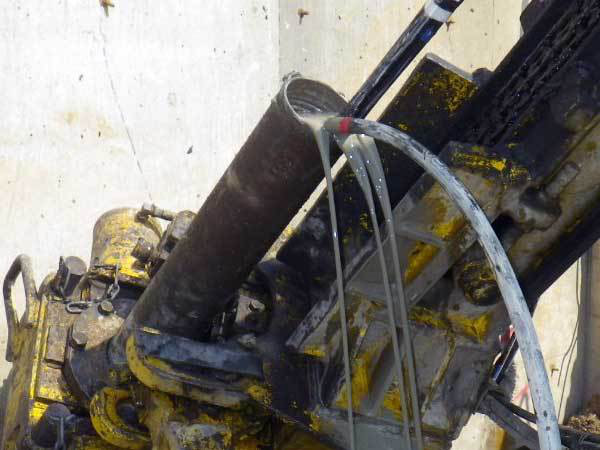
In fact, there are actually job sites where the water pressure is so high that the grout gets forced out.
I’ve only experienced this once myself, but it certainly had me panicking at the time. Since the appropriate response varies depending on the circumstances, I’d like to write a separate article about it if I get the chance.
I think sand blow-up is a subtly troublesome problem that can’t be solved by machine specifications or setup alone.
Water volume, compressors, additional excavation, and grout injection methods—the conclusion I’ve reached so far on-site is that we have no choice but to combine these four elements according to the ground conditions.
I wouldn’t say we get it perfectly every time, either. In fact, as with the mistake I described earlier, we often end up getting the short end of the stick because each site presents new challenges that we haven’t anticipated.
Even so, I believe that putting our failures into words and documenting them each time provides a basis for making decisions on the next job site.
See you later.