Hello, everyone.
This is Enta.
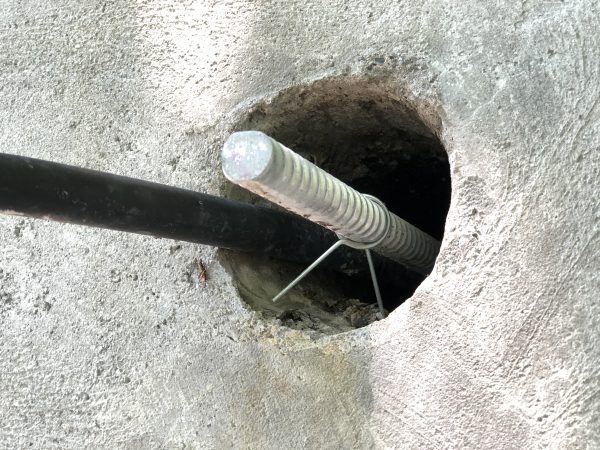
Take a look at this ground anchor.
It has a real old-school vibe, doesn't it? lol
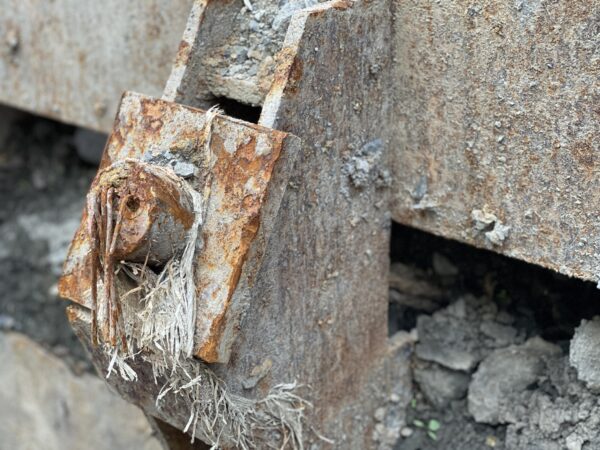
But this anchor is actually still alive!
I'm still alive even after getting beaten up by a backhoe lol
It seems to have been about two years since it was installed, but this temporary ground anchor is still going strong even though it’s completely rusted over.
The PC strands on the back were rusty, but they were still taut and held their tension firmly.
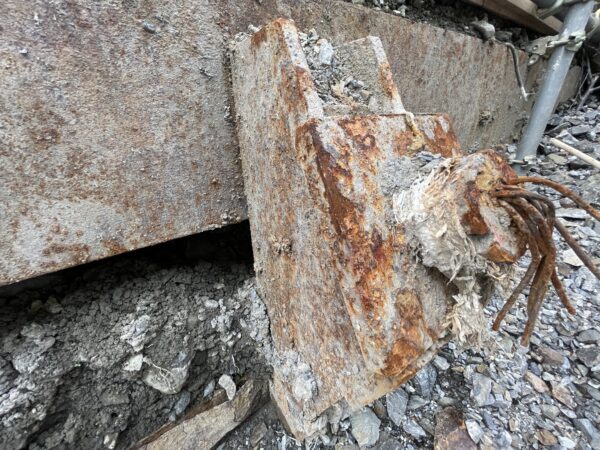
All the anchors were still firmly in place.
You don't see anchors like this very often, lol.
In our civil engineering structures, we apply one safety factor after another.
So it's pretty safe lol
Actually, something like this doesn't faze me in the least.
Back in the day, rebar installers used to work with raw materials.
"Raw material" refers to material that has not been plated.
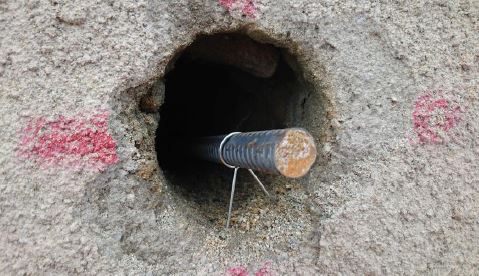
The photo above shows raw rebar.
This was common about 30 years ago.
Since hot-dip galvanizing is now the standard, only galvanized models are available.
Occasionally, there are raw materials used in temporary rock bolts, but even so, I think they’ll last 50 years as long as they’re surrounded by cement slurry.
Otherwise, NEXCO’s rebar installation crews would be in pretty bad shape, wouldn’t they?
In fact, according to data from the NEXCO Research Institute, the key to rebar insertion work lies in the treatment of the rebar heads, and
If there are issues with the head treatment, the result may indicate rust, but,
After that, the rebar was hot-dip galvanized.
However, there is still a design parameter known as the "corrosion allowance" (the diameter at which corrosion poses no structural problem), which has been used for a long time.
That's 1 mm.
The rail is 2 mm.
I don't think it's an exaggeration to say that galvanized steel practically never rusts, lol.
It lasts for over 25 years in coastal areas, right?
If it's surrounded by grout in the mountains, it pretty much won't rust, right?
A Discussion of Galvanizing Standards, Thickness, and Coating Weight
Is a corrosion allowance necessary unless it's a temporary structure?
Even though I know the current design is based on layer upon layer of safety measures, I can’t help but feel a bit skeptical.
It seems like civil engineering these days tends to go overboard.
That said, since there’s a track record of this, that’s probably how things will go from here on out—but won’t the corrosion allowance eventually disappear?
That's what I think. (Someday.)
I hope that the things I don't need will disappear and that my life will become simpler.
For example, "If the structure is to stand on its own in this type of soil, then the rebar should be this length and this diameter," and so on.
If you analyze past statistical data, you can make a decision based on the graph.
Maybe it's okay if we don't see the complicated calculations (though they're not really that complicated)?
When it comes to both design and construction, simple is best, isn't it?
I do feel like rebar insertion work is getting simpler and simpler, though ^^
See you later.