Hello, everyone.
This is Enta.
I went to the dentist the other day, and my tooth got swollen and my face swelled up...
After they removed part of the cavity and put in a filling, it seems it got infected...
Take good care of your teeth!
But that's beside the point.
In economics, there is a concept known as the “law of diminishing marginal utility.”
Simply put, this law states that for every additional unit of a given good consumed, the satisfaction (utility) derived from it gradually decreases.
The first beer tastes absolutely amazing, but by the fifth one, it’s not that impressive anymore lol. You know how it is.
Even if I bought a new iPhone 17 and then bought an iPhone 18 the following year, I’d probably just be like, “Hmm, so that’s it?”
I thought this might apply directly to overtime work on-site as well, so I decided to look into it a bit.
The first hour of overtime is different from the fifth hour in terms of value
I worked from the morning, finished at the end of my shift, and then worked another hour.
During that first hour of overtime, since I’m still in the flow and my mind and body are still working, I’m able to get a decent amount of work done.
However, as the second and third periods pile up, the amount of work that comes out of each hour gradually decreases.
Fatigue builds up, concentration wanes, and mistakes increase, leading to rework.
As a result, if you ask, “Did the work actually progress by the exact amount of time we extended it?”—well, that’s not how it works.
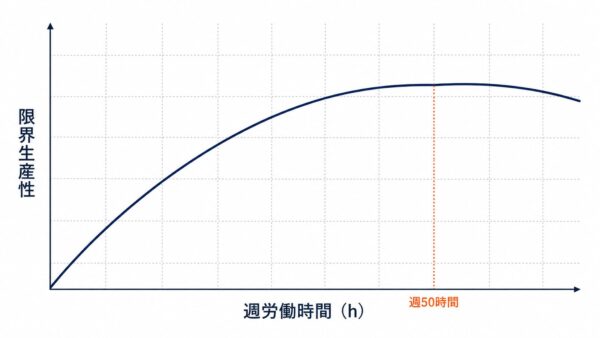
This is precisely the phenomenon of diminishing marginal utility—the phenomenon in which the value (productivity) derived from an additional hour (one marginal unit) decreases as time goes on.

In fact, research indicates that “50 hours a week” is generally considered the threshold.
Since my personal impressions alone aren't very convincing, I found various references on this topic in labor economics materials. (All sourced from the internet.)
According to data published by the Japan Institute for Labor Policy and Training (JILPT) in 2017,
As part of a study using data from overseas factories, a report has been cited indicating that marginal productivity declines significantly when weekly working hours exceed 50 hours.
Another study also appears to report that a 10 percent increase in overtime work leads to a 2 to 4 percent decline in marginal productivity.
In other words, the idea that “the more overtime you work, the more work you get done” no longer holds true once you exceed a certain amount of time.
This means that just because someone who can complete 100 tasks in 8 hours works for 12 hours doesn't mean they'll end up completing 150 tasks.
In fact, it means that, overall, the results can even end up being negative due to fatigue and mistakes.
In my case, when I'm tired, I end up mindlessly fiddling with my phone or browsing the web for other things, and I get distracted...
Starting in 2024, the construction industry will no longer have “unlimited overtime.”
Starting in April 2024, the construction industry became subject to limits on overtime work.
This is what’s known as the “2024 Problem” in the construction industry.
According to the Ministry of Health, Labor and Welfare’s guidelines, overtime work is generally limited to 45 hours per month and 360 hours per year; even if a “36 Agreement” with special provisions is concluded, the annual limit is set at 720 hours.
Precisely because this is an industry where delays in construction schedules and changes to work plans due to weather are a daily occurrence, it had become almost a given that overtime would be used to make up for them—but that very assumption has now been overturned by law.

So the only options are to "hire more people" and "fine-tune the process."
The law of diminishing marginal utility teaches us a simple fact: "Even if you keep adding more of the same resource, you will eventually reach a plateau."
If overtime—as a resource—has reached its limit, we have no choice but to switch to another resource.
Bring in one additional support person; extend the morning planning meeting by just 5 minutes; decide the order of material delivery the day before.
This means that at this stage, the “effect per additional unit” is still greater here.
Well, that's assuming there are people around, of course.
Before extending the time, it’s a good habit to pause and ask yourself, “Is that hour really worth it?”
I believe it’s something everyone should have—whether they’re the overall manager, a foreman, a site supervisor, or just a member of the crew.
It's also important to go home early to recharge and get ready for tomorrow, rather than wasting time working overtime for no reason!
On the other hand, I won’t deny that Japanese people also like this approach to work—wrapping things up neatly—but it’s best to do so in moderation.
When it comes to working abroad, there are a lot of countries where people don’t bother wrapping things up neatly—they just drop everything the moment their shift ends and head straight home, lol.
See you later.