"There's No Way They'd Go Bankrupt": The Shock of a Major General Contractor's Collapse
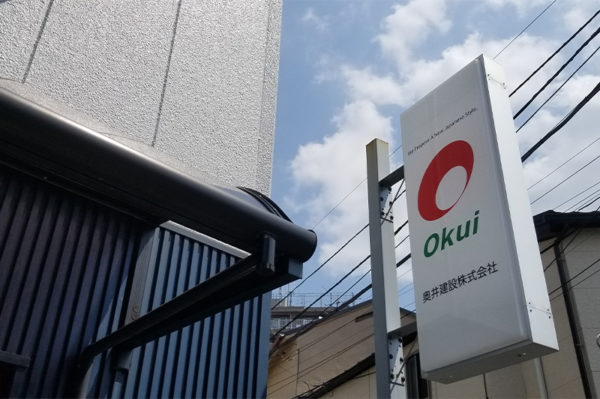
Okui Construction Co., Ltd. (Headquarters: 2-9-4 Umeda, Adachi Ward, Tokyo; President: Hirohiro Okui) filed for bankruptcy with the Tokyo District Court on March 23 and received a bankruptcy commencement order on the same day.
Since the Great East Japan Earthquake, Okui Construction has actively capitalized on demand for reconstruction projects in the Tohoku region and expanded its business; for the fiscal year ended October 2017, the company recorded completed project revenue of 5,526.6 million yen and has continued to secure orders, primarily for public works projects. For the fiscal year ended September 2019, the company reported completed project revenue of 5,471 million yen.
The company has a strong track record in public works projects for government agencies and is well-known in Tokyo as a long-established, prestigious general contractor; some of Tokyo’s other general contractors even commented, “It’s rare these days for a general contractor of this size to go bankrupt.”
However, in January 2018, it was discovered that construction management had been negligent during the expansion and renovation of the “Komazawa Olympic Park General Sports Complex Baseball Stadium,” a project commissioned by the Tokyo Metropolitan Government. Around the fall of 2019, the company found itself in a situation where it had to temporarily suspend payments to subcontractors involved in the project, resulting in payment delays to those subcontractors. Furthermore, its financial credibility had deteriorated due to factors such as multiple business partners filing lawsuits to recover contract payments.
Consequently, although the company sought to strictly enforce operational procedures and prevent a recurrence, its cash flow deteriorated due to a decline in orders. The burden of loans from financial institutions—amounting to nearly half of its annual sales—proved too heavy, making it difficult to continue operations, which ultimately led to bankruptcy. Total liabilities amount to approximately 2.7 billion yen, though this figure may change in the future.
Meanwhile, a source at a partner bank commented, “This was a general contractor that would never have gone bankrupt if it had been managed carefully. In that sense, this is a case where lax management took its toll.” We obtained internal documents from Okui Construction and investigated the truth behind its bankruptcy.
*Since Okui Construction is a family-owned company, many of its associates also bear the Okui surname. As I reviewed the documents, I encountered numerous cases that appeared to involve disputes among relatives. For this reason, with the exception of the deceased and the current President and CEO, all other individuals mentioned in this report will be identified only by their initials.
Okui Construction: Board of Directors Meeting Documents from the Day of Bankruptcy
First, let’s reconstruct the board of directors meeting held on the day the bankruptcy petition was filed, based on the documents. The board consisted of eight members, four of whom had the surname Okui; one member was absent, so seven members attended the meeting.
One of the warning signs of bankruptcy is frequent changes in the position of President and CEO. This is a point that requires careful attention during credit investigations. At Okui Construction, Mr. Y—who was also a shareholder—had served as President and CEO since June 2015, but his sudden resignation in September 2019 sent shockwaves through the company.
On the day the bankruptcy petition was filed, Mr. I—who had expertise in accounting and finance, rather than being a member of the Okui family—chaired the board of directors meeting. Mr. I frankly explained, “Since we anticipate being unable to settle the promissory notes due at the end of March, we would like to file for bankruptcy.” Six of the seven members voted in favor of the chairman’s proposal, and the decision to file for bankruptcy was made.
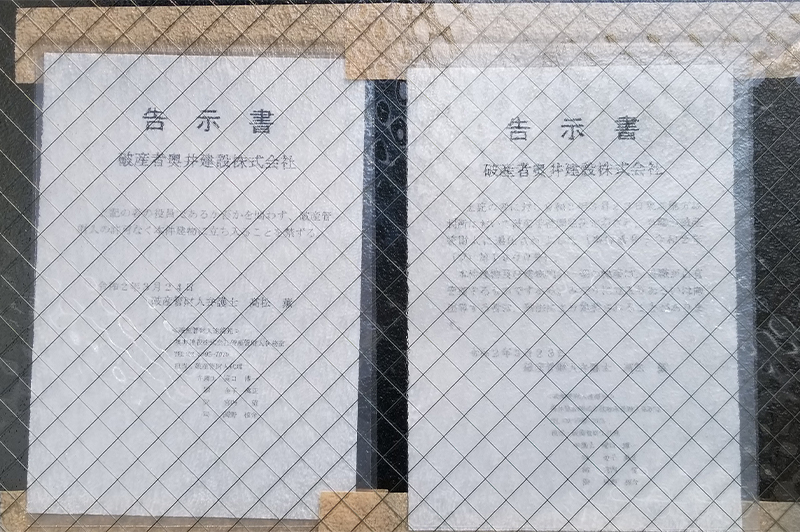
Bankruptcy Notice Posted at Okui Construction Headquarters
The next item on the agenda was the removal of Mr. M of the Okui family from his position as Representative Director. Mr. M had served as President and Representative Director since February 2004 and subsequently as Chairman and Representative Director; not only had he been involved in the company’s management for a long time, but he was also a major shareholder holding a large portion of the stock. Therefore, given various circumstances, it was determined that if bankruptcy proceedings were initiated, Mr. M’s continued tenure as Representative Director would pose a significant obstacle; consequently, a motion to remove him from that position was put to a vote and passed with six votes in favor.
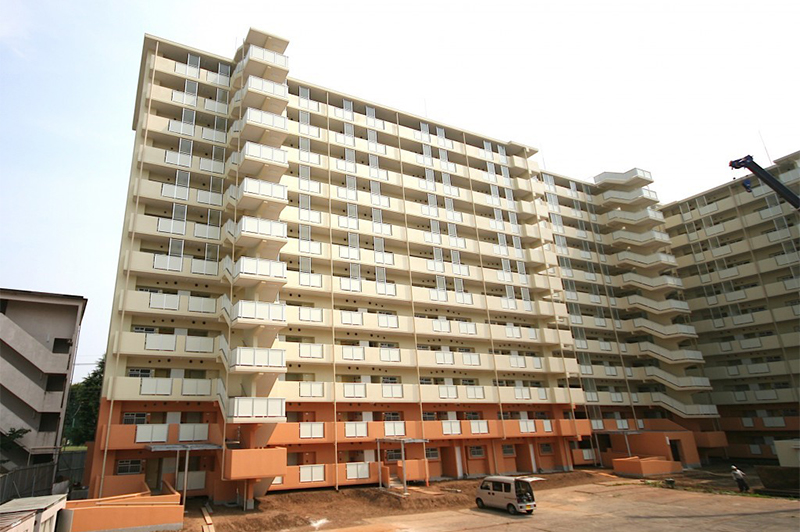
An apartment complex built by Okui Construction
Another issue on the agenda is the return of power to the imperial government. Mr. I was asked by members of the Okui family to assume the position of President and Representative Director. However, regarding the final handover, he determined that it was appropriate to return the company to the Okui family, and so Mr. I assumed the position of Representative Director and Managing Director, while Mr. Hirohiro Okui, who had previously served as Representative Director and Managing Director, became the final President and Representative Director. Presumably, these two will be the ones to see the company through to its final chapter.
When reporting on business failures or bankruptcies, employees often take the news in stride. Moreover, since Okui Construction is a company of about 50 employees, they were largely in the know about the company’s internal situation, and their main concern was how much longer it would last.
Although Hirohiro Okui and Mr. M are father and son, it was Hirohiro Okui who took the lead in moving to remove Mr. M from his position as representative director. We also investigated the reasons behind this decision further.
The "Idea Man" CEO Runs Amok
Many construction companies are family-owned. The president of a construction company in Tokyo explains the advantages and disadvantages of family-owned businesses as follows.
"Family-owned companies tend to have strong internal cohesion. When things are going well, they’re going well. As long as the CEO makes sound business decisions and focuses on the core business, things will never go badly. Moreover, Okui Construction was stable because it focused primarily on public works projects. I think it was a decent company. I suspect there must have been other factors that led to its bankruptcy."
What exactly was that ”other factor”? To understand it, we need to trace the history of the Okui family alongside that of Okui Construction.
Okui Construction traces its origins to April 1947, shortly after the end of World War II, when Ryuzo Okui founded the company as a sole proprietorship in the construction industry; it was incorporated in January 1955. Subsequently, Mr. Zentaro Okui assumed the position of Representative Director. As is well known, the construction industry expanded alongside the era of rapid economic growth, and Okui Construction also undertook a wide range of projects, including the construction, renovation, and seismic retrofitting of Tokyo Metropolitan Government housing, school buildings, and private residences.
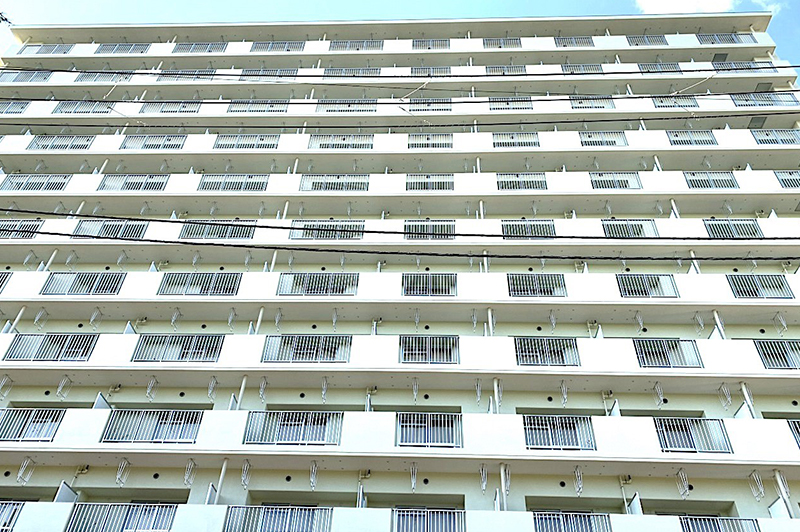
A House Built by Okui Construction
However, after he passed away, his wife, Zentarō, temporarily assumed the position of representative director but later resigned. His nephew, Mr. M, then became the representative director and steered the company for many years.
"I think we were unlucky that the construction industry was still in a slump when I took over as president. However, I’ve heard that the company was actually expanding its operations at first," said a representative from the aforementioned Tokyo-based construction company.
Mr. M is also known for making some surprisingly bold moves in his management of the construction industry. Since one of Mr. M’s friends was from Yamada Town in Iwate Prefecture—an area affected by the Great East Japan Earthquake—he obtained a permit from the Minister of Land, Infrastructure, Transport and Tourism to participate in reconstruction projects in the disaster-stricken area and has been actively involved in those efforts. He was also an innovative thinker who, at one point, established his registered headquarters in the Tohoku region and adopted a dual-headquarters system in Tokyo and Tohoku to gain a competitive edge in securing contracts.
That said, with the reconstruction efforts in Tohoku having largely come to a close, the company decided to relocate to Koto Ward, Tokyo—where its de facto headquarters was located—in January 2018, close its Tohoku headquarters, and withdraw from its Tohoku operations. The bankruptcy occurred shortly after the company had announced its policy to focus on securing orders within Tokyo.
As for Mr. M, he was also well known for his extensive network. In addition to his work at Okui Construction, he established the Seishin Kaikan, a nonprofit organization under the International Science and Technology Council, and served as its representative director. In addition to obtaining his First-Class Architect license, Mr. M completed the Graduate School of Policy and Media Studies at Keio University in March 2013 while working full-time. He currently serves as Chairman of the OK-U&I Foundation, a public interest incorporated foundation, and has built a network through his hobby of karate.
At the same time, rather than focusing on managing the construction company, he began devoting his attention to the entertainment industry, business, sports such as karate, and supporting politicians, which led to funds flowing out of Okui Construction one after another. Furthermore, oversight of construction projects as a whole became lax, and projects operating at a loss became frequent.
For the construction industry, while maintaining relationships with politicians is necessary, it is also a sensitive issue; as a result, Employee A at a Tokyo-based construction company points out that “it should be kept to a moderate level.”
He shares his firsthand experience of how, as relationships with politicians deepen, cash flows out at an alarming rate. It’s well known that, when organizing political fundraising events, politicians’ secretaries sell tickets priced at 20,000 yen each to various companies and organizations. However, once a relationship is established, it becomes impossible to flatly refuse when they plead, “Please buy about 10 tickets.”
He further emphasizes that since company employees are also used for campaign activities, their fatigue levels increase. Mr. A says that while it would be fine if there were benefits, purchasing party tickets offers few advantages. He adds that there is a risk that deepening relationships with politicians could lead to neglect of one’s core business.
The fear of losing track of where the company's money ends and your own ends
Furthermore, unless the company has ample funds to spare, becoming a patron of sports or similar activities will similarly result in a drain on the company’s funds.
Not so long ago, becoming a patron of a sumo wrestler was considered a mark of a successful business leader. However, simply becoming a patron doesn’t mean that person will award construction contracts. Mr. A strongly emphasizes that one should focus on one’s core business and, if profits are made, share them with employees.
The downside of a family-owned company is that it becomes difficult to distinguish between the company’s finances and one’s own. While I cannot go into too much detail, it is said that at Okui Construction, at least approximately 340 million yen was misappropriated for personal use over a three-year period, leading to a situation where cash was steadily disappearing from the company. As a result, although the books may have shown otherwise, the company is believed to have been operating at a loss for an extended period and was likely surviving only through loans from financial institutions.
After working at an IT company, Hirohiro Okui joined Okui Construction and was appointed to the board of directors in November 2017. After joining the company, he set about streamlining operations, cutting expenses, implementing IT systems, and moving toward a paperless office. Together with Mr. I, he attempted to restore the company’s financial health, but the company’s finances were reportedly in worse shape than anticipated. By the end of March 2020, the company was unable to secure the approximately 450 million yen needed to settle its financial obligations, leading to bankruptcy.
There are many lessons to be learned from bankruptcy. The main one this time is that companies should, above all, focus on their core business and strive to manage their operations with care. When business owners become patrons of politicians, athletes, entertainers, and the like, they seem to fall into the illusion that they have become important figures themselves. When politicians or familiar celebrities from television bow to them, they convince themselves that they have risen to a higher social status.
As a result, funds begin to flow out regardless of whether they belong to the company or the individual. While family-owned companies often have the major shareholder serving as the CEO—which offers the advantage of rapid decision-making—they also have the disadvantage that there is no one to stop the CEO if they run amok.
In principle, for a board of directors to effectively rein in unchecked behavior, it must function properly; however, in a system where the top executive’s will is equated with the company’s will, such behavior goes unchecked, and there have been numerous cases where companies have gone bankrupt as a result. While some in the public eye believe that directors should offer advice to the CEO, it is easy to imagine how difficult it is to do so in a family-owned company when dealing with an eccentric CEO.
This case served as a lesson that business executives should exercise moderation when it comes to hobbies and socializing with politicians.